July-August, 2025
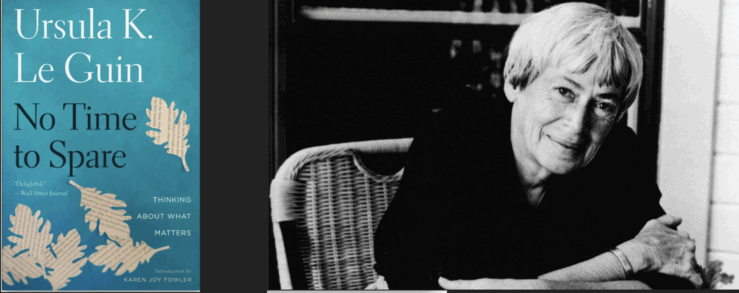
No Time to Spare: Thinking about What Matters, Ursula K. Le Guinn, 2017
About the Book
This is a book of essays – originally written for Le Guin’s blog – that was published in 2017. The essays were written, as best I can tell, from 2010 to approximately 2015, when Le Guinn was in her 80’s.
They are not organized chronologically, but instead in four sections separated by interludes of essays about or inspired by her cat, Pard. The four sections are “Going Over 80,” “The Lit Biz,” “Trying to Make Sense of It,” and “Rewards.” The essays are written in a casual voice, and are more notable for their ideas than their word-crafting.
I found the book engaging, and am happy to have read it. I say a bit my favorite essays – there are over three dozen in the book — and * my favorites of the favorites.
Favorites
The Diminished Thing
“What to make of diminished thing?” (Robert Frost’s Ovenbird). Le Guin discusses old age – she is in her 80’s at this point – and argues against the notion of ‘You are only as old as you think you are,’ and the tendency of younger people to deny that their elders are old. Le Guin disagrees: “To tell me my old age doesn’t exist is to tell me I don’t exist. Erase my age, erase my life – me. …So it is that old men come to learn the invisibility that women learned 20 or 30 years earlier.”
Le Guin also writes about respect:
“…the social requirement of respectful behavior to others, by reducing aggression and requiring self-control, makes room for understanding. It creates a space where understanding and affection can grow.”
–ibid., p. 15
Le Guin’s answer to the ovenbird’s question is “a lot.” At least if one is fortunate. And, she adds, don’t dimmish old age by trying to deny it.
Would You Please Fucking Stop
A funny rant against the tendency to use only variants of “fuck” and “shit” for emphasis.
* Having My Cake
(1600 words)
…A great essay, and one that I believe will, for me at least, repay study, since I am trying to learn how to write interesting short essays.
She begins admitting that for a long time she didn’t understand the proverb about not being able to have your cake and eating it too. How can you eat a cake you don’t have, she asks? She also notes that this proverb, and others like it, are used to test whether people are mentally ill, and wonders about her sanity. But then she slowly realizes that “have” is really being used to mean “keep,” and decides it’s a good proverb, though she back tracks a bit, analyzing the language and why it might be found confusing. This translates into a more general medication on language, and her writerly fascination with it. And then she ponders the parallels between her fascination with words, and artists’ fascination with the materials with which they work, though she is uncertain about the degree to which they hold. But finally, at the very end, she brings it back to cake:
“Words are my matter, my stuff. Words are my skein of yarn, my lump of wet clay, my block of uncarven wood. Words are my magical anti-proverbial cake: I eat it, and I still have it.”
ibid., p.52
Papa H
Nothing much to say about this essay, but that it was an enjoyable mediation of The Illiad and The Odyssey as exemplars, or perhaps archetypes, of the two basic fantasy stories: The War; and The Journey.
The Narrative Gift as Moral Conundrum
A mildly interesting essay, but I loved her comments on the difference between story and plot:
I have a high opinion of story. I see it as the essential trajectory of narrative: a coherent, onward movement, taking the reader from Here to There. Plot, to me, is variation or complication of the movement of story.
Story goes. Plot elaborates the going.
Plot hesitates, pauses, doubles back (Proust), forecasts, leaps, doubling or tripling simultaneous trajectories (Dickens), diagrams a geometry onto the story line (Hardy), makes the story Ariadne’s string leading through a labyrinth (mysteries), turns the story into a cobweb, a waltz, a vast symphonic structure in time (the novel in general) …
ibid., p. 75
Rehearsal
A very short essay on drama and stagecraft inspired by watching a rehearsal of a play based on The Left Hand of Darkness. “People you thought you’d made up, imagined, invented, are there, not” Performing a play is, Le Guin argues, essentially an act of ritual or magic: “They collaborate methodically (ritual must be methodical) … Essentially they do it by limiting space, and moving and speaking within that space.“
*Without Egg
(1100 words)
A description of an incident, during a visit to Vienna in the early 1950’s, where Le Guin distressed a waiter by saying that she didn’t want an egg with her breakfast. Her reflections on why this was disturbing are interesting, but where the essay shines is in her beautifully detailed description of how she goes about eating a soft boiled egg. She describes the egg, the egg cup, the spoon, the opening of the egg, and the process of eating it.
First Contact
An essay on an encounter with a rattlesnake, and the process of humanely transporting it elsewhere.
This time was outside ordinary time, and outside ordinary feelings; it involved danger for both of us; and it involved a bond between creatures who do not and cannot ordinarily relate to each other in any way. Each would naturally try not to relate – to just get away – or to kill in self-defense.
–ibid., p. 199
Notes from a Week at a Ranch in the Oregon High Desert
These are really notes, as the title says, rather than an essay. But I find it a nice example of how, perhaps, I might take notes during my travels. Le Guin’s notes, while not a narrative, have a bit more structure and connectivity than mine typically do. They capture images, and often there is enough to infer some of the activities going on.
Some nice writing:
- the cool shadowed air between the eastern and western rimrock
- the warm towers of air
- the old tall poplars holding darkness
- I sit in windy shadow
- The hens pay no attention, scattering out, scudding along like sail boats over grass
- behind the ridge that darkens as brightness grows
Views: 16