The Forest Unseen: A Year’s Watch in Nature, David George Haskell

March/April 2026

* The Forest Unseen: A Year’s Watch in Nature, David George Haskell, 2012

In this book a biologist marks out a one-square-meter patch of forest, and visits it over fifty times during the course of a year. On each visit he observes and reflects on what he sees, starting with the concrete and then exploring a web of connections and associations that illustrate the systemic and interconnected aspects of the ecosystem. One part ecology, one part biology, one part poetry. Having read the first few entries it looks like it will be a great read. It was a finalist for the Pulitzer Prize.

Preface

Opens with a description of Tibetan monks making a mandela, and a comment that its aim is to symbolize the entire universe in this small circle of sand.

“I believe the forests ecological stories are all present in a mandala-sized area. Indeed, the truth of the forest may be more vividly and clearly revealed by contemplation of a small area than it could be by donning ten-league boots and covering a continent but uncovering little.

—The Forest Unseen, p xii

Continue reading The Forest Unseen: A Year’s Watch in Nature, David George Haskell

Views: 17

The Midcontinent Rift

GSM Lecture Summary (23-March-2026)

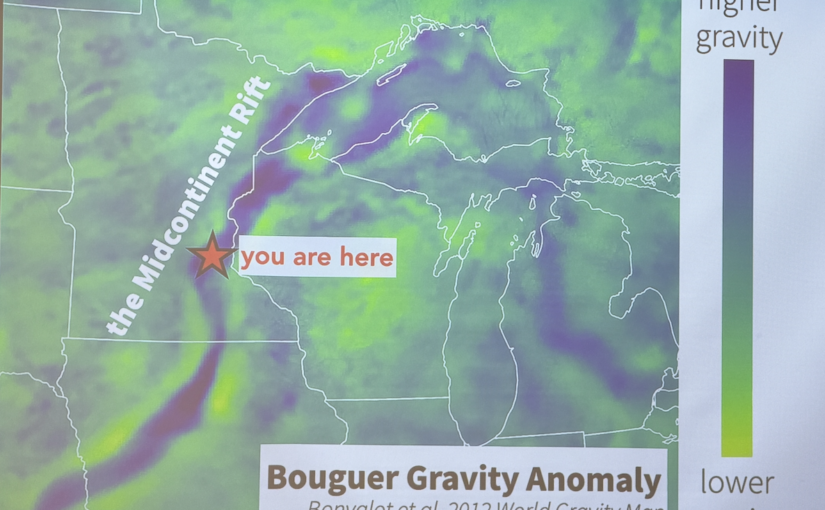
These are my notes from the 23-Mar-2026 GSM lecture on the Midcontinent Rift. The MCR almost split Laurentia (part of what is now North America) about 1.1 billion years ago. The MCR was about 2,000 miles long and produced a huge outpouring of lava, some of which is visible in the vicinity of Lake Superior; but most is buried below other rocks, and visible only via gravity anomalies and seismic reflection studies.

The lecture talked about the initiation of the rift, and in particular used paleomagnetic data to argue that the closing and inversion of the rift coincided with the collision of Laurentia with Amazonia and Kahlahari (two other ancient landmasses) that formed the supercontinent of Rodinia. There are also some nice maps of the Keweenaw peninsula which are the surface expression of some of the closing tectonics.

Continue reading The Midcontinent Rift

Views: 14

Atoms of Delight, Kenneth Steven

Atoms of Delight: Ten Pilgrimages in Nature, Kenneth Steven, 2024

March 2026

A short book of essays by a Scottish poet about, essentially, walks he has taken — essays are usually followed by a poem that relates to the walk described. I believe that the phrase “Atoms of Delight” is taken from Scottish writer Neil Gunn.

I’m enjoying the book, and the poems, but mildly rather than intensely. I stumbled across this book in a bookstore, while looking for something else. This is part of my effort to read more books that describe the landscape.

Serpentine

Recounting a walk to St Columba’s Bay that he has taken many times, both as an adult and especially as a child, and how the walk rekindles in him the feeling of being a child.

  • A memory of running ahead and waiting for his parents to catch up.
  • And, today, imagining that he can catch glimpses of his parents, from years ago, walking.
  • The bay is held in rock arms, and the ocean is fierce, not “any gentle sea lapping at the lips of the bay.
  • Somewhere out in the bay there is a reef of serpentine, and he describes the pebbles they form, “like sweets specifically designed to catch the eye of a child.
  • He describes gathering cobbles as a child — you’re either a tide dancer or a sifter. “I still come here, year on year, to be blown out of myself and into childhood.

Hold it to the light and it changes
becomes a globe of fractures;
a cavern of ledges and glinting—
not one green but many at once.

…carrying the cuts of its journey,
the brokenness letting in the light

The High Lochs

An essay remembering the highlands, where his mother’s people are from, and where his parents went for outings, his mother fly-fishing, and his father bird watching.

The fossil imprints left in the mind can only be chiseled out only as stories, because no other evidence survives.

It always seemed an impossible blue, perhaps because it was set against such dark garments of moorland.

The silence was like a thin, beautiful layer of ice, something you didn’t want to break.


At night the sky a breath of stars

Cloudberries

About a time spent in the Norwegian arctic with the Sami, shortly after Chernobyl.

The plateau wasn’t just a bare back of rock and trees: it undulated – rose and dipped and rose again. There were hollows and little dark eyes of pools that I recognised as lochans.

Conkers

Not a bad essay, but this one did not speak to me.

The Pool

A Treasure

Agates

The Santa Crux Well

The Oaks

The Northern Lights

Views: 13

Gratitude, Oliver Sacks

May 24–25, 2019

Unlike the notes on the other OS Sacks books on this site, this was not — I don’t think! — read as part of the essays project with CT. Although I feel confident he has read it. I think that it was this book, my favorite of his works, that awakened my interest in him as an essayist, and let to the long detour that CT and I have taken through his ouvre.

What follows are my notes from circa 2019, in a less structured form than has been my later custom.


1. Mercury

  • He dreamed of Mercury, shimmering blobs rising and falling: Mercury, element 80, is a symbol of his age.
  • Other elements have taken their turn – Gold for 79 – signaling his lifelong interest in periodic table of the elements.
  • He writes of a near death experience at 41, accompanied by thoughts of gratitude, and giving and giving back.
  • … and of his pleasure in being alive, with positive and negative experiences…
  • … and of his regrets, and what it might mean to complete a life…
  • His hope for his end: to die in harness, as did Francis Crick. 
  • His feeling of age not as a shrinking, but an enlargement of mental life and perspective.”
Continue reading Gratitude, Oliver Sacks

Views: 26

Hallucinations, Oliver Sacks

March 2023

This is volume #25 in the Essays Project that CT and I are doing. It is the last volume of Sacks we have not yet read; we will also read Insomniac City by Bill Hayes, his partner in his final years, just for completeness. Then it is back to essays by other authors.

Introduction

Before the 1830’s, when “hallucinations” was introduced as a medical term, hallucinations were referred to as “apparitions.” I found that interesting because in reading old literature I also assumed they were superstitiously referring to seeing ghosts. So this gives the ‘seeing of appartions’ a different flavor.

Hallucinations are defined as seeing things that are not actually there — this distinguishes them from errors of perception. And hallucination also means that what is perceived in the mind is clear and detailed — it is like seeing (or otherwise sensing) an object, except there is nothing there. This distinguishes them from mental images. Dreams could be considered a form of hallucination, but are usually treated separately.

This book does not address hallucinations that occur as a result of schizophrenia, but rather those that appear to arise, directly or indirectly, from neurological traumas.

Continue reading Hallucinations, Oliver Sacks

Views: 30