In Defense of Sanity, G. K. Chesterton

August–September 2026

I dipped into GKC quite early in my essay reading project, influenced by reading partner CT’s appreciation of his work. But this is the first book of his essays — an anthology of his ‘best’ works—that I am reading in its entirety.

LATER: Well, I intended to read it in its entirety, but, as I describe presently, I gave up about a quarter of the way through. I very much enjoy his more general essays, about aspects of the natural world, or the oddities of society and nature, but — whether it was the selection of essays for this collection, or a gradual shift in his focus as a writer – the later essays are more oriented towards criticism of literature or modernity. They lose the imagery and wry humor that I appreciate, and become more of a dismissive lament – and a not very eloquent critique – about various aspects of modernity.

My Favorites

  • On Certain Modern Writers and the Institution of the Family
    We make our friends; we make our enemies; but God makes our next-door neighbour…
  • On Running After One’s Hat
    An adventure is only an inconvenience rightly considered. An inconvenience is only an adventure wrongly considered.
  • The Romantic in the Rain
    An essay on rain, why people should appreciate rather than deprecate it, and how it changes the appearance of the world. “Shallow lakes of water reiterate every detail of earth and sky; we dwell in a double universe.
  • Cheese
    On the pleasure of variations of natural things that reflect their locality: “soft play of slight variation which exists in things produced everywhere out of the soil, in the milk of the kine, or the fruits of the orchard.
  • On Being Moved
    A light, humorous essay on moving

The Essays

Introduction to The Defendant

This essay—well, really just an introduction—didn’t resonate with me, but I thought the opening image was excellent.

In certain endless uplands, uplands like great flats gone dizzy, slopes that seem to contradict the idea that there is even such a thing as a level, and make us all realise that we live on a planet with a sloping roof, you will come from time to time upon whole valleys filled with loose rocks and boulders, so big as to be like mountains broken loose. The whole might be an experimental creation shattered and cast away. ibid., p1

A Defense of Skeletons

Argues that the conventional or horror or at least displaced of skeletons is misplaced. Suggestions instead that they can be seen is on and even humorous. But what I most liked about the essay was the lead in which talked about the trunks and branches of trees in the winter:

Some little time ago I stood among immemorial English trees that seemed to take hold upon the stars like a brood of Ygdrasils.

[…]

the fringe of the forest melts away like a vignette. The tops of two or three high trees when they are leafless are so soft that they seem like the gigantic brooms of that fabulous lady who was sweeping the cobwebs off the sky.

ibid. p xx

And the wrap up, where the essay opens out, has a very nice bit:

Has the poet, for whom Nature means only roses and lilies, ever heard a pig grunting? It is a noise that does a man good—a strong, snorting, imprisoned noise, breaking its way out of unfathomable dungeons through every possible outlet and organ. It might be the voice of the earth itself, snoring in its mighty sleep.

* On Certain Modern Writers and the Institution of the Family

I wrote about this essay several years ago (here). It’s worth a read, and has some excellent passages. Here are just two:

We make our friends; we make our enemies; but God makes our next-door neighbour. Hence he comes to us clad in all the careless terrors of nature; he is as strange as the stars, as reckless and indifferent as the rain.

—ibid., p 14

It is quite proper that a British diplomatist should seek the society of Japanese generals, if what he wants is Japanese generals. But if what he wants is people different from himself, he had much better stop at home and discuss religion with the housemaid.

—ibid., p 15

* On Running After One’s Hat

Beginning with a description of the flood at Battersea, the area in which he lives he opened out into a discussion of inconvenience and boredom and how it might be reframed as wonderful and interesting. This segues into the figure of a man running after his hat and he asks why this should be seen as an inconvenience, when the same people run eagerly after a small ball on a tennis court.

An adventure is only an inconvenience rightly considered. An inconvenience is only an adventure wrongly considered.

—ibid., p 24

Woman

Didn’t really speak to me.

A Piece of Chalk

This is one of GKC‘s most anthologized essays, and it is indeed a pleasant read. He talks about going out for a walk and taking along brown butcher’s paper and chalk with which to draw. He discusses color, and especially the importance of white, and the English countryside. He discovers, however, that he’s forgotten his white chalk, but is saved, in the end, by realizing that he’s forgotten is sitting, in southern England, on an entire body of white chalk.

What I Found in My Pocket

Beginning with a kind of irrelevant anecdote, he writes about being locked up in a third clsss railway card with nothing to read, and deciding to look through his pockets. He writes of various objects, reflecting on them in various ways. At the end the twist is that although his pockets contain a beast variety of things, they do contain his railway ticket.

On Lying in Bed

He opens my observing that lying in bed would be perfect. If only he had colored pencils, long enough to draw on the ceiling. He imagined many possibilities then he goes on to observe that in the modern house there is almost no blank space other than the ceiling. This segues into a discussion of attitude— exemplified by the feeling of it lying in bed is decadent— and goes on to suggest that in modern times people are more preoccupied with matters of habit and manners, then with ethics and morality.

This alarming growth of good habits really means a too great emphasis on those virtues which mere custom can misuse, it means too little emphasis on those virtues which custom can never quite ensure, sudden and splendid virtues of inspired pity or of inspired candour.

ibid., p 43

The Diabolist

Well-written but didn’t engage me.

The Twelve Men

A discussion of the benefits of using a jury of common men rather than experts to pass judgment. This passage summarizes it nicely:

And the horrible thing about all legal officials, even the best, about all judges, magistrates, barristers, detectives, and policemen, is not that they are wicked (some of them are good), not that they are stupid (several of them are quite intelligent), it is simply that they have got used to it. Strictly they do not see the prisoner in the dock; all they see is the usual man in the usual place. They do not see the awful court of judgment; they only see their own workshop.
[…]
Men shall come in who can see the court and the crowd, and the coarse faces of the policemen and the professional crim-inals, the wasted faces of the wastrels, the unreal faces of the gesticulating counsel, and see it all as one sees a new picture or a ballet hitherto unvisited.

—ibid., p 51

The Shop of Ghosts

I enjoyed the beginning of this essay. GKC is peering through the dimly lit window of a toy shop in a poor neighborhood. In his minds eye the display comes alive, “filled with all the colours God ever made.”

Moving on, he enters the shop, intending to buy something, but the proprietor refuses money, saying he only gives things away. GKC recognizes him as Father Christmas, old and seeming ailing, but not passed on yet. GKC is succeeded by a series of historical visitors—Charles Dickens being the first—all of whom had thought Father Christmas was dying. It ends with the observation that he has always seemed to be dying but will never die.

* The Romantic in the Rain

An essay about how nice rain is, and how odd it is that people dislike it. It meanders from imagining how wine drinkers would feel about it raining wine, to a preference for Mackintoshes over umbrellas “Shut up, an umbrella is an unmanageable walking stick; open, it is an inadequate umbrella.” It has some very nice imagery:

For indeed this is one of the real beauties of rainy weather, that while the amount of original and direct light is commonly lessened, the number of things that reflect light is unquestionably increased. There is less sunshine; but there are more shiny things; such beautifully shiny things as pools and puddles and mackintoshes. It is like moving in a world of mirrors.
[…]
Shallow lakes of water reiterate every detail of earth and sky; we dwell in a double universe. Sometimes walking upon bare and lustrous pavements, wet under numerous lamps, a man seems a black blot on all that golden looking-glass, and could fancy he was flying in a yellow sky. But wherever trees and towns hang head downwards in a pigmy puddle, the sense of Celestial topsy-turvydom is the same. This bright, wet, dazzling confusion of shape and shadow, of reality and reflection, will appeal strongly to any one with the transcendental instinct about this dreamy and dual life of ours. It will always give a man the strange sense of looking down at the skies.

— ibid., p 59 & 60

The Mad Official

An essay that takes a long path to get to its point which is to protest a judicial decision regarding a woman whose children were found to be “quite dirty.” The long path has to do with what it means to go mad — as an individual or a society — and the claim is that one is going mad when one reacts to outrageous things as though they are unremarkable things.

“... whenever we see things done wildly but taken tamely, then the state is growing insane.

The Mystagogue

This did not engage me at all. It seems to end up as an attack on art critics. The general claim is that if something can not be concretely expressed — that is, is discussed only in ambiguous and abstract terms — it is likely to be evil, or at least at attempt to deceive…

The Architect of Spears

GKC argues for the beauty and power of gothic architecture, particularly as seen in cathedrals. He claims it is not the symbolism and richness—dismissing mid-eastern and oriental design with what strike me as narrow culturally-bound prejudices—but rather that it is militant and on the march. I found the essay fanciful and unconvincing, though it exhibts great energy in its descriptions.

Don’t

Not very interesting to me. A list of things that he’d like people to stop doing. For instance, ‘Don’t say there is no true creed, for every creed believes itself right and the other’s wrong’

The Mystery of the Mystics

It seems to be a review of a book on mysticism. Not very interesting.

A Much Repeated Repetition

An essay against the saying “History repeats itself.” His argument is that history is the only thing that doesn’t repeat. Facile, but not very deep, imo.

The Maxims of Maxim

Appears to be a reply to a letter to a publication by Hiram Maxim, an engineer, who seems to cast some aspersion on religion. Among other things GKC makes the point that logical reasoning is only as good as its premises: “…you can only find truth with logic if you have already9 found truth without it.

The Book of Job (GKC as MC, 1929)

An essay on the interpretation of the book of Job. Not of interest to me.

* Cheese (Alarms and Discursions, 1910)

Beginning with a tongue in cheek discussion of cheese, and how neglected it has been by most poets, opens into an argument for the value of diversity, particularly the way various things vary according to their region.

Safety matches, tinned foods, patent medicines are sent all over the world; but they are not produced all over the world. Therefore there is in them a mere dead identity, never that soft play of slight variation which exists in things produced everywhere out of the soil, in the milk of the kine, or the fruits of the orchard. You can get a whisky and soda at every outpost of the Empire: that is why so many Empire-builders go mad. But you are not tasting or touching any environment, as in the cider of Devonshire or the grapes of the Rhine. You are not approaching Nature in one of her myriad tints of mood, as in the holy act of eating cheese.

—ibid., p 105

On Gargoyles (Alarms and Discursions, 1910)

Yet another complain against the modern world.

In this essay he begins with the discovery of a moss-covered gargoyle in the ruins of an abbey. Reflecting on it provokes “a symbolic reverie” in which he envisions the three great stages of art. These are the pagan, the gothic, and finally the modern, the last being characterized by a welter of disconnected images and symbols, having lost the unifying theme of gothic….

The Fading Fireworks (Alarms and Discursions, I9IO)

Beginning with an image that suggests that Guy Falks day is in decline, we have another lament about modernism. In this essay he segues to a discussion of religion, and contrasts the colors of fireworks (which he associates with Confucianism because of their invention in China) with those of stained glass windows. He takes it as significant that the colours of fireworks are ephemeral, and have only darkness behind them, in contrast to stained glass windows which are solid and persistent, and have light behind them.

The Furrows (Alarms and Discursions, I910)

GCK is struck by furrows in the field, and engages in fanciful associations about their production and character.

The furrows are like arrows; they fly along an arc of the sky. They are like leaping animals; they vault an inviolable hill and roll down the other side.

[…]

…there is hardly anything in nature such as a mere droop of weakness. Rigidity, yielding a little, like justice swayed by mercy, is the whole beauty of the earth.

The Meaning of Dreams (Lunacy and Letters, 1958)

A mildly interesting reflection on dreams…

Such things as birth and death and dreams are at once so impenetrable and so provocative that to ask men to put them on one side, and have no hopes or theories about them, is like asking them not to look at a comet or not to look out the answer of a riddle. Around these elemental acrostics human hypothesis has circled and will always continue to circle. Even in an empire of atheists the dead man is always sacred. The grave, like a tilled field, brings forth crop after crop of creeds and mythologies.

—ibid., p 118


* On Being Moved (Lunacy and Letters, 1958)

A light humors essay on moving. It begins with GKC sitting in a chair, writing on his knee, as all his possessions are being removed by moving men.

They would take away my chair, except for the formmidable necessity of carrying me away with it, a task from which the most enormous would shrink. But sideboards and pianos melt away at their lightest gesture and bedsteads simply flee before them.

—ibid., p 122

The Remainder of the Book

It was about this point where I decided I was not motivated to finish the book. I glanced through a dozen more essays in sequence, and hopscotched my way through the rest, but they had taken a turn towards criticism, either of literary work, or GKC’s relentless and dismissive rebuttals of all things ‘modern.’ With this more abstract and reflective turn, his essays lost the imagery and occasional humor that made the earlier ones palatable (though it is possible that in my skimming I failed to find these bits).

Below is the next tranche of essays, although others follow which I did not transcribe:

  • The Pickwick Papers (Appreciations and Criticisms of the Works of Charles Dickens, I91I)
  • The Bluff of the Big Shops (The Outline of Sanity, 1926
  • On Architecture (Generally Speaking, 1928) On Shakespeare (Generally Speaking, 1928)
  • The Slavery of Free Verse (Fancies vs. Fads, I923)
  • Turning Inside Out (Fancies vs. Fads, 1923)
  • On Turnpikes and Mediævalism (All I Survey, 1933)
  • The Drift from Domesticity (The Thing, I929)
  • On Vulgarity (Come to Think of It, 1930)
  • On a Humiliating Heresy (Come to Think of It, 1930)
  • On Original Sin (Come to Think of It, 1930)
  • On Jane Austen in the General Election (Come to Think of It, 1930On Essays (Come to Think of It, 1930)
  • On Evil Euphemisms (Come to Think of It, 1932)
  • A Plea for Prohibition (Sidelights, 1932)
  • The American Ideal (Sidelights, 1932)
  • Marriage and the Modern Mind (Sidelights, 1932)
  • Magic and Fantasy in Fiction (Sidelights, 1932)
  • On the New Prudery (Avowals and Denials, 1934)
  • On the Return of the Barbarian (Avowals and Denials, 1934)

# # #

Views: 5

EP#25: Insomniac City, Bill Hayes

Insomniac City is by Bill Hayes, the partner of Oliver Sacks in his final 2-3 years. This is a book rather than a set of essays, but we are including it just to round out the coverage of OS. And, it should be noted, we have occasionally included other books-rather-than-essays such as OS’s lovely A Leg to Stand On.

That said, I don’t have a lot to say about Insomniac City. It is an account of Hayes’ arrival in and growing appreciation of NYC (as well as Hayes’ photographs), with alternating chapters describing his relationship with OS.

Hayes’ accounts of NYC didn’t engage me. He has what feels to me like an overly romantic/heroic view of NYC which doesn’t ring true to me, perhaps, though, because I’ve never lived there. I was much more positive about his accounts of his daily life with Sacks. It was nice to get a glimpse of Sacks through other eyes, and find that his eccentricities and charm persisted. I found it especially nice to see that Sacks, who had been alone most of his life, experienced a kind and loving relationship in his last few years.

# # #

Views: 6

The Forest Unseen: A Year’s Watch in Nature, David George Haskell

March/April 2026

* The Forest Unseen: A Year’s Watch in Nature, David George Haskell, 2012

In this book a biologist marks out a one-square-meter patch of forest, and visits it over fifty times during the course of a year. On each visit he observes and reflects on what he sees, starting with the concrete and then exploring a web of connections and associations that illustrate the systemic and interconnected aspects of the ecosystem. One part ecology, one part biology, one part poetry. Having read the first few entries it looks like it will be a great read. It was a finalist for the Pulitzer Prize.

Preface

Opens with a description of Tibetan monks making a mandela, and a comment that its aim is to symbolize the entire universe in this small circle of sand.

“I believe the forests ecological stories are all present in a mandala-sized area. Indeed, the truth of the forest may be more vividly and clearly revealed by contemplation of a small area than it could be by donning ten-league boots and covering a continent but uncovering little.

—The Forest Unseen, p xii

Continue reading The Forest Unseen: A Year’s Watch in Nature, David George Haskell

Views: 45

Atoms of Delight, Kenneth Steven

Atoms of Delight: Ten Pilgrimages in Nature, Kenneth Steven, 2024

March 2026

A short book of essays by a Scottish poet about, essentially, walks he has taken — essays are usually followed by a poem that relates to the walk described. I believe that the phrase “Atoms of Delight” is taken from Scottish writer Neil Gunn.

I’m enjoying the book, and the poems, but mildly rather than intensely. I stumbled across this book in a bookstore, while looking for something else. This is part of my effort to read more books that describe the landscape.

Serpentine

Recounting a walk to St Columba’s Bay that he has taken many times, both as an adult and especially as a child, and how the walk rekindles in him the feeling of being a child.

  • A memory of running ahead and waiting for his parents to catch up.
  • And, today, imagining that he can catch glimpses of his parents, from years ago, walking.
  • The bay is held in rock arms, and the ocean is fierce, not “any gentle sea lapping at the lips of the bay.
  • Somewhere out in the bay there is a reef of serpentine, and he describes the pebbles they form, “like sweets specifically designed to catch the eye of a child.
  • He describes gathering cobbles as a child — you’re either a tide dancer or a sifter. “I still come here, year on year, to be blown out of myself and into childhood.

Hold it to the light and it changes
becomes a globe of fractures;
a cavern of ledges and glinting—
not one green but many at once.

…carrying the cuts of its journey,
the brokenness letting in the light

The High Lochs

An essay remembering the highlands, where his mother’s people are from, and where his parents went for outings, his mother fly-fishing, and his father bird watching.

The fossil imprints left in the mind can only be chiseled out only as stories, because no other evidence survives.

It always seemed an impossible blue, perhaps because it was set against such dark garments of moorland.

The silence was like a thin, beautiful layer of ice, something you didn’t want to break.


At night the sky a breath of stars

Cloudberries

About a time spent in the Norwegian arctic with the Sami, shortly after Chernobyl.

The plateau wasn’t just a bare back of rock and trees: it undulated – rose and dipped and rose again. There were hollows and little dark eyes of pools that I recognised as lochans.

Conkers

Not a bad essay, but this one did not speak to me.

The Pool

A Treasure

Agates

The Santa Crux Well

The Oaks

The Northern Lights

Views: 18

Gratitude, Oliver Sacks

May 24–25, 2019

Unlike the notes on the other OS Sacks books on this site, this was not — I don’t think! — read as part of the essays project with CT. Although I feel confident he has read it. I think that it was this book, my favorite of his works, that awakened my interest in him as an essayist, and let to the long detour that CT and I have taken through his ouvre.

What follows are my notes from circa 2019, in a less structured form than has been my later custom.


1. Mercury

  • He dreamed of Mercury, shimmering blobs rising and falling: Mercury, element 80, is a symbol of his age.
  • Other elements have taken their turn – Gold for 79 – signaling his lifelong interest in periodic table of the elements.
  • He writes of a near death experience at 41, accompanied by thoughts of gratitude, and giving and giving back.
  • … and of his pleasure in being alive, with positive and negative experiences…
  • … and of his regrets, and what it might mean to complete a life…
  • His hope for his end: to die in harness, as did Francis Crick. 
  • His feeling of age not as a shrinking, but an enlargement of mental life and perspective.”
Continue reading Gratitude, Oliver Sacks

Views: 44

Hallucinations, Oliver Sacks

March 2023

This is volume #25 in the Essays Project that CT and I are doing. It is the last volume of Sacks we have not yet read; we will also read Insomniac City by Bill Hayes, his partner in his final years, just for completeness. Then it is back to essays by other authors.

Introduction

Before the 1830’s, when “hallucinations” was introduced as a medical term, hallucinations were referred to as “apparitions.” I found that interesting because in reading old literature I also assumed they were superstitiously referring to seeing ghosts. So this gives the ‘seeing of appartions’ a different flavor.

Hallucinations are defined as seeing things that are not actually there — this distinguishes them from errors of perception. And hallucination also means that what is perceived in the mind is clear and detailed — it is like seeing (or otherwise sensing) an object, except there is nothing there. This distinguishes them from mental images. Dreams could be considered a form of hallucination, but are usually treated separately.

This book does not address hallucinations that occur as a result of schizophrenia, but rather those that appear to arise, directly or indirectly, from neurological traumas.

Continue reading Hallucinations, Oliver Sacks

Views: 48

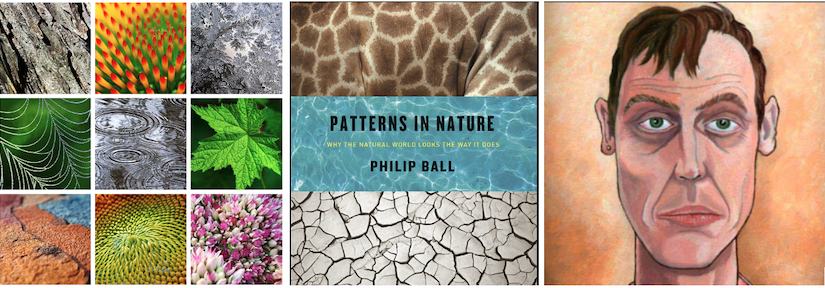
Patterns in Nature, Philip Ball

February 2026

Patterns in Nature: Why the Natural World Looks the Way It Does, Philip Ball, 2016

About the Book

My pick for the first round of reading for the club for 2026. I’m obsessed with patterns, and this book has 250 beautiful photos. Whether it will go deep enough to teach me some new things is another question, but even if not it should be a pleasant read.

The Book

Introduction

  • In 1917 D’Arcy Wentworth Thompson published On Growth and Form. One of his aims was to counter the tendency to ascribe all patterns to evolution, to assert that they were all products of adaptation and natural selection. Instead, he argues, that often patterns simply arise from physical forces.
  • Patterns are often (always?) produced via growth.

… it does make many patterns variations on a theme, and reflects the fact that they often arise from broadly similar processes-ones in which some driving force, be it gravity or heat or evolution, prevents the system from ever settling into a steady, unchanging state; in which various influences interact with each other, sometimes reinforcing and sometimes competing; in which patterns and forms might switch abruptly to a new shape and appearance when the driving force exceeds some threshold value; in which small events can have big consequences and what goes on here can influence what transpires at a distant point there; and in which accidents may get frozen into place and determine what unfolds thereafter. 

—ibid.,

Symmetry

  • Symmetry operations: Reflection; Rotation; Translation.
  • Patterns arise through (limited) symmetry breaking. Something that is perfectly symmetric, i.e. the same under all symmetry operation, has no pattern; pattern arise from reducing symmetry. “The more symmetry that gets broken, the more subtle and elaborate the patterns.”

Fractals

  • A complex pattern may be described simply if one focuses on the process that generates it.
  • Fractal networks, having fractional dimensions, are good at spanning an integral dimensional space without filling it up.  
  • Fractal forms may be produced by growth and accumulation, or by erosion and removal.
  • Growth instabilities — self amplifying projections as in snowflake formation. 
  • In the absence of fractal structures filled spaces in which redistribution must occur must generate their own structures (e.g., convection cells or ‘pedestrian columns.’)
  • The self-similarity across scales means that a complex structure can be produced by a simple algorithm. 
  • The branching vein networks of leaves, unlike branches or roots, can intersect and join up, forming loops that provide alternative pathways if parts of the leaf are damaged. P 70. 

Spirals

  • Archimedean vs.  logarithmic 
  • Logarithmic: increase circumference as it grows; one side grows faster (to create curve). 
  • Vortices due to friction in moving fluid
  • Flow vortices vs self-organizing density waves

Flow and Chaos

  • Laminar flow
  • Shear flow
  • Kármán vortex streets
  • • • Flocking

Waves and Dunes

Bubbles and Foam

Arrays and Tiling

Cracks

Spots and Stripes

Views: 24

The Year of Living Magically, Joan Didion


The Year of Living Magically, Joan Didion, 2005

January 2026

This is a celebrated book by a celebrated author. It appeared in the NY Times’ (or possibly that Atlantic’s) 100 Best books of the (1st Quarter) of the 21st Century, and was one of a handful of books (Station Eleven is another) that I decided to read this year as a consequence of seeing it there. 

The book is a memoir of a year in Didion’s life following the death of her husband, John Gregory Dunne. It is, essentially, a study of profound grief, and the way in which Didion (and perhaps others) try to come to grips with it. During this period, her daughter, Quintanna, was in and out of hospital ICUs, exacerbating Didion’s difficulties. As the title suggests, Didion focuses on her disordered thinking, documenting ‘magical’ beliefs that her husband would come back to her, that discarding his effects would prevent his return, that she could have done things differently and thus avoided his (medically predictable) death. 

The book is intense, and jumps around to different moments in time. Unlike other things I’ve read by Didion, I don’t find her use of language compelling. Possibly it would repay study of the structure, if one is writing a memoir, but for my purposes it does not offer a lot. Although I can’t say that I’m happy I’ve read it, due to the difficult subject matter, it was worthwhile, and I think will make me more sensitive to the ways in which grief can manifest itself. 

# # #

Views: 37

A Poetry Handbook, Mary Oliver

*A Poetry Handbook:A Prose Guide to Understanding and Writing Poetry, Mary Oliver. 1994.

About the Book

Oliver is a contemporary American poet and a winner of the Pulitzer Prize and the National Book Award. I’ve dipped into a number of books that offer guidance regarding reading and/or writing poetry, but this short (~100 page) book is the first to hold my attention until the end. 

The book marches through the preliminaries quickly. A short introduction takes up the question of which aspects of writing poetry can taught, and which cannot. It is followed by very brief chapters, 2–5 pages each, on preparing to write; reading poetry; and imitation as an approach to learning the craft. Then the book turns to a series of topics taken up in chapters (short, if not as short as the first) like “sound,” “the line,” “forms,” “free verse,” and so on. The strength of the book for me, besides its admirable brevity, is that it uses copious examples to illustrate its discussion. This might turn out to be my favorite book of the year, although since we are only a few weeks in that is a bit rash to say. 

Unsystematic Notes

In what follows I will not attempt a tour of the book as a whole, but will just highlight what I found especially apt for my purposes (which, I will say, are not aimed at producing poetry, per se, but rather at strengthening the lyricism in the essays I write). 

Sound

The first two chapters on topics are on “Sound” and “More Devices of Sound.” These, I think, are my favorite bits of the book, both because I learned a lot, and they are as applicable to lyric essays as to poems. Beginning with the observation that phrases have sonic qualities independent of their semantics (‘Hurry Up’ has a different feel from ‘Slow Down”), she then takes an analytic approach, breaking down letters (or clusters of letters) into groups: vowels and consonants; the consonants further divided into mutes (b, d, k, p, q, t, chard and ghard) and semi-vowels; and the semivowels into aspirates (c, f, g, h, j, s, x), liquids (l, m, n, r); and vocals (v, w, y, z).

All this is drawn from an 1860 grammar book that Oliver had on her shelf. The point I take away is not that all of this is hard and fast, but that it is worth paying attention to the “felt quality of sound” that words have. “Hush” (with aspirates) feels different from “Shut up” (with mutes). “Rock,” with its mute ending, feels different than “stone,” with its liquid ending. Then she goes on to look at the role these sounds play in Robert Frost’s Stopping by the Woods on a Snowy Evening. I don’t resonate with everything she says about the function of sound in this poem, but it offers, for me, a radically different lens which I hope to apply to my own work. 

The next chapter, “More Devices of Sound,” take up multi-word devices. Alliteration, consonance – where both initial and concluding sounds correspond–and assonance, where the vowels echo one another, as in: 

and land so lightly / and roll back down the mound beside the hole.” 

The chapter also takes up onomatopoeia, repetition, and rhythm.

The Line: Rhythm, length, etc.

After sound the book turns to rhythm, with the chapter on “The Line,” introducing the notion of feet (stress patterns) and line length. The book argues that the iambic stress patterns is most common in English (and thus other patterns sound more “composed”), and that pentameter (five feet) corresponds most naturally the patterns of speech and breathing (in English), and that use of lines longer or shorter (especially when they are breaking a norm established in a verse) have an impact on the reader/listener. They may at times emphasize particular feelings such as surprise or deliberation, or they may simply, by adding variation, make the verse livelier. But for a line’s length or rhythm to have such an effect, the writing must first establish a norm: Here is what Oliver has to say about the effect of rhythm in general:

The reader, as he or she begins to read, quickly enters the rhythmic pattern of a poem. It takes no more than two or three lines for a rhythm, and a feeling of pleasure in that rhythm, to be transferred from the poem to the reader. Rhythm is one of the most powerful of pleasures, and when we feel a pleasurable rhythm we hope it will continue. When it does, the sweet grows sweeter. When it becomes reliable, we are in a kind of body-heaven. Nursery rhymes give this pleasure in a simple and wonderful way. 

—ibid., p. 42)  

Oliver also considers different types of rhymes, and the effect of different types of line breaks (enjambment). These topics interest me less as they are not so applicable to essays. Still, one of Oliver’s concluding comments seems worth bearing in mind with respect to how it might apply to an essay:

Every poem has a basic measure, and a continual counterpoint of differences playing against that measure. Poems that do not offer such variations quickly become boring.

—ibid., p. 56

Other Topics, mainly poetic

The next four chapters discuss, respectively, verse; free verse; diction, tone and voice; and imagery. I found these chapters interesting, but not particularly applicable to my ends. The final three chapters return to process – revision; and workshops vs. solitude – and offer a concluding chapter offering Oliver’s thoughts on how to write and live as a poet. Mostly these did not speak to me, though her comment that poems may suffer from having too much – brilliance, or metaphor, or detail, or… – is worth noting. Pictures need frames; gemstones need settings. 

# # #

Views: 168

Seven Brief Lessons on Physics, Carlo Rovelli

I’m not sure how I came across this book or even why it attracted me. I think that — wherever I encountered it — there must have been a description that mentioned simple but lyrical expositions of key ideas in Physics.

So, far, after having read the first two chapters, I’m liking it very much.

…And now, having completed it, I enjoyed it very much. While a few concepts, particular the issue of time, remain cloudy, over all I understand a lot more about the ‘shape’ of modern physics, and the current frontiers and challenges being addressed. I highly recommend the book.

Continue reading Seven Brief Lessons on Physics, Carlo Rovelli

Views: 138

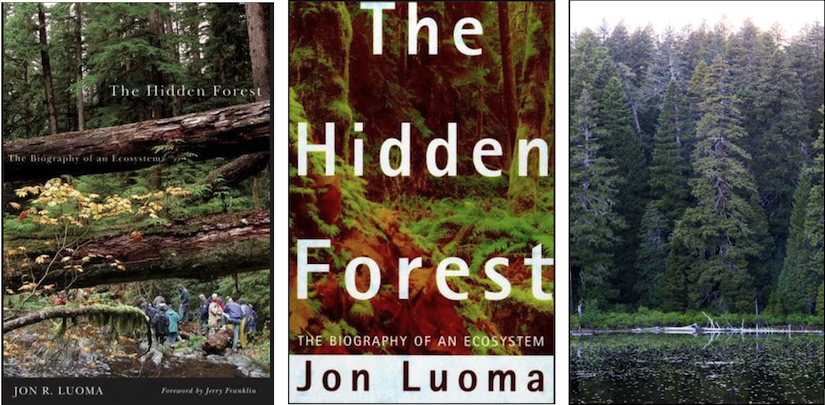
The Hidden Forest, John Luoma

December 2025

The Hidden Forest: The Biography of an Ecosystem, John R. Luoma. 1999/2006

About the Book

I’m reading this with RB. Originally published in 1999, it proved unexpectedly popular and was re-published in 2006 by Oregon State University Press. I had mis-remember this book as being about a periodic study, over the course of a year, of about 20 square meters of forest. Instead, this is an account of several decades of study of the H. J. Andrews experimental forest — a Douglas Fir ecosystem in the Pacific Northwest set aside for scientific investigation. The book appears (I’m writing this after reading four chapters) to combine forest ecology science with an account of how scientific thinking about forests (and their management) have changed over the last 5+ decades. It is very well-written.

The Book

Chapter 1 <chapters have no titles>

  • An experiential introduction to the Andrews Experimental Forest.
  • In the forests of the Pacific Northwest, every genus of conifer is the largest of its kind on the planet: the Sitka spruce, the western red cedar, the western hemock, the sugar pine, the noble fir, and the Douglas fir. It is believed that this immensity is an adaptation to the climate – 90% of the region’s abundant rain falls in the winter, and the immense boles of the trees enable them to store water in quantity.
  • These forests hold more biomass per acre than tropical rain forests: 500 tons/acre
  • Most studies of forests are (a) very short term and (b) cover a very small error. The Andrews Experimental Forest is a notable exception, covering 16,000 acres, and permitting studies that will last many decades.

Chapter 2 – ((some history))

  • The aim of this experimental forest is to understand how an entire ecosystem works.
  • Carolus Linneaus, the inventor of the taxonomic naming system, also wrote a book called The Oeconomy of Nature (1749), which was, essentially, the first book on ecology. He introduced concepts such as the ecological niche, the food chain, and the idea of succession.
  • In 1789, Gilbert White, an amateur naturalist, published a book describing a four decade long study of a ecosystem: The Natural History of Selborne. White’s book introduced the idea that waste (e.g., cow droppings) could become food for other organisms (e.g., insects and worms), which in turn became food for yet other organisms (e.g., fish).
  • A century later Henry David Thoreau documented the succession of forest trees in New England presented at a lecture in 1860).
  • In 1866 Ernest Haeckle coined the word Okologie as the name for a science that would study the complex interconnections of things noted by Darwin in Origin (1858)
  • In 1895 Eugenius Warming, a Dutch biologist, began to lay out, in detail, how organisms functioned as parts of biological communities. He introduced the notion of comensalism, in which species are so composed as to minimally compete with one another for resources
  • In 1894 Henry Cowles Chandler, on a train trip, happened to view a surprising succession of ecosystems in the dunes of Northern Indiana. Investigating, he realized that what he was seeing was an example of how ecosystems adapted to environmental change.

Cowles concluded that the marram grass colonizing a bare dune| could survive high wind and searing wind, even burial by sand and direct sunlight. But once it was firmly established, the marram not only stabilized the landform-the dune—it provided for other life-forms a bit of shelter and cooling shade, and as it lived, then died, its decay made just a trace of nutrient-rich soil. In time, less hardy plants eventually could prosper. Eventually those plants would crowd out the marram, building more soil, more shade, making way for a new guild of species, and on and on until the ecosystem reached a “chi-max” stage, a mature, dense forest that would operate-or so Cowles supposed—in a steady, stable state. In time, the progressive shade and shelter of plants and the steady decay of accumulating life would change the very character of the soil, and then of the ecosystem itself.

—ibid., 29

  • In the 1970’s, Fred Swanson, initially trained as a geologist, became interested in the landforms in the pacific northwest, and morphed into a geomorphologist. He found that the landscape was basically participating in a very slow landslide, and that trees, roots and all, moved millimeters to feet every year.

Chapter 3 – ((the paradigm shift in forestry))

  • The idea of forests as managed tree plantations, designed to maximize productivity revenue. Some of the problems resulting from the implementation of this paradigm, and the harmful believes (e.g., old growth forests are decadent; downed trees and logs should be removed).
  • Transition to recognizing the value of diversity — of structure, species, niches, etc. — in forests.
  • In 1969 Jerry Franklin succeeded in getting an NSF grant to support multidisciplinary study of forests. I believe that this is when the Andrews Experimental Forest was set aside, but I’m not sure.

Chapter 4–((discoveries in the high canopy))

  • Description of using a crane to study the canopy of the forest. Claim that the canopy of an old growth forest is its own ecosystem — similar in kind to that of a coral reef, in that its functioning is driven by air and light.
  • Lobaria Oregana, a lichen that grows in the canopy, and only in trees over a hundred years old, is responsible for fixing Nitrogen at the rate of 22 pounds/acre, making it one of the dominant N2 fixers of the forest.
  • A different researcher discover a fungus (Rhabdocline parkeria) that lives inside Douglas fir needles — it is an endophytic symbiont that synthesizes alkaloids for defense against pests in exchange for sugar and other nutrients. This makes sense because fungi adapt and evolve far more quickly than trees.
  • Another researcher discovered that large trees can develop above ground roots to take advantage of the detritis and soil that accumulates in the upper canopy over the centuries.

Chapter 5—((decay of litter, branches, et al))

The forest clonks and bangs and sings with the hissing and the booming and the knocking and the thwacking of bits of litter, from pieces of limb or lichen, moss or needle, of seed cone or sloughing bark. For hour by hour, day by day, the standing forest ecosystem fairly rains down bits of its own life, and death, to the forest floor.

—ibid., p 68

  • Over a year, five tons of litter will fall onto a single acre of the floor of an old growth forest. In addition, rain, snow and fog-drip dissolve nutrients that live as ‘lawns’ on Lobaria lichen in the canopy, and carry nutrients down to the forest floor. This links the ecosystem of the canopy to that of the forest floor.
  • Although rich in carbon, a log has only the fraction of the nutrients required by a tree: those are found in leaves, buds, and the thin layer of inner bark containing the phloem and the xylem.
  • An early survey of the Andrews forest found 219 tons/acre of downed wood, and another 49 tons in the form of standing snags.
  • Description of the structure of leaves, and the process of photosynthesis. Photosynthesis is described at the atomic level, with electrons being knocked out of orbits in a cascade, culminating in the electrolysis of water into oxygen and hydrogen, the latter of which is enzymatically (in a process called “the dark phase”) joined with carbon dioxide to make sugars. Over the course of a season, a tree will produce about 2 tons of sugar.
  • A tree trunk consists of: bark, inner bark (the tissue-thin cambium that produces wood), the sapwood (that transports water and nutrients [N, P, K, Ca, S, Mg, & Fe (and trace amounts of I, Mn, Cl, & Co)), and the heart wood (that provides structural support). The water is transported upward because it is in a continuous column, and due to hydrogen bonds has a significant tensile strength approach that of metal wires).
  • A tree that falls in a forest will open a large ‘gash’ — in part because it will pull down other trees as well – within which saplings, forbes and other organisms may grow. Likewise, snags offer habitat for a large variety of organisms.
  • It may take a large log 2 centuries to completely decay. During the process, the log will come to contain more biomass than the living tree. 20% of its weight may be biomass, in contrast to 5% of the weight of a living tree.
  • Log decay:
    • Decomposers start fermentation
    • Ambrosia beetles, attracted by the scent of alcohol, create tunnels under the bark
    • As they burrow, the Ambrosia beetles transport fungi on their backs
    • The fungi grow in the gallaries of tunnels, providing food for the beetles and their larva
    • At the same time female bark beetles will burrow into the bark
    • After the inner bark is consumed, new organisms appear. The Ponderous borer will bore into the heart wood, laying its own eggs. Carpenter ants will do the same.
    • Predators and parasites will follow the borers — for example, a small wasp that feeds on borer larva
    • After about ten years the Pacific dampwood termite will invade the log, and begin digesting the the cellulose; the microbes in their gut also fix nitrogen…

I asked AI to clean up and expand the above list:

Early Decomposers (Year 0-1)

Bacteria and yeasts - Begin fermentation of simple sugars and starches in the sapwood, producing ethanol and carbon dioxide as byproducts; lower pH through production of organic acids, creating anoxic conditions that inhibit some competing microorganisms

Early-Middle Stage (Years 1-3)
2. Ambrosia beetles - Attracted by ethanol and volatile organic compounds from fermentation; bore through bark into sapwood creating extensive gallery systems; physically fragment wood and increase surface area for decomposition

Ambrosia beetle-associated fungi (Raffaelea, yeasts) - Transported in beetle mycangia; colonize gallery walls, breaking down cellulose and hemicellulose; provide nutrition for beetle larvae; further acidify wood environment
Bark beetles (females) - Burrow into inner bark (phloem/cambium); vector ophiostomatoid fungi into sapwood; create entry points for other organisms; deplete inner bark nutrients

Middle Stage (Years 3-10)
5. Wood-boring beetles (Ponderous borers, cerambycid beetles) - Attack after bark nutrients depleted; bore into heartwood creating larger tunnels; fragment wood structure; larvae develop over 2-3 years

Carpenter ants - Excavate galleries in softened wood (don't consume wood but remove it); prefer wood with 20-40% moisture content; create extensive cavity systems that increase wood exposure to air and moisture

Predatory and parasitoid wasps - Follow wood borers; parasitize beetle and borer larvae; their activity creates additional openings in wood structure

White-rot fungi (basidiomycetes) - Begin colonizing wood through beetle galleries and cracks; produce lignin-degrading enzymes; break down complex lignin compounds into simpler molecules; increase nitrogen availability. [[TE: For lignin breakdown to occur the basidiomycetes require molecular O2]]

Late-Middle Stage (Years 10-20)
9. Pacific dampwood termites (Zootermopsis) - Colonize wood with elevated moisture content (>20-30%); digest cellulose with help of gut protozoa and bacteria; their gut microbiome includes nitrogen-fixing bacteria that convert atmospheric nitrogen into ammonia; create fine galleries throughout remaining wood

Nitrogen-fixing bacteria (Rhizobiales, others) - Populations increase as wood C:N ratio decreases; fix atmospheric nitrogen, enriching wood and surrounding soil with bioavailable nitrogen; support fungal decomposition

Late Stage (Years 20-50+) - fungi & bacteria => soil invertbrates
11. Soft-rot fungi (ascomycetes) - Dominate in wet, well-decayed wood; attack cellulose in cell walls; work under high moisture, low oxygen conditions where white-rot fungi less active

Brown-rot fungi (basidiomycetes) - Break down cellulose and hemicellulose while leaving lignin relatively intact; create simpler organic compounds; and create cubical cracking pattern in wood; make remaining lignin accessible to other decomposers

Diverse bacterial communities (Acidobacteria, Burkholderia, Actinobacteria) - Populations increase dramatically as fungi create simpler organic compounds; metabolize fungal exudates, wood sugars, organic acids; continue nitrogen transformations; prepare substrate for soil incorporation

Soil invertebrates (mites, springtails, millipedes, salamanders) - Colonize highly decayed, moist wood; physically fragment remaining wood; mix decomposed material with mineral soil; transport fungi and bacteria; accelerate final stages of incorporation into forest floor
  • Benefits of logs:
    • Decomposing logs act as sponges, retaining enormous amounts of water, even after fires.
    • Nurse logs (especially western red cedars and Sitka spruce) enable saplings to grow on them (which would otherwise have difficulty taking root on the mossed-over forest floor).
    • Downed logs slow erosion, and the soil built up on their uphill side provides habitat for insects and small mammals
    • Rotting logs provide habitat for salamanders, voles, chipmunks
    • Logs in rivers slow streams, reduce erosion, aid sedimentation, and provide fish and wildlife habitat
  • Functions of snags:

Chapter 6—((bugs and living soil))

  • In terms of number of species, arthropods [== “jointed feet”] vastly outnumber non-microbial species: 41,000 vertebrates; 500,000 plants; 30 million insects. The combined weight of insects on earth may exceed that of all humans by a factor of 12.
  • Diversity and evolution: The diversity of arthropods is in large part due to the combination of their short lifespans with high mobility due to flight.
  • The diversity of arthropods in the forest floor of Andrews appears to rival the diversity found in tropical forests. They are referred to as a “precision barometer,” a rather odd metaphor, but I take the meaning.
  • The community of arthropods in the forest floor is a very accurate mirror of the ecosystem above.
  • Soil, rather than being primarily an assemblage of inorganic material, is mainly made of biogenic substances… countless microbes and the bodies and feces of invertebrates.

On one such slide, Moldenke showed me the image of what was clearly a needle from a Douglas fir—or so it seemed. … But a closer look showed that it was not intact at all. It was a collection of unconnected fragments, thousands of infinitesimal bits arranged in almost precisely the pattern of the needle. Without moving the needle at all, countless tiny arthropods had swallowed parts of it. In fact, every bit of the needle had been chewed up and swallowed. Bacteria living in the insects’ digestive systems had worked furiously for a few hours on the outside of the bit of food, extracting nutrients both for themselves and for the arthropod. And then the remaining cell tissue-constituting most of what had been chewed off in the first place-was repackaged into a tiny pellet of ground-up plant matter, and then excreted almost precisely in place. The needle had been, in short, thoroughly reprocessed through the first stages of decay. And it still looked much like a needle, or at least a needle rendered by a pointalist.

—ibid., p 100

  • There is a lot of detail on how arthropods (and their microbes) rapidly transform detritus into soil. (Note that many arthropods – mites, springtails, microspiders, et al. — are extremely small sub-millimeter scale).
  • Most of the nutrients used by the forest are very near the surface in the biogenic portion of the soil. Roots go deep primarily for water and to provide support.

Moldenke: “If you went to Andrews Forest and brought me back a handful of dirt, I could tell you what time of year you dug the sample up—all critters have life cycles-the altitude it was taken, the slope face-whether north or south. I could tell you the vegetative cover—whether it was Oregon grape or wood sorrel or something like that. I could tell you the successional stage of the forest—whether it is early, middle, or late— whether it was old growth or not. In some areas, I could tell you what kind of tree was nearby and how far away,” he says. … “And it’s easy! Anybody could do it with a little bit of training.”

—ibid., p 106

Chapter 7—((roots and fungi))

  • A. B. Hatch discovered the relationship between fungi and tree roots and coined the term micorrhizae. He discovered that saplings associated with fungus grow faster than those with no such associations.
  • Fungal hyphae interpenetrate tree roots, growing between individual cells and sometimes even growing into cells. The hyphae get sugar and some vitamins from the tree roots and in response grow into mats that cover hundreds of square feet that bring water to the tree; fungal hyphae are also capable of taking in certain nutrients (like phosphorous, which is not water soluble). Dendrologists now believe that hyphae connect trees to a thousand times more soil area than the roots themselves. These fungal mats also seem to act as reservoirs for nutrients that would otherwise get washed away.
  • Some organisms, such as voles, shrews, and pika, feed on fungal fruiting bodies (e.g. digging for truffles), and spread the spores in their feces.
  • Tree roots grow — at a micro-scale — with extreme rapidity. They extend root hairs which, in the absence of water melt away (well, melt means eaten by microbes and small arthropods).
  • A single rye plant has approximately 600 thousand miles of root hairs, and has an estimated 14 billion individual hairs.
  • In some cases there appears to be a one to one relationship between a root and a leaf — that former provides water to the leaf, and the later sugar and nutrients to the roo.
  • Scientists now believe that about 40% of the photosynthate made by the leaves of a tree go to support its micorrhizal fungi and the ecosystem that exists just beyond the roots.
  • Soil Structure. The structure of soil — particular the diversity of pores or spaces in it — seems to be correlated with its health/fertility. This structure is a consequence of fungal hyphae exuding polysaccharides that ‘glue’ grains of soils into clumps.
  • Some trees that grow in intense shade — maples, hemlocks — appear to be able to obtain nutrients from the very overstory trees that are making the shade; they do this thru hyphal bridges.

… discussion break—next two chapters for March 9th …

Chapter 8—((disturbances))

  • The original conception of ecosystems did not get everything right.
    (1) One mistaken idea was that ecosystems evolve until they reach a permanent, self-sustaining stable climax community
    (2) Ecologists also did not pay attention to the role of disturbances in ecosystems — to the fact that they may rely on disturbance. “…the weaving and wedging of evolution…” Without fire some forests cannot reproduce; without drought, some wetlands can not thrive or even survive.
  • Jack Pine forests. Jack pines thrive on poor soil and harsh climates; in the absence of these they will be out-competed by other trees. Jack pines build up thick mats of highly flammable needles, and, in the area of Michigan being discussed, burn every few decades. The burns are needed for their cones to open, so that they can reproduce; the burns are also essential for maintaining the landscape needed by the Kirkland Warblers.
  • Jack Pine forests provide habitat for the Kirtlands Warbler. This bird nests on the ground under the low hanging branches of Jack Pine (and only Jack Pine). It also relies on insects that associate with Jack Pine for nutrition, and also requires forests with open areas where blueberries and other easily picked edibles are available.
  • Foresters are exploring ways of creating forest-landscapes that will support the Kirlands Warbler. So far these are not as effective as the regular cycle of burns, but they succeed to a degree.
  • The exemplifies a more general approach sometimes referred to as “new forestry,” that tries to preserve properties of the natural ecosystem (e.g., snags, downed logs etc).
  • Douglas Firs are not the climax ecosystem — without disturbances like wind, they would eventually be replaced by Western Hemlock.
  • Om 1977 the Franklin teams writes a paper that will eventually cause major changs in how people think about forests: The Ecological Characteristics of Old Growth Douglas Fir Forests.
  • In 1988 Chris Maser and Jim Trappe published a small booklet: The Seen and Unseen World of the Fallen Tree.
  • Mt St Helens story. After the eruption the Franklin team started studying recovery of the ecosystem. To their surprise, only a few weeks post-eruption, there was life amid the ash: gophers, deer mice, fungi, plants (like blackberry) re-sprouting from rhizomes; there were also amphibians and aquatic invertebrates that had survived in the mud beneath streams and lakes. And of course many kinds of seeds which, as the ash eroded, were able to sprout. The Franklin team referred to this as the biological legacy, and went on to propose that preserving this legacy was one of the keys to the new forestry.

Chapter 9—((The New Forestry))

  • 1967: E. O. Wilson and Robert Macarthur: The Theory of Island Biogeography. This is a classic book that was the beginning of Conservation Biology, and argued that the issues involving species extinction were more complex than simply habitat loss.
  • Issues that are related to species extinction include inbreeding; population biology (with a small overall population, natural population fluctuations may hit zero, in which case the cycle stops); edge vulnerability.
  • Endangered Species act was passed in 1973, but it took time for species to be studied to determine whether they could be listed as threatened or endangered.
  • The Spotted Owl story.
  • Job loss in Pacific Northwest lumber industry was due primarily to automation, not the Endangered Species Act. From 1979 to 1987 about 15% of the industries jobs were lost to automation. And even with job loss related to that — e.g., due to the preservation of old growth forest for the spotted owl — was only moved ahead in time: there was not much old growth left, and the mills and personnel that serviced that aspect of the industry were doomed.
  • New Forestry: Recovery biological legacies. Emphasis on preserving larger areas, and creating corridors between preserved areas for species migration and re-colonization.

… reading break—likely will discuss 3/16…

C10—((Flows in forests ))

  • The 1996 flood in the PNW. More sediment entered streams during the flood than in the preceding three decades.
  • A river flows downstream not in two dimensions but in three — over time it changes the land around it. Floods alter the contours of fluvial landscapes and also reshape the ecological communities that inhabit them.
  • There is a remarkably consistent correlation between the width of a river channel and the wavelength of its meanders: 1::10-14.
  • There are dramatic differences between recently logged forests and unlogged ones: Within 5 years flows of a recently logged area increase 50%; and they remain 20-40% higher for as much as 25 years. Even logging as little as 5% of a forest can increase peak flow rates by 10% to 55%.
  • Fungal mats occupy large areas of the forest floor (up to a quarter of the area) and constitute lots of biomass (as much as 50%) One previously unsuspected function is that fungi can extract nutrients directly from humic molecules left over after bacteria break down sugar, starches and lignin.
  • Some mycorrhizal species can break down rocks and extract their minerals — what are they, and what kind of rocks do they break down?
  • Various pests and diseases (spruce budworm and other defoliators may not be so much a problem as a solution: they take out the weakest branches and trees, leaving the healthy.
  • The idea that old growth forests consume less CO2 fails when one includes the the co2 released by wood debris, etc., in managed forests.

C11–((Into the Future))

  • This chapter was of less interest to me. It advocated for more long term research, and for the value of simply describing what happens in ecosystems. And it gives examples of the value that such long term ecosystem scale research can provide.
  • “Destruction is even more likely to occur at a ponderous pace in the secrecy of the invisible presence.” —John Magnuson

Views: 53

The City & the City, China Mieville

I read this for the Fall 2025 Science Fiction and Fantasy course I took at the U of MN.

I was not enthralled by this book. In fact, at about the halfway point, I misplaced it and did not finish it. I still haven’t found it, though no doubt it will turn up somewhere.

[Spoiler follows]

The City & the City is a competent murder mystery, but with the fantastical twist that the City is a place where an analog of the City in a parallel universe is partially visible and sometimes accessible. Inhabitants of the City have trained themselves to not see traces of the parallel city – if they give it too much attention something will happen — a mysterious force or set of police or something – will appear and remove everyone who was implicated or involved in noticing/acting in the parallel world. Yet, in spite of this, or perhaps because of it, there is an officially managed gateway between the two versions of the City, though much bureaucracy is involved in moving from one side to another.

The murder which drives the plot — well, at least the plot for the half of the book I’ve read — appears to have been committed in the parallel city, and then the body deposited in the other city. This brings police from both ‘sides’ together to investigate what happened. That had just begun to happen when I lost the book…

While it’s an interesting set up, and while the writing is well done, I found (as is often the case) that I don’t really care for the protagonists. There’s one chief detective (or maybe he’s an inspector) and he’s gotten a younger colleague involved to assist him — but he seems to have no life other than work, and no real friends. The most emotional life he shows has to do with his colleague, but even there it is pretty sparse (though perhaps something richer will develop as the book proceeds).

While I finish the book when I find it again? I’m not sure… I don’t find that I care very much or feel very curious.

# # #

Views: 34

Musicophilia, Oliver Sacks

EP#24: Musicophilia: Tales of Music and the Brain, Oliver Sacks, 2007

November 2025 – February 2026

This is the 24th entry in the Essays Project. We continue on our quest to read the complete Sacks oeuvre. 

Afterwards: There were essays in this that I enjoyed, but overall the book seemed lacking to me. That’s especially true of the first half. I can’t really put my finger on what is missing, although perhaps it had to do with Sack often reporting on the what other neurologists had learned of other patients with cases similar to those of Sack’s patients…

Preface

It is a bit of a mystery why humans appreciate music. Darwin remarked on this in The Descent of Man, as have subsequent neurologists and psychologists such as Pinker. Pinker and others argue that our musical powers are a consequence of recruiting neurological systems developed for other purposes and that music has, in the words of William James, entered our mind by “the back stairs.

Yet music is found in all cultures and, with a very few exceptions, all humans can perceive tones, timbre, pitch, intervals, melodies, harmony, and rhythm. Music, as well, seems to have a deep conection and resonance with emotions.

Our auditory systems, our nervous systems, are indeed exquisitely tuned for music. How much this is due to the intrinsic characteristics of music itself-its complex sonic patterns woven in time, its logic, its momentum, its unbreakable sequences, its insistent rhythms and repetitions, the mysterious way in which it embodies emotion and “will”-and how much to special resonances, synchronizations, oscillations, mutual excitations, or feedbacks in the immensely complex, multilevel neural circuitry that underlies musical perception and replay, we do not yet know. 

ibid. xii

To me, it seems evident that music is a means by which humans bond with one another, and strengthen connections within a community. I think back to Putnam’s observation that the best predictor of the economic success of towns in Italy was whether they had a chorale society, music being a way, as he saw it, to create social capital. It seems odd to me that Sacks (and others he cites) do not appear to pick up on this.

Continue reading Musicophilia, Oliver Sacks

Views: 120

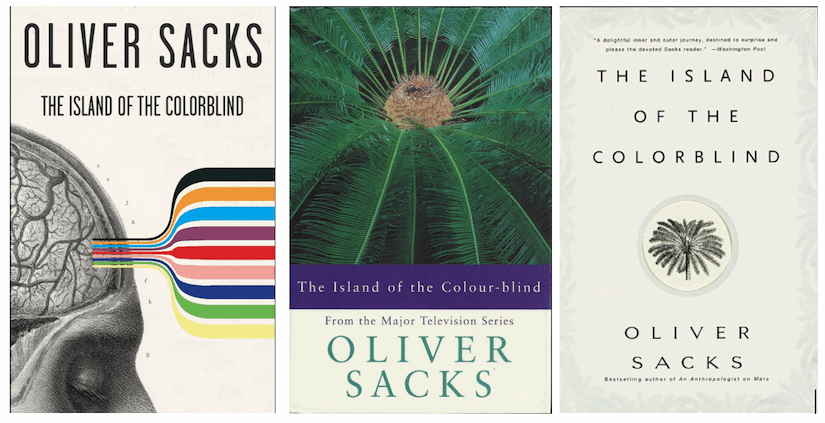
Island of the Colorblind, Oliver Sacks

October – November 2025

This is the 23rd entry in the Essays Project. We continue on our quest to read the complete Sacks oeuvre. Despite its title, this book is divided into two books: The Island of the Colorblind and Cycad Island.

Retrospective on the Book

This was not one of my favorite books, but it was not without interest. It gave interesting glimpses of life in the South Pacific, particularly the hints of how the US military dominates and suppresses freedom in this area of the world. Seems like a remnant of some of the worst of the colonial days. With respect to Sacks’ visits to various islands, the offer interesting accounts, though I have to say it seems to me that he learned little on his visits that he had not already learned from the informants who accompanied him or who he met there.

For me, the high point of the book was the last chapter about his visit to the island of Rota, a little-visited island near Guam. This visit, unlike the others, had no neurological goal: it was simply to see ferns, cycads and the other primitive plants that are dear to Sacks. I like this chapter because it provides some suggestive passages that offer insight on his love of ferns and the allies, which will come to the fore in his Oaxaca Journal. To wit:

The sense of deep time brings a deep peace with it, a detachment from the timescale, the urgencies, of daily life. Seeing these volcanic islands and coral atolls, and wandering, above all, through this cycad forest on Rota, has given me an intimate feeling of the antiquity of the earth, and the slow, continuous processes by which different forms of life evolve and come into being. Standing here in the jungle, I feel part of a larger, calmer identity; I feel a profound sense of being at home, a sort of companionship with the earth.

ibid., 198

Preface

Sacks wrote this book in one swoop, in July of 1995. Subsequently he added voluminous notes, which his editors paired back; this edition appears to have notes that the original one did not.

Sacks writes that his visits to the islands described herein were brief and unexpected, part of no agenda or research program. It does seem that he is pursuing his theme of how individuals (and, in this case, communities) adapt to rare neurological conditions: hereditary colorblindness in the first case, and a fatal neurodegenerative disorder in the second. It also sounds as if his other biological and botanical interests will play into the books.

Continue reading Island of the Colorblind, Oliver Sacks

Views: 39

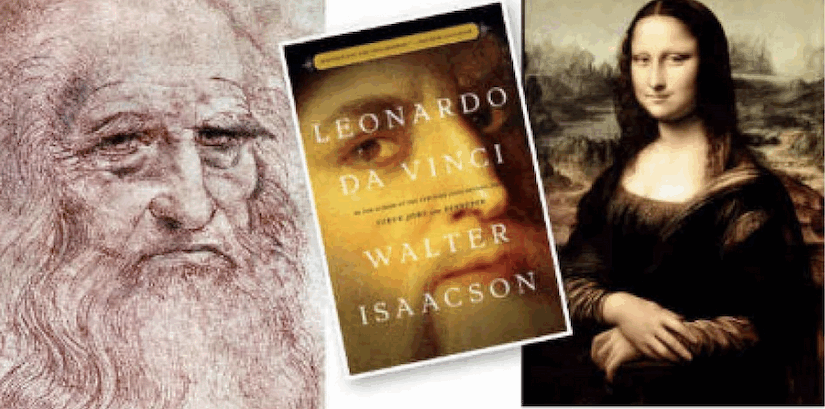
Leonardo Da Vinci, Walter Isaacson

October 2025

About the Book

Reading this with NS & DO, a subset of the 26 minute book group. As I begin, I find myself a little hesitant about a biography written about someone 400+ years ago, where there is presumably a scarcity of 1st hand accounts. But certainly his very detailed notebooks will help…

Later: And the notes do, indeed, help, although the undated nature of the notes, and the fact that they have been remixed over the ensuing centuries makes them less effective as a chronological record. Still, I’m learning a lot about Leonardo, his approach to life and innovation, and his accomplishments.


The Book

INTRODUCTION – I Can Also Paint

The introduction offers a general description of Leonardo as a man who blended art and science and who, in fact, probably did not distinguish. It suggests that we have much to learn from Leonardo in that “Leonardo’s genius was a human one, wrought by his own will and ambition,” in contrast to those who seem to have prodigious cognitive powers. Certainly, he left profuse documentation of his curiosity and his reliance on observation and analysis of the natural world to fuel his creativity and inventiveness. Leonardo: “He who can go to the fountain does not go to the water jar.

The rest of the introduction discusses sources — three early accounts — and offers some suppositions about Leonardo’s personality.

Continue reading Leonardo Da Vinci, Walter Isaacson

Views: 72

Gods of the Upper Air, Charles King

October 2025

About the Book

I’m reading this book chapter by chapter with CJS.The topic is the emergence of cultural anthropology via the work of Franz Boas and his students, who included Margaret Mead, Ruth Benedict, Ella Deloria, and Zora Nealel Hurdson. The work described here laid the foundation for the belief that all humans are fundamentally equal in their abilities, and that much of what had been thought to be innate was culturally constructed.

The Book

C1: Away

This chapter is really a preface. It begins with a vignette of Margaret Mead arriving in Samoa, but then segues to the general aim of the book.

A little over a century ago, any educated person knew that the world worked in certain obvious ways. Humans were individuals, but each was also representative of a specific type, itself the summation of a distinct set of racial, national, and sexual characteristics.

Each type was fated to be more or less intelligent, idle, rule-bound, or warlike. Politics properly belonged to men, while women, when they were admitted to public life, were thought to be most productive in charitable organizations, missionary work, and the instruction of children. Immigrants tended to dilute a country’s natural vigor and breed political extremism. Animals deserved kindness, and backward peoples, a few rungs above animals, were owed our help but not our respect. Criminals were born to a life beyond the law but might be reformed. Sapphists and sodomites chose their depravities but were probably irredeemable. It was an age of improvement: an era that had moved beyond justifying slavery, that had begun to shake off the strictures of class, and that might eventually do away with empires.

—ibid., p 4

The claim of the book is that the work of Boas and his students was critical to overturning these understandings. Boas and his students invented (and named) cultural anthropology and developed the theory of cultural relativity. Their work challenged heretofore accepted ideas that people fell into natural categories that differed in their abilities and predilections. It did this via a scientific examination of cultures…

Continue reading Gods of the Upper Air, Charles King

Views: 90

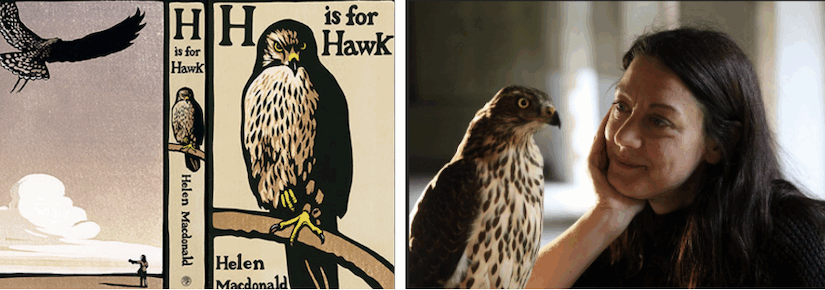
H is for Hawk, Helen Macdonald

October 2025

About the book

I read Macdonald’s Vesper Flights early this year when we were in Hawaii. Flights is a book of essays mostly about natural history and mostly about birds – though, true to the original meaning of essay, “about” covers a lot of ground. The writing was beautiful, and I not only read the book but studied it to improve my own writing. I’d expected much the same from Hawk. 

But Hawk is a very different book. To be sure, the writing is beautiful, and it will repay study, but it is a single-track narrative rather than a series of essays. Hawk traces out two central narratives: one is an account of her training a goshawk and her experiences training, living and hunting with it; intertwined with this narrative is an account of coming to terms with her father’s death, and the period of isolation, depression, and gradual recovery that ensured. Though as I write this, I note that the ‘coming-to-terms’ narrative is really itself a braid that includes childhood memories and an account of the life of T. H. White. Hawk was published in 2014 – I believe it to be her first book, possibly excepting poetry.

I am not going to provide a chapter by chapter account. Rather, my aim here, is just to record the phrases and passages that struck me. 

Continue reading H is for Hawk, Helen Macdonald

Views: 42

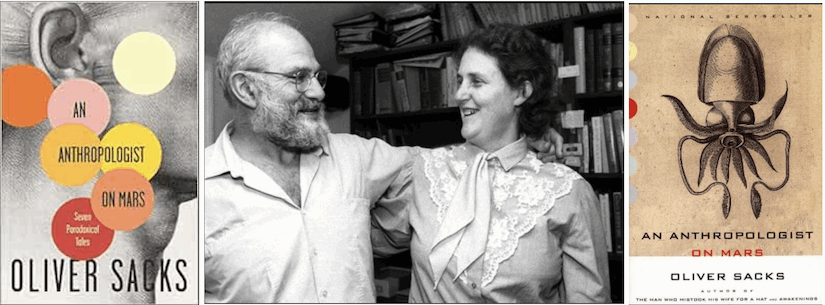
EP#22: An Anthropologist on Mars, Oliver Sacks

This book seems to focus on people with either acquired or inborn neurodivergences who have adapted to their situations and live, in a sense, in very different worlds from ours.

After reading: yes, this supposition is correct Most are leading successful, if different lives, except for ‘the last hippy’ of chapter 2.

Continue reading EP#22: An Anthropologist on Mars, Oliver Sacks

Views: 69

The Saint of Bright Doors, Vajra Chandrasekara

The Saint of Bright Doors, Vajra Chandrasekara, 2023

This is an acclaimed science fiction book that has gathered both critical and popular praise. I read it a couple of years ago — I try to read the ‘best of the year’ books in SF – and it didn’t engage me, although I did manage to finish it. I am now reading it a second time, as part of a Science Fiction and Fantasy course I’m taking at the U, and am going to try harder to appreciate it; or at least to understand what others appreciate in it. And perhaps also reflect on aspects of it that prevent me from appreciating it.

At this point I’ve just started the re-read it. I am noticing some very nice turns of phrase. I also notice that the protagonist begins as, in a sense, an abused child who is being trained to do terrible things by a mother who sees him only as a tool. I’m not really noticing much in the way of love or affection or humor among any of the characters.

Continue reading The Saint of Bright Doors, Vajra Chandrasekara

Views: 45