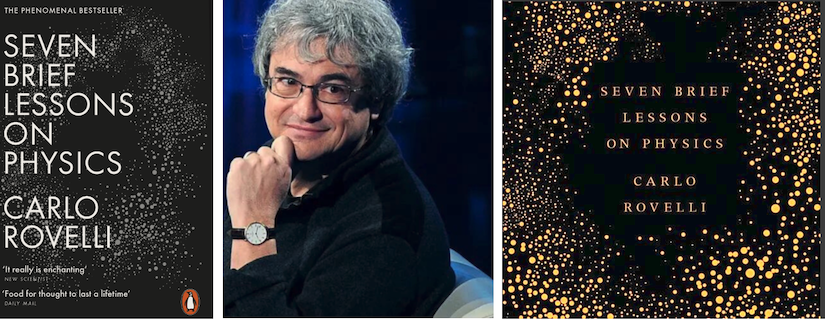
I’m not sure how I came across this book or even why it attracted me. I think that — wherever I encountered it — there must have been a description that mentioned simple but lyrical expositions of key ideas in Physics.
So, far, after having read the first two chapters, I’m liking it very much.
…And now, having completed it, I enjoyed it very much. While a few concepts, particular the issue of time, remain cloudy, over all I understand a lot more about the ‘shape’ of modern physics, and the current frontiers and challenges being addressed. I highly recommend the book.
I’m reading this book chapter by chapter with CJS.The topic is the emergence of cultural anthropology via the work of Franz Boas and his students, who included Margaret Mead, Ruth Benedict, Ella Deloria, and Zora Nealel Hurdson. The work described here laid the foundation for the belief that all humans are fundamentally equal in their abilities, and that much of what had been thought to be innate was culturally constructed.
The Book
C1: Away
This chapter is really a preface. It begins with a vignette of Margaret Mead arriving in Samoa, but then segues to the general aim of the book.
A little over a century ago, any educated person knew that the world worked in certain obvious ways. Humans were individuals, but each was also representative of a specific type, itself the summation of a distinct set of racial, national, and sexual characteristics.
Each type was fated to be more or less intelligent, idle, rule-bound, or warlike. Politics properly belonged to men, while women, when they were admitted to public life, were thought to be most productive in charitable organizations, missionary work, and the instruction of children. Immigrants tended to dilute a country’s natural vigor and breed political extremism. Animals deserved kindness, and backward peoples, a few rungs above animals, were owed our help but not our respect. Criminals were born to a life beyond the law but might be reformed. Sapphists and sodomites chose their depravities but were probably irredeemable. It was an age of improvement: an era that had moved beyond justifying slavery, that had begun to shake off the strictures of class, and that might eventually do away with empires.
—ibid., p 4
The claim of the book is that the work of Boas and his students was critical to overturning these understandings. Boas and his students invented (and named) cultural anthropology and developed the theory of cultural relativity. Their work challenged heretofore accepted ideas that people fell into natural categories that differed in their abilities and predilections. It did this via a scientific examination of cultures…
Entry 11 in the Essays Project with CT; the ‘summer of Sacks’ has turned into the fall of Sacks. It is interesting to be getting such a comprehensive view of a single person’s life and writing. Uncle Tungsten was apparently written in response to the spontaneous surfacing of childhood memories as Sacks approached his 60th year. We’ve read some other essays from that time, mostly from Everything in its Place (essays on South Kensington and Humphry Davies), and found those very good though we hope considerable new ground will be covered. [Later: New ground is being covered — there is not a lot of repetition…]
* Uncle Tungsten: Memories of a Chemical Boyhood, Oliver Sacks, 2001.
These are my notes on On the Move, Oliver Sacks autobiography (billed as volume 2, but the publisher, volume 1 being Uncle Tungsten: Memories of a Chemical Boyhood, written a couple of decades earlier). This is part of the course of essay reading I am doing with CT; in particular, this is part of what we have dubbed ‘The Summer of Sacks.’ These are not, of course, essays, but we have become interested in Sacks, and it is interesting to see the essays against a fuller narrative of his life.
The book discusses the use of checklists, both in the author’s domain of surgery, and in other domains such as aircraft piloting and construction management. It makes and documents claims about the ability of checklists to significantly, and sometimes radically, reduce errors and increase success rates.
I see three main lessons in the book, one obvious, and the other two less obvious.
The Obvious Lesson
The first and obvious lesson is that checklists can serve as a powerful tool for buttressing unaided human cognition. Even experts are prone to forgetting or overlooking steps in task, and using checklists can make a massive difference in the quality and valence of a task’s outcome.
But on the other hand, as example after example in the book showed, the items on the checklists that are making such a difference are obvious. For example, in the pilot’s checklist for what to do during “Engine Failure,” the second item – in large print – is “Fly the airplane.” Similarly, in checklists used in hospital, checklist items are things like “Confirm that the patient has verified his identity,” and “Confirm that all team members have introduced themselves by name and role.” Checklists are not being used to keep track of complicated things, or hard to remember things, or things that their users don’t know well.
The Important and Easily-missed Lessons
Instead, checklists are being used to ensure a group is working together in an effective way. Checklists are being used as scaffolding to support group processes, not so much individual cognition. This brings us to the second and third lessons I took from the book (lessons which I do not think were emphasized nearly enough): checklists are used as part of a shared, social practice rather than as a solitary tool.
The second lesson is that going through a checklist was a group activity, and it is this collective activity that leads the group to reflect on and prepare for the group’s task; it also facilitated (“activated”) later communication within the group and appears to have increased group affinity and commitment. This effect is explicitly invoked in checklists that highlight communicative activities (“the submittal schedule” — who should talk with whom about what and by when) rather than instrumental activities.
The third lesson is that when a checklist is adopted as an organizationally-sanctioned activity, it has a side effect of requiring that the organization’s infrastructure, on-hand resources, and staffing be configured to enable the checklist to be successfully executed. This function was facilitated, in one deployment of checklists, by making an on-site executive part of the team responsible for deploying checklists. The executive was able to reconfigure the organization’s supply base so that needed materials were on hand, and further was able to persuade a supplier to package materials needed to execute the checklist together. Thus, ultimately, the checklist worked to reconfigure the organization and its supply chain.
Details
page 7-10. Philosophers essay on errors distinguishes between errors of ignorance and errors of ineptitude. The first seem more forgivable than the second, but in the context of performance of complex activities under time pressure. the latter seem inevitable.
page x. A patient in an intensive care unit undergoes 178 procedures a day.
page 38. Using a checklist to make sure 4 steps were carried out reduced the 10-day line infection rate from 11% to 0. Other examples showed reductions from 41% to 3% for untreated pain, and 70% to 4% in improper procedures for those on mechanical ventilators (resulting in a 25% decrease in cases of pneumonia).
page 43-44. In the Keystone initiative, getting project manager and executive participation in checklist roll out was key. Executives made sure that the required chlorhexidine soap was available (previously it was available in only 1/3 of the ICUs), and that required sterile drapes were stocked. After a while, the supplier of lines was persuaded to produce a kit that had both the soap and drapes in it.
page 46. In a checklist deployment to hospitals to reduce cardiac arrest fatalities, checklists were deployed to first responders (rescue squad personnel) and first coordinators (hospital operators) even though they were the least powerful. This enabled the organization to prepare by being alerted ahead of time and mustering the needed skills.
pages 65-68. The building construction checklist of both instrumental tasks (put together by 16 disciplines and looked over by subcontractors), and communications activities (“the submittal list” – who talks to whom when about what). By ensuring that the right people are charged with talking at the right time, you radically lower the need for a single person to understand all the details of what is going on.
pages 76-80. Walmart and Katrina and empowering store owners. And Van Halen and brown M&M story as a procedural integrity check.
pages 95-97. The Proctor and Gamble soap in India study. The use of soap was made more systematic, and more pleasant.
pages 99-100: “Cleared for Takeoff” checklist for ensuring timely administration of pre-operative antibiotics. A mechanical forcing function (a metal tent stenciled with “cleared for takeoff over the scalpel that served as both a prompt and a legitimation of the nurse’s role in the process. Increase in proper antibiotic administration went from 60% to 89% (3 months) to 100% (10 months).
page 103. “‘That’s not my problem,’ is probably the worst thing people can think, whether they are starting an operation, taxiing an airplane full of passengers down the runway, or building a thousand-Foot skyscraper. But in medicine, we see it all the time.”
pages 107-110. Introductions among team members increase team affinity and empower lower status members to speak up. “When nurses were given a chance to say their names and mention concerns at the beginning of an operation, they were more likely to note problems and mention solutions.” Employee satisfaction rose 19% and OR nurse turnover went from 23% to 7%
page 120. Good vs. bad checklists. Would be nice to know more about this, rather than the obvious and rather sloganish comments in the book. …Nice point about getting leadership to adopt checklists first.
pages 154-155: WHO Safe Surgery Checklist results. Double-digit reductions.
page 177. Item 1 on the checklist: “Fly the airplane.” … “The checklist gets the dumb stuff out of the way, the routines your brain shouldn’t have to occupy itself with.”