In Defense of Sanity, G. K. Chesterton

August–September 2026

I dipped into GKC quite early in my essay reading project, influenced by reading partner CT’s appreciation of his work. But this is the first book of his essays — an anthology of his ‘best’ works—that I am reading in its entirety.

LATER: Well, I intended to read it in its entirety, but, as I describe presently, I gave up about a quarter of the way through. I very much enjoy his more general essays, about aspects of the natural world, or the oddities of society and nature, but — whether it was the selection of essays for this collection, or a gradual shift in his focus as a writer – the later essays are more oriented towards criticism of literature or modernity. They lose the imagery and wry humor that I appreciate, and become more of a dismissive lament – and a not very eloquent critique – about various aspects of modernity.

My Favorites

  • On Certain Modern Writers and the Institution of the Family
    We make our friends; we make our enemies; but God makes our next-door neighbour…
  • On Running After One’s Hat
    An adventure is only an inconvenience rightly considered. An inconvenience is only an adventure wrongly considered.
  • The Romantic in the Rain
    An essay on rain, why people should appreciate rather than deprecate it, and how it changes the appearance of the world. “Shallow lakes of water reiterate every detail of earth and sky; we dwell in a double universe.
  • Cheese
    On the pleasure of variations of natural things that reflect their locality: “soft play of slight variation which exists in things produced everywhere out of the soil, in the milk of the kine, or the fruits of the orchard.
  • On Being Moved
    A light, humorous essay on moving

The Essays

Introduction to The Defendant

This essay—well, really just an introduction—didn’t resonate with me, but I thought the opening image was excellent.

In certain endless uplands, uplands like great flats gone dizzy, slopes that seem to contradict the idea that there is even such a thing as a level, and make us all realise that we live on a planet with a sloping roof, you will come from time to time upon whole valleys filled with loose rocks and boulders, so big as to be like mountains broken loose. The whole might be an experimental creation shattered and cast away. ibid., p1

A Defense of Skeletons

Argues that the conventional or horror or at least displaced of skeletons is misplaced. Suggestions instead that they can be seen is on and even humorous. But what I most liked about the essay was the lead in which talked about the trunks and branches of trees in the winter:

Some little time ago I stood among immemorial English trees that seemed to take hold upon the stars like a brood of Ygdrasils.

[…]

the fringe of the forest melts away like a vignette. The tops of two or three high trees when they are leafless are so soft that they seem like the gigantic brooms of that fabulous lady who was sweeping the cobwebs off the sky.

ibid. p xx

And the wrap up, where the essay opens out, has a very nice bit:

Has the poet, for whom Nature means only roses and lilies, ever heard a pig grunting? It is a noise that does a man good—a strong, snorting, imprisoned noise, breaking its way out of unfathomable dungeons through every possible outlet and organ. It might be the voice of the earth itself, snoring in its mighty sleep.

* On Certain Modern Writers and the Institution of the Family

I wrote about this essay several years ago (here). It’s worth a read, and has some excellent passages. Here are just two:

We make our friends; we make our enemies; but God makes our next-door neighbour. Hence he comes to us clad in all the careless terrors of nature; he is as strange as the stars, as reckless and indifferent as the rain.

—ibid., p 14

It is quite proper that a British diplomatist should seek the society of Japanese generals, if what he wants is Japanese generals. But if what he wants is people different from himself, he had much better stop at home and discuss religion with the housemaid.

—ibid., p 15

* On Running After One’s Hat

Beginning with a description of the flood at Battersea, the area in which he lives he opened out into a discussion of inconvenience and boredom and how it might be reframed as wonderful and interesting. This segues into the figure of a man running after his hat and he asks why this should be seen as an inconvenience, when the same people run eagerly after a small ball on a tennis court.

An adventure is only an inconvenience rightly considered. An inconvenience is only an adventure wrongly considered.

—ibid., p 24

Woman

Didn’t really speak to me.

A Piece of Chalk

This is one of GKC‘s most anthologized essays, and it is indeed a pleasant read. He talks about going out for a walk and taking along brown butcher’s paper and chalk with which to draw. He discusses color, and especially the importance of white, and the English countryside. He discovers, however, that he’s forgotten his white chalk, but is saved, in the end, by realizing that he’s forgotten is sitting, in southern England, on an entire body of white chalk.

What I Found in My Pocket

Beginning with a kind of irrelevant anecdote, he writes about being locked up in a third clsss railway card with nothing to read, and deciding to look through his pockets. He writes of various objects, reflecting on them in various ways. At the end the twist is that although his pockets contain a beast variety of things, they do contain his railway ticket.

On Lying in Bed

He opens my observing that lying in bed would be perfect. If only he had colored pencils, long enough to draw on the ceiling. He imagined many possibilities then he goes on to observe that in the modern house there is almost no blank space other than the ceiling. This segues into a discussion of attitude— exemplified by the feeling of it lying in bed is decadent— and goes on to suggest that in modern times people are more preoccupied with matters of habit and manners, then with ethics and morality.

This alarming growth of good habits really means a too great emphasis on those virtues which mere custom can misuse, it means too little emphasis on those virtues which custom can never quite ensure, sudden and splendid virtues of inspired pity or of inspired candour.

ibid., p 43

The Diabolist

Well-written but didn’t engage me.

The Twelve Men

A discussion of the benefits of using a jury of common men rather than experts to pass judgment. This passage summarizes it nicely:

And the horrible thing about all legal officials, even the best, about all judges, magistrates, barristers, detectives, and policemen, is not that they are wicked (some of them are good), not that they are stupid (several of them are quite intelligent), it is simply that they have got used to it. Strictly they do not see the prisoner in the dock; all they see is the usual man in the usual place. They do not see the awful court of judgment; they only see their own workshop.
[…]
Men shall come in who can see the court and the crowd, and the coarse faces of the policemen and the professional crim-inals, the wasted faces of the wastrels, the unreal faces of the gesticulating counsel, and see it all as one sees a new picture or a ballet hitherto unvisited.

—ibid., p 51

The Shop of Ghosts

I enjoyed the beginning of this essay. GKC is peering through the dimly lit window of a toy shop in a poor neighborhood. In his minds eye the display comes alive, “filled with all the colours God ever made.”

Moving on, he enters the shop, intending to buy something, but the proprietor refuses money, saying he only gives things away. GKC recognizes him as Father Christmas, old and seeming ailing, but not passed on yet. GKC is succeeded by a series of historical visitors—Charles Dickens being the first—all of whom had thought Father Christmas was dying. It ends with the observation that he has always seemed to be dying but will never die.

* The Romantic in the Rain

An essay about how nice rain is, and how odd it is that people dislike it. It meanders from imagining how wine drinkers would feel about it raining wine, to a preference for Mackintoshes over umbrellas “Shut up, an umbrella is an unmanageable walking stick; open, it is an inadequate umbrella.” It has some very nice imagery:

For indeed this is one of the real beauties of rainy weather, that while the amount of original and direct light is commonly lessened, the number of things that reflect light is unquestionably increased. There is less sunshine; but there are more shiny things; such beautifully shiny things as pools and puddles and mackintoshes. It is like moving in a world of mirrors.
[…]
Shallow lakes of water reiterate every detail of earth and sky; we dwell in a double universe. Sometimes walking upon bare and lustrous pavements, wet under numerous lamps, a man seems a black blot on all that golden looking-glass, and could fancy he was flying in a yellow sky. But wherever trees and towns hang head downwards in a pigmy puddle, the sense of Celestial topsy-turvydom is the same. This bright, wet, dazzling confusion of shape and shadow, of reality and reflection, will appeal strongly to any one with the transcendental instinct about this dreamy and dual life of ours. It will always give a man the strange sense of looking down at the skies.

— ibid., p 59 & 60

The Mad Official

An essay that takes a long path to get to its point which is to protest a judicial decision regarding a woman whose children were found to be “quite dirty.” The long path has to do with what it means to go mad — as an individual or a society — and the claim is that one is going mad when one reacts to outrageous things as though they are unremarkable things.

“... whenever we see things done wildly but taken tamely, then the state is growing insane.

The Mystagogue

This did not engage me at all. It seems to end up as an attack on art critics. The general claim is that if something can not be concretely expressed — that is, is discussed only in ambiguous and abstract terms — it is likely to be evil, or at least at attempt to deceive…

The Architect of Spears

GKC argues for the beauty and power of gothic architecture, particularly as seen in cathedrals. He claims it is not the symbolism and richness—dismissing mid-eastern and oriental design with what strike me as narrow culturally-bound prejudices—but rather that it is militant and on the march. I found the essay fanciful and unconvincing, though it exhibts great energy in its descriptions.

Don’t

Not very interesting to me. A list of things that he’d like people to stop doing. For instance, ‘Don’t say there is no true creed, for every creed believes itself right and the other’s wrong’

The Mystery of the Mystics

It seems to be a review of a book on mysticism. Not very interesting.

A Much Repeated Repetition

An essay against the saying “History repeats itself.” His argument is that history is the only thing that doesn’t repeat. Facile, but not very deep, imo.

The Maxims of Maxim

Appears to be a reply to a letter to a publication by Hiram Maxim, an engineer, who seems to cast some aspersion on religion. Among other things GKC makes the point that logical reasoning is only as good as its premises: “…you can only find truth with logic if you have already9 found truth without it.

The Book of Job (GKC as MC, 1929)

An essay on the interpretation of the book of Job. Not of interest to me.

* Cheese (Alarms and Discursions, 1910)

Beginning with a tongue in cheek discussion of cheese, and how neglected it has been by most poets, opens into an argument for the value of diversity, particularly the way various things vary according to their region.

Safety matches, tinned foods, patent medicines are sent all over the world; but they are not produced all over the world. Therefore there is in them a mere dead identity, never that soft play of slight variation which exists in things produced everywhere out of the soil, in the milk of the kine, or the fruits of the orchard. You can get a whisky and soda at every outpost of the Empire: that is why so many Empire-builders go mad. But you are not tasting or touching any environment, as in the cider of Devonshire or the grapes of the Rhine. You are not approaching Nature in one of her myriad tints of mood, as in the holy act of eating cheese.

—ibid., p 105

On Gargoyles (Alarms and Discursions, 1910)

Yet another complain against the modern world.

In this essay he begins with the discovery of a moss-covered gargoyle in the ruins of an abbey. Reflecting on it provokes “a symbolic reverie” in which he envisions the three great stages of art. These are the pagan, the gothic, and finally the modern, the last being characterized by a welter of disconnected images and symbols, having lost the unifying theme of gothic….

The Fading Fireworks (Alarms and Discursions, I9IO)

Beginning with an image that suggests that Guy Falks day is in decline, we have another lament about modernism. In this essay he segues to a discussion of religion, and contrasts the colors of fireworks (which he associates with Confucianism because of their invention in China) with those of stained glass windows. He takes it as significant that the colours of fireworks are ephemeral, and have only darkness behind them, in contrast to stained glass windows which are solid and persistent, and have light behind them.

The Furrows (Alarms and Discursions, I910)

GCK is struck by furrows in the field, and engages in fanciful associations about their production and character.

The furrows are like arrows; they fly along an arc of the sky. They are like leaping animals; they vault an inviolable hill and roll down the other side.

[…]

…there is hardly anything in nature such as a mere droop of weakness. Rigidity, yielding a little, like justice swayed by mercy, is the whole beauty of the earth.

The Meaning of Dreams (Lunacy and Letters, 1958)

A mildly interesting reflection on dreams…

Such things as birth and death and dreams are at once so impenetrable and so provocative that to ask men to put them on one side, and have no hopes or theories about them, is like asking them not to look at a comet or not to look out the answer of a riddle. Around these elemental acrostics human hypothesis has circled and will always continue to circle. Even in an empire of atheists the dead man is always sacred. The grave, like a tilled field, brings forth crop after crop of creeds and mythologies.

—ibid., p 118


* On Being Moved (Lunacy and Letters, 1958)

A light humors essay on moving. It begins with GKC sitting in a chair, writing on his knee, as all his possessions are being removed by moving men.

They would take away my chair, except for the formmidable necessity of carrying me away with it, a task from which the most enormous would shrink. But sideboards and pianos melt away at their lightest gesture and bedsteads simply flee before them.

—ibid., p 122

The Remainder of the Book

It was about this point where I decided I was not motivated to finish the book. I glanced through a dozen more essays in sequence, and hopscotched my way through the rest, but they had taken a turn towards criticism, either of literary work, or GKC’s relentless and dismissive rebuttals of all things ‘modern.’ With this more abstract and reflective turn, his essays lost the imagery and occasional humor that made the earlier ones palatable (though it is possible that in my skimming I failed to find these bits).

Below is the next tranche of essays, although others follow which I did not transcribe:

  • The Pickwick Papers (Appreciations and Criticisms of the Works of Charles Dickens, I91I)
  • The Bluff of the Big Shops (The Outline of Sanity, 1926
  • On Architecture (Generally Speaking, 1928) On Shakespeare (Generally Speaking, 1928)
  • The Slavery of Free Verse (Fancies vs. Fads, I923)
  • Turning Inside Out (Fancies vs. Fads, 1923)
  • On Turnpikes and Mediævalism (All I Survey, 1933)
  • The Drift from Domesticity (The Thing, I929)
  • On Vulgarity (Come to Think of It, 1930)
  • On a Humiliating Heresy (Come to Think of It, 1930)
  • On Original Sin (Come to Think of It, 1930)
  • On Jane Austen in the General Election (Come to Think of It, 1930On Essays (Come to Think of It, 1930)
  • On Evil Euphemisms (Come to Think of It, 1932)
  • A Plea for Prohibition (Sidelights, 1932)
  • The American Ideal (Sidelights, 1932)
  • Marriage and the Modern Mind (Sidelights, 1932)
  • Magic and Fantasy in Fiction (Sidelights, 1932)
  • On the New Prudery (Avowals and Denials, 1934)
  • On the Return of the Barbarian (Avowals and Denials, 1934)

# # #

Views: 5

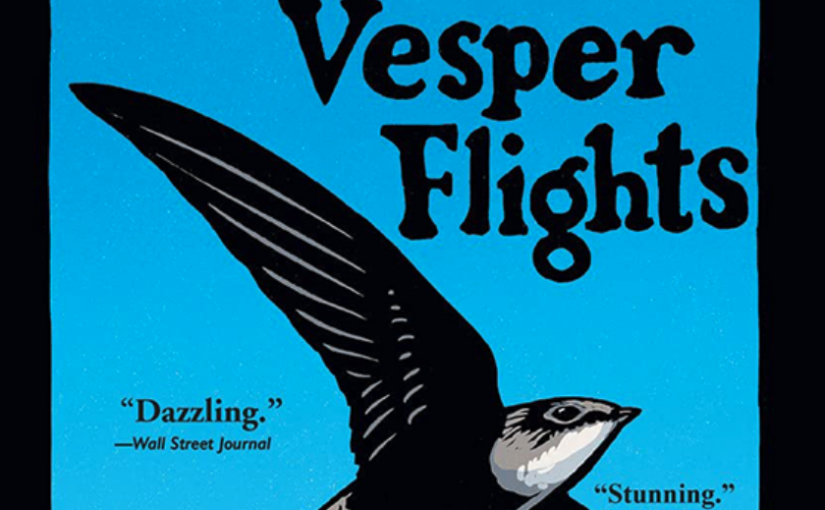
Vesper Flights, Helen Macdonald

January 2025

I picked up this book, probably about a year ago at the recommendation of Dan Russell. In terms of single-author collections, I’ve liked this more than anything I’ve read in years, perhaps with the exception of Loren Eisley’s essays. Regardless, Macdonald is a superb writer, and in particular her descriptions of the natural world are remarkable. I intend to seek out her other books.

I like, as well, her view of what literature ought to do:

What science does is what I would like more literature to do too: show us that we are living in an exquisitely complicated world that is not all about us. — Helen Macdonald, Vesper Flights. p. ix

Favorites

  • 2. Nothing Like a Pig
  • 9. Ants
  • 10. Symptomatic
  • 12. Winter Woods
  • 18. Deer in the Headlights
  • 35 Eulogy
  • 38. Dispatches from the Valley

The Craft of Writing — things I’ve learned here

  • Describing a Moment: And then it happens: a short, collapsing moment.” This passage, by foregrounding the nature of the moment, and the movement from uncertainty to realization, does a superb job of highlighting and intensifying an epiphany. (In Nothing like a Pig.)
  • A beautiful resonating description: a long, yawning burr that dopplered into memory and replayed itself in dreams.
  • Use of incongruity for stream-of-consciousness. In Deer in the Headlights she does a great job of conveying the incongruity of two worlds — the forest and the highway — in a single sentence that juxtaposes glimpses of the nature of each. Similarly, in The Student’s Tale, the first sentence, with independent clauses connected by a series of “ands,” really conveys an immediate stream-of-consciousness experience, where the attention is hopping around, and making non-rational connections as it does so (.e.g, the grapes on the table are black, and so is the taxi out front).
  • Transforming dynamic movement into a pattern.The hitching curves of the gulls in a vault of sky crossed with thousands of different flightlines…” (Ants). For me, this generates a pattern — a vault of sky circumscribed by imagined flightlines – that extends over time and creates a persistent space which frames other happenings…

1. Nests

This essay describes nests. She begins with her feelings about nests develop when she was a child, and encountered them in her yard. She then goes into the present, and reflects more on this than their meanings.

*2. Nothing like a Pig

This essay describes an encounter with a boar. She reflects both on the boar, and more in general on animals in particular, and how the conception of an animal differs from the reality of the animal

Then it happens: a short, collapsing moment as sixty or seventy yards away something walks fast between the trees, and then the boar. The boar. The boar.

– Vesper Flights, Helen Macdonald, p 11.

A great bit of writing. The “short, collapsing moment.” The uncertainty about distance — “sixty or seventy yards” — and what she is seeing — “something.” The revelation: “and then the boar.” And the repetition: “The boar. The boar.

3. Inspector Calls

A very nice short piece about an encounter with autistic boy, who is visiting her flat with his parents. In particular he connects with her bird and the bird with him.

4. Field Guides

“Field guides made possible the joy of encountering a thing I already knew but had never seen.”

5. Terkels Park

An essay on the place where she grew up. A bit nostalgic, but it was unusual, and had interesting reflections, so I found it worth reading. Some very nice writing:

I could lie awake in the small hours and hear a single motorbike speeding west or east: a long, yawning burr that dopplered into memory and replayed itself in dreams.

— ibid. p 12

My eyes catch on the place where the zoetrope flicker of pines behind the fence gives way to a patch of sky with the black peak of a redwood tree against it and the cradled mathematical branches of a monkey puzzle, and my head blooms with an apprehension of lost space,

— Ibid. p 13

6. High-Rise

About watching migrating birds at night from the top of the Empire State Building. An interesting discussion of how birds migrate — the height and speeds at which they fly, and the way they navigate — and the problems that the lights and tall buildings of the city give them.

7. The Human Flock

Overhead a long wavering chevron of beating wings is inked across the darkening sky.

Recounting the observation of large flocks of migrating cranes, and continuing to a discussion of the dynamics of swarms and murmurations. “Turns can propagate through a cloud of birds at speeds approaching 90 miles an hour…” This segues into a concluding comment on refugees, and a plea to regard them as individuals rather than masses.

8. The Student’s Tale

An account of meeting a student who is a refugee and spending time in camps…

A great opening sentence:

There’s a window and the rattle of a taxi and grapes on the table, black ones, sweet ones, and the taxi is also black and there’s a woman inside it, a charity worker who befriended you when you were in detention, and she’s leaning to pay the driver and through the dust and bloom of the glass I see you standing on the pavement next to the open taxi door and your back is turned towards me so all I can see are your shoulders hunched in a blue denim jacket.

— The Student’s Tale, Vesper Flight, Kate Macdonald, p. 53

I think this is a marvelous stream-of-consciousness sentence, with the writers attention shifting from taxi to grapes to taxi to the woman and then to the student whose shoulders are hunched. The second person is also very effective.

*9. Ants

About the mating flights of ants, and the birds that prey upon them. Also reflects on the power of scientific understanding to enhance the beauty of things, rather than detract: “…it’s things I’ve learned from scientific books and papers that are making what I’m watching almost unbearably moving.”

A red kite joins the flock, drifting and tilting through it on paper-cut wings stamped black against the sky.

[…]

The hitching curves of the gulls in a vault of sky crossed with thousands of different flightlines, warm airspace tense with predatory intent and the tiny hopes of each rising ant.

— Helen Macdonald, Vesper Flights, p. 63

*10. Symptomatic

Discusses her experiences with migraines. The writing is beautiful and ranges from describing the onset and symptoms of her migraine, to the way in which she has come to live with them. Ends with a partial analogy to earth undergoing climate change…

I was busily signing books when a spray of sparks, an array of livid and prickling phosphenes like shorting fairy lights, spread downwards from the upper right-hand corner of my vision until I could barely see through them.
—Helen Macdonald, Vesper Flights, p. 66

11. Sex, Death, Mushrooms

On mushroom hunting: “It is raining hard, and the forest air is sweet and winey with decay.

The air is damp and dark in here. Taut lines of spider silk are slung between their flaking trunks; I can feel them snapping across my chest. Fat garden spiders drop from my coat on to the thick carpet of pine needles below.
—Helen Macdonald, Vesper Flights, p. 80

I like feeling the snapping, and the spiders dropping from her coat to the forest floor. It animates the scene, and tells us she is moving through it.

* 12. Winter Woods

Beginning with her custom of walking in the woods every New Year’s day, she reflects on the things that are distinctive about forests in winter. From the revelation of the landscape, to the bark textures and angled branches of leafless trees, to the sometimes transitory life that becomes evident. Winter woods, she suggests, are full of potential:

So often we think of mindfulness, of existing purely in the present moment, as a spiritual goal. But winter woods teach me something else: the importance of thinking about history. They are able to show you the last five hours, the last five days, the last five centuries, all at once. They’re wood and soil and rotting leaves, the crystal fur of hoarfrost and the melting of overnight snow, but they are also places of different interpolated timeframes. In them, potentiality crackles in the winter air.
—ibid., p. 85

13. Eclipse

On viewing a solar eclipse. The phenomenology of the event, but also the deep, irrational, fundamental, emotional impact. The essay is reminiscent of Joan Didion’s essay, and in particular the way in which the fading daylight alters the colors in ways that cast the landscape in an alien light. It ends, beautifully, with a description of the light returning, and the emotions that brings.

14. In Her Orbit

A description of a trip with an astrobiologist to study extremophiles at very high altitudes in the Andes. Some beautiful descriptions of desolate and unworldly environments.

15. Hares

A description of the phenomenon of boxing hares, their place in English thought and mythology, and their decline due to environmental change.

16. Lost, But Catching Up

A very short essay description her glimpse of a hound that was trying to catch up to the pack during a fox hunt.

17. Swan Upping Nestboxes

About the English tradition of “Swan Upping,” and her experience observing the activity; all interladen with reflections on the role of tradition and its uneasy releationship to Brexit, which had recently occurred.

18. Deer in the Headlights

Discusses her changing feelings about deer, from initially wishing to known nothing about them and valuing them as a source of surprise and delight, to a desire to understand them. She says it better, though:

Deer occupy a unique place in my personal pantheon of animals. There are many creatures I know very little about, but the difference with deer is that I’ve never had any desire to find out more. They’re like a distant country I’ve never wanted to visit. I know the names of different deer species, and can identify the commonest ones by sight, but I’ve always resisted the almost negligible effort it would take to discover when they give birth, how they grow and shed their antlers, what they eat, where and how they live. Standing on the bridge I’m wondering why that is.
– Helen Macdonald, Vesper Flights, p. 141

As the title suggests, much of the essay is about deer-vehicle collisions; and also about how people react to them, in the moment, and, sometimes in cruel ways, on the internet. It is a complex essay. It doesn’t really speak to me, but there are a lot of great turns of phrase and passages.

Here is how the essay begins:

The deer drift in and out of the trees like breathing. They appear unexpectedly delicate and cold, as if chill air is pouring from them to the ground to pool into the mist that half obscures their legs and turning flanks. They aren’t tame: I can’t get closer than a hundred yards before they slip into the gloom.

– Helen Macdonald, Vesper Flights, p. 140

And here is a passage I admire for the way it highlights the incongruity of the two worlds: nature and the highway. It moves from the forest, to the road, to the forest, to the road, to her standing, embodied, on the bridge.

For a while the road doesn’t seem real. Then it does, almost violently so, and at that moment the bridge and the woods behind me do not. I can’t hold both in the same world at once. Deer and forest, mist, speed, a drift of wet leaves, white noise, scrap-metal trucks, a convoy of eighteen-wheelers, beads of water on the toes of my boots and the scald of my hands on the cold metal rail.

– Helen Macdonald, Vesper Flights, p. 141

19. The Falcon and the Tower  

She is watching birds — falcons — in an abandoned industrial plant in Dublin. The essay discusses falcons, and how they have adapted to living in cities and their infrastructures. Moves from their behavior and natural history, to the ways in which people have viewed them, to their change in habitat given the ‘advance’ of civilization. Ends with a reflection on the brevity of life, and a note of hope.

20. Vesper Flights

The essay that gives the collection a title. Begins with her finding a dead Swift and not knowing what to do with it. Segues into a description of Swifts and how they are somewhat “magical” — “the closest things to aliens on earth.” After describing their natural history, describes the phenonmenon of “vesper flights,” where they gather in the evening and fly up to 8,000 feet. She describes how this behavior was discovered, and goes through the history of this behavior being observed and understood. Interleaved with this is her accounts of how, as a small child, she sought comfort in the evening (her own private vespers) by imagining herself as embedded in layers of the earth below her and the atmosphere above her. This comes together as we learn that vesper flights, for Swifts, help them take account of where they are and the oncoming weather conditions, and as Macdonald reflects on ways in which she (we) can adopt practices that enable us to locate ourselves and think about what comes next.

21. In Spight of Prisons

A very nice, short essay about her annual practice of going to see glowworms in a quarry.

* 22. Sun Birds and Cashmere Spheres

About her efforts to observe Oriels at the single place in Britain where they can still be found. Over time, their habitat is degraded, and at last there is only one… but, at the last moment, she is able to get a glimpse of it. She has a lovely sentence where she describes the song (or a song) or the oriel: “Wo-de-wal-e, wo-de-wal-e, a phrase like the curl of the cut ends of a gilded banner furling over the page of an illuminated manuscript.

In this essay, she excels at capturing the fragmentary, mosaical nature of perception.

…what I saw became something like looking into a Magic Eye picture. Here was a circle, and in it a thousand angles of stalk and leaf and scraps of shade at various distances, and every straight stalk or branch was alternately obscured and revealed as the wind blew. I began to feel a little seasick watching this chaos, but then, as magically as a stereogram suddenly reveals a not-very-accurate 3D dinosaur, the muddy patch just off centre resolved itself into the nest.

[…]

Finally, I saw my oriole. A bright, golden male. It was a complex joy, because I saw him only in stamped-out sections, small jigsaw pieces of a bird, but moving ones, animated mutoscope views. A flick of wings, a scrap of tail, then another glimpse – this time, just his head alone – through a screen of leaves. I was transfixed. I had not expected the joyous, extravagant way this oriole leapt into the air between feeds, the enormously decisive movements, always, and the little dots like stars that flared along the edge of his spread-wide tail.

– Helen Macdonald, Vesper Flights, p. 177 & 179

23. The Observatory

About swans, beginning with an odd experience she had with one approaching her, and sitting beside her, in a moment of grief.

24. Wicken

About a visit to a nature preserve with her young niece, and her niece’s puzzlement about why there were so many animals here — ‘did they bring them from a zoo?’ Reflections on the shift from a time when nature and animals were all around us, to the present, when they are mostly found in special preserves.

25. Storm

A short essay describing a thunderstorm, and also reflecting on storms as metaphors, in particular, in this essay, for the onset of Brexit.

26. Murmurations

Begins with getting a passport replaced at the last minute, and then moves to how birds were seen during war time, and the rise and evolution of the notion of birdwatching.

27. A Cuckoo in the House

On cuckoos, how people perceive them, and in particular a rather eccentric British intelligence agent — Maxwell Knight — who raised a cuckoo. Didn’t grab me, but others might well find it a fascinating tale.

28. The Arrow-Stork

About tracking migrating birds. Makes this interesting point:

Projects like this give us imaginative access to the lives of wild creatures, but they cannot capture the real animals’ complex, halting paths. Instead they let us watch virtual animals moving across a world of eternal daylight built of a patchwork of layered satellite and aerial imagery, a flattened, static landscape free of happenstance. There are no icy winds over high mountain passes here, no heavy rains, soaring hawks, ripening crops or recent droughts.
– Helen Macdonald, Vesper Flights, p. 217

29. Ashes

About destroying diseased trees, beginning with elms with Dutch Elm disease in her childhood, and ending with ash trees and the emerald ash borer.

30. A Handful of Corn

About feeding animals. Starts with a nice anecdote about an elderly woman who put out corn to attract badgers at night. Continues into the practice of feeding animals, and makes the interesting point that there are some animals it is socially acceptable to feed, and others — foxes, rats, pigeons — that it is not.

31. Berries

This short essay begins with her decorating a Christmas tree, and sprucing up its decorations with berries from outside, but feeling slightly guilty because berries exist as food for birds. Segues into natural history of both birds and berries.

A great bit of description: “…like a gravity stricken whirlwind, a pack of fat birds swirled down from the blank sky…

32. Cherry Stones

About the return of hawfinches to Britain, the excitement it engenders, and the ways in which their behavior seems to be changing vis a vis what habitat they prefer. Also touches on the blurring of natural history and national identity.

33. Birds, Tabled

About the practice of capturing and keeping birds, which in England is mostly done by the working classes, and which is, it seems, looked down upon by others. She discusses the practice, how bird keepers feel about it and their birds, and the class differences and that this highlights. Interesting.

34. Hiding

An interesting piece about hides (what we in the U.S. call “blinds”). It touches both on the aims and experience of watching animals from blinds, as well as the human experience within blinds.

* 35. Eulogy

A eulogy for a friend: a description of the her friend is interleaved with a night outing to see nightjars. A beautiful piece of writing.

The essay begins with a description of the outing, setting out while it is still light, but with the darkness coming:

 As night falls, our senses stretch to meet it. A roebuck barks in the distance, small mammals rustle in the grass. The faintest tick of insects. The scratchy, resinous fragrance of heathland grows stronger, more insistent. As we pass clumps of viper’s bugloss we watch the oncoming night turn their leaves blacker, their purple petals bluer and more intense until they seem to glow. The paths become luminous trails through darkness. White moths spiral up from the ground, and a cockchafer zips past us, elytra raised, wings buzzing.

– Helen Macdonald, Vesper Flights, p. 255

After this, she makes the connection to her friend: “Soon all color will be gone. The thought is a hard one.” And then, after writing about him: “Now, watching the slow diminishment of sense and detail around me, I’m thinking of Stu and what is happening to him, thinking of his family, of what we face at the end of our lives’ long summers when the world parts from us, of how we all, one day, will walk into darkness.

A somber essay, but ending with a note of, not hope, but acceptance. Stu says, “It’s OK. It’s OK. It’s not hard.”

It’s OK, he said. It’s not hard. Those are the words I am remembering as we walk onward, as the minutes pass, until night thickens completely and there is starlight and dust and the feel of sand underfoot. It’s so dark now I cannot see myself. But the song continues, and the air around us is full of invisible wings.
– Helen Macdonald, Vesper Flights, p. 259

36. Rescue

An account of a visit to the house of a friend who rescues and rehabilitates swifts. It begins with her friend feeding nestlings, and ends with the release of a swift, and a haunting description of the swift’s transformation as it is about to take to the sky.

37. Goats

A brief, funny story about her, her dad, and pushing goats. Wouldn’t call it an essay though.

* 38. Dispatches from the Valleys

A curious essay centered around her experiences in her first job out of college, working on a falcon conservation-breeding farm. She describes what it was like — it sounded unpleasant to me, but she clearly got to do many things she loved and valued. She describes what led her to leave the farm, and does a good job of creating tension by naming two incidents, first “the dreadful incident with the ostrich,” and then “the cattle on the hill,” and describing each played out.

The ostrich incident — euthanasia of a horribly injured bird — was straightforward, if unpleasant. The “cattle on the hill” incident is quite strange: it involves her spending hours sneaking up on them, and then jumping up and scaring them into stampeding, though she does not know why.

At the end of the essay, though, she recounts an epiphany, and, for me, it resolves not just the ‘cattle on the hill’ incident, but the whole essay:

And then I thought of the day I stalked the steers on the hill and it resolved into perfect clarity. For I had seen myself as one of those steers, one of a feral and uncared-for herd enjoying life in the middle of nowhere, not thinking about what would happen in the future, and not much worried about it, but knowing deep down that one day I was headed for the abattoir. There would be no escaping the deep sea for the shore. And my stalking and shouting was not mindless. It had been an inchoate attempt to knock them out of their contented composure. It had been a warning to make them run the hell out of there, because the valley we were all in was dark and deep and could have no good end.
– Helen Macdonald, Vesper Flights, p. 282

39. The Numinous Ordinary 

An interesting essay with some nice passages in it, but it didn’t really resonate with me.

40. What Animals Taught Me

Discusses the author’s changing conceptions of and relationships to animals. She liked caring for them, as a child, but came to recognize that was about her feeling good about herself, rather than about the animals. As she grew older, she found that an intense focus on animals was a way to make herself disappear, to allow herself into a separate world that did not contain the difficulties she was faced with. Later, with respect to falconry, she speaks about how she learned that the other party in a relationship might see it very differently — a lesson she was slow to apply to humans. The “deepest lesson animals have taught me is how easily and unconsciously we see other lives as mirrors of our own.” And “None of us sees animals clearly. They are too full of the stories we have given them.

Towards the end of the essay, speaking of a rook, she comments that now what she enjoys is not imagining that she can feel what the rook feels, know what it knows, but that it’s slow delight in knowing that she cannot.

As it passes overhead, the rook tilts its head to regard me briefly before flying on. And with that glance I feel a prickling in my skin that runs down my spine, my sense of place shifts, and the world is enlarged. The rook and I have shared no purpose. We noticed each other, is all. When I looked at the rook and the rook looked at me, I became a feature of its world as much as it became a feature of mine. Our separate lives coincided, and all my self-absorbed anxiety vanished in that one fugitive moment, when a bird in the sky on its way somewhere else sent a glance across the divide and stitched me back into a world where both of us have equal billing.
– Helen Macdonald, Vesper Flights, p. 299

# # #

Views: 57

LS: Land Above the Trees: A Guide to American Alpine Tundra, Ann Zwinger & Beatrice E. Willard

February 2024…

This book was recommended in Kim Stanley Robinson’s The High Sierra: A Love Story, as a good guide to the ecology and botany of the Sierra Nevada (and the upper portions of other North American ranges). And, indeed, it is beautifully written with a narrative style in which the reader moves through landscapes with the authors, looking at this and that, in contrast to what I had expected would be more of a catalog or encyclopedic approach. The book is divided into two principle parts: part 1 examines elements of ‘above the trees’ ecosystems, like fellfields or krumholtz; part 2 looks at particular North American tundra ecosystems, with one chapter being on the Sierra Nevada.

Continue reading LS: Land Above the Trees: A Guide to American Alpine Tundra, Ann Zwinger & Beatrice E. Willard

Views: 30

EP #5*: Favorites from the Golden Age of the Am. Essay** 1945-1970

2023

Favorites:
An Evening with Jackie Kennedy, Norman Mailer
Writing about Jews, Philip Roth
The Paranoid Style in American Politics, Richard Hofstadter
The Twenty-ninth Republican Convention, Gore Vidal
One Night’s Dying, Loren Eisley

Continue reading EP #5*: Favorites from the Golden Age of the Am. Essay** 1945-1970

Views: 48

EP #6*: Favorites from the Contemporary American Essay

April-May 2023

Thomas Beller, Portrait of the Artist as a Young Bagel, 2005
Aleksandar Hemon, The Aquarium, 2013
Leslie Jamieson, The Empathy Exams, 2013
Karen Russell, Beeper World, 2014 
John McPhee, Draft #4, 2017
Floyd Skloot, Gray Areas: Thinking with a Damaged Brain, 2003

* Part 6 of the Essays Project: A course of reading conducted with Charles Taliaferro. Note that these are my particular favorites and views, not CT’s, though no doubt some are influenced by him.

** The Contemporary American Essay, edited by Philip Lopate

Continue reading EP #6*: Favorites from the Contemporary American Essay

Views: 18

w/CS: The Tangled Tree: A Radical New History of Life, David Quammen

January – April 2023

The Tangled Tree: A Radical New History of Life, David Quammen, 2018. These are my chapter by chapter notes. Besides having very good reviews and being by a well-regarded author, this book got a (rare) very high rating from Reid Priedhorsky…

Read this with CS.

Continue reading w/CS: The Tangled Tree: A Radical New History of Life, David Quammen

Views: 117

EP #3*: Favorites from Best American Essays of the 20thC

Thursday, 25 August 2022

My favorites from the Best American Essays of the 20th Century:
The Brown Wasps, Loren Eisley – 1956
Perfect Past, Vladimir Nabokov – 1966
Stickeen, John Muir – 1909
The Search for Marvin Gardens, John McPhee – 1972
Total Eclipse, Annie Dillard – 1982

And essays which weren’t quite favorites, but which I found instructive:
Pamplona in July, Ernest Hemingway, 1923
Putting Daddy On, Tom Wolfe, 1964  
The White Album, Joan Didion, 1970

Continue reading EP #3*: Favorites from Best American Essays of the 20thC

Views: 52

w/CS: Otherlands: A Journey Through Earth’s Extinct Worlds, Thomas Halliday- Introduction

Tuesday 15 March 2022

LATER: This is the best science book I have ever read; I have a 20+ page document of notes on both the content and the lyrical writing. I regret that I had not systematically started keeping notes in this blog at the point we were reading this.


This morning CS and I meet to begin our discussion of the book Otherlands, by Thomas Halliday. Halliday is a paleontologist and evolutionary biologist who investigates long-term patterns in the fossil record; he appears to be quite young, but has already won a raft of awards for his scientific work as well as one or two awards for his writing. A riffle through the book leaves me with high expectations. I note with approval that it has about fifty pages of notes, all pointing to various scholarly articles and books. The front matter includes an abbreviated chart of geolgical eras (mostly the Phanerozoic eon, presumably indicating the time-span covered in the book); I do like it that the book works backward in time rather than oldest first.

Continue reading w/CS: Otherlands: A Journey Through Earth’s Extinct Worlds, Thomas Halliday- Introduction

Views: 31

EP #2: Best Am. Essays of 2020 – First look…

Wednesday 9 March 2022

It’s a cold day, in the teens, with a some faint wisps of cirrus clouds in a whitish blue sky. As the temperatures have fallen over the past few days, puddles have solidified, breeding long spear-like ice crystals. There are ice crystals in the sky as well — they make up the Cirrus clouds and distinguish them from most other types of clouds which are made of water droplets. Cirrus clouds occur during fair weather, which this is; they sometimes herald warm fronts, but not this time.

I have just come from my weekly meeting with CT, where we discussed essays. We have finished the Oxford Book of Essays, and embarked on a new book: The Best American Essays, 2020. After the Oxford book, whose most recent essay was authored in 1984, we wanted to get a sense of the state of the art. For this session, we read the Foreward, Introduction, and first three essays of BAE2020.

Continue reading EP #2: Best Am. Essays of 2020 – First look…

Views: 30

EP #1*: Ten Favorites from The Oxford Book of Essays**

February 27, 2022

Favorites:
The Haunted Mind, Nathaniel Hawthorne, 1835
The Acorn-Gatherer, Richard Jefferies, 1884
Cordova, Arthur Symons, 1898
A Clergyman, Sir Max Beerbohm, 1918
The Death of the Moth, Virginia Woolf, 1925
Insouciance, 1928,  D H Lawrence
The Toy Farm, J. B. Priestly, 1927
The Snout, Loren Eisley, 1957
The Crisp at the Crossroads, Reyner Banham, 1970
La Paz, Jan Morris, 1963

Continue reading EP #1*: Ten Favorites from The Oxford Book of Essays**

Views: 47

Essays: G. K. Chesterton: family & sociability

Thursday 6 July 2021

I also read CK Chesterton’s essay on the family as an institution. I’d dipped into it before, but read it all the way through and now have my own copy of the book to mark up. He has some funny and acute observations:

The man who lives in a small community lives in a much larger world. He knows much more of the fierce varieties and uncompromising divergences of men. The reason is obvious. In large community we can choose our companions. In a small community, our companions are chosen for us.

GK Chesterton, In Defense of Sanity – On Certain Modern Writers, p 10-11
Continue reading Essays: G. K. Chesterton: family & sociability

Views: 83