Fall 2025
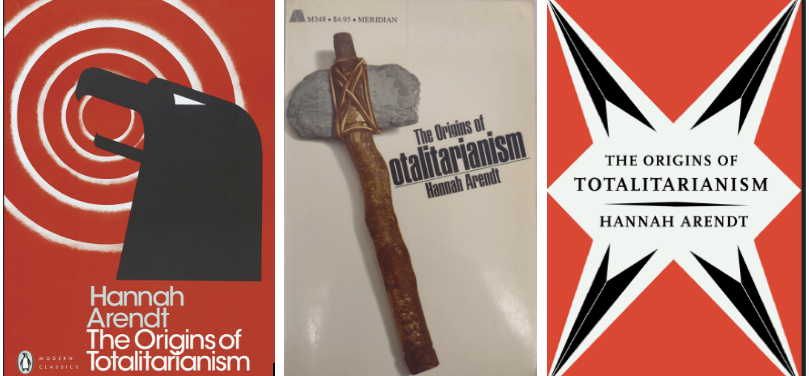
A classic work originally published in 1951; this edition has a forward by Ann Applebaum written in 1924.
I did not read the entire book in detail; in particular, I only skimmed the section on antisemetism. To me, the most interesting claim in the book is that totalitarianism owes much of its origins to colonialism/imperialsm. All that said, here is a summary of the main points of each of the three sections:
The Book
Antisemitism
Arendt argues that antisemitism is distinct from traditional anti-Jewish sentiment, and that it instead emerged from the breakdown of the nation-state system (meaning the emergence of groups of ‘stateless’ people in the wake of the breakup of Russian and the Austro-Hungarian empire, and the failure of existing states to protect basic human dignity and political membership, or even “the right to have rights”
The Dreyfus affair. The wrongful conviction and eventual exoneration of a military office suspected of treason; conviction was easy because he was jewish and unpopular. As evidence that contradicted his conviction accumulated, the affair became a political litmus test…
Arendt contends that antisemitism was weaponized by totalitarian movements to mobilize masses against the existing political order, making Jews a proxy for attacking the nation-state system itself. This is due to she argues to the influence Jews had through their financial services to the state, even while remaining politically neutral. (I would also argue that this role was facilitated by the fact that they would never be able to take or maintain power independently because of their social position).
Imperialism
- Imperialism as “expansion for expansion’s sake,” with an aim towards empire and global domination.
- Argues that European imperialism provided precedents/proving grounds for totalitarian methods of domination and bureaucratic control through colonial experiments.
- Formation of a transnational capitalistic class: analysis of how economic interests transcended national boundaries, creating new forms of political organization that prioritized capital accumulation over traditional state structures.
- Bureaucracy: Tyranny without a tyrant. “Arendt argues that bureaucracy as it developed in India, Egypt, and Algeria was a new form of government of foreign people that sought to rule and dominate them outside of legal restraints. As a non-legal government based on personal power, bureaucracy was intertwined with racism that justified the brutal colonial rule by European powers.”
- Also, the justification for bureaucrats is typically associated with their education and intelligence, thus creating a rift between the educated elite and the uneducated masses that, for Arendt, threatens to become the new racism.
Bureaucracy
- Tyranny without a tyrant
- Eliminating opportunities for citizen action and speech
- Frustration with unaccountable systems leads to violent responses
- Dehumanizing – reducing people to “cogs in the administrative machinery”
- Inscribing politics into administrative policy and mechanisms
Totalitarianism
Totalitarianism
Criteria
- Transnational: World domination as goal.
- Terror as a means to subjugate the masses rather than just political opponents
- Control via police rather than military.
- Domination of all spheres of life, not just political aspects.
- Use of a monolithic ideology as of an instrument of coercion.
- Creation of superfluous people.
- “Novel form of government” that “differs essentially from despotism, tyranny and dictatorship”
Preconditions
- Erasure of distinction between fact and fiction among the masses.
- Movements founded on a mass of isolated, lonely individuals.
Other forms of control
The crucial distinction is that these traditional forms maintain some structural limitations and pursue specific goals, while totalitarianism represents “a novel form of government” that “differs essentially from other forms of political oppression.
- Despotism (as opposed to Monarchy): A form of government in which a single entity rules with absolute power,” not subject to laws; dependent on the acquiescence of the people. May be benevolent or benign. Differs from monarchy in that the monarchy is subject to rules and laws, particularly with respect to who is eligible to rule.
- Tyranny: Control via mutual fear — government of people, people of government for own self-interest without any legal restraint.” Aristotle’s definition states: “Any sole ruler, who is not required to give an account of himself, and who rules over subjects all equal or superior to himself to suit his own interest and not theirs…”
- Dictatorship: Hierarchy of control using military means. Dictatorship ranges from constitutional (legitimate — temporary and subject to the rule of law) to unconstitutional (illegitimate—attained by usurpation and intended to be permanent).
Views: 14