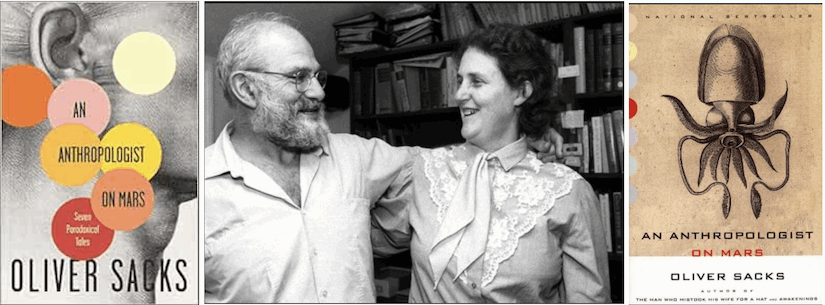
This book seems to focus on people with either acquired or inborn neurodivergences who have adapted to their situations and live, in a sense, in very different worlds from ours.
After reading: yes, this supposition is correct Most are leading successful, if different lives, except for ‘the last hippy’ of chapter 2.
Preface and Front Matter
I noticed that Sacks gives extensive acknowledgement to Kate Edgar, not just as an editor but a friend and collaborator; he also adds that she has given it impetus and shape. Looking back, he acknowledged her for friendship and collaborator for Seeing Voices as well. Before that, with Hat and Leg it is just as an editor.
He begins the preface with observations on how an operation on his right shoulder has altered his posture, gait, and daily actions, and how his body is — mostly unconscously — adapting. He suggests that adaptation follows different paths for each person, and cites Luria’s claim that the ability of the brain to adapt so radically suggests a very different conception of the nervous system as dynamic and creative. It may even, he argues, redefine the very concepts of “health” and “disease.”.
Thus while one may be horrified by the ravages of developmental disorder or disease, one may sometimes see them as creative too, for if they destroy particular paths, particular ways of doing things, they may force the nervous system into making other paths and ways, force on it an unexpected growth and evolution. This other side of development or disease is something I see, potentially, in almost every patient; and it is this, here, which I am especially concerned to descrabe.
— ibid. p xvi
C`1: The Case of the Colorblind Painter
The account of a successful artist who, as a result of an auto accident at 65, lost all ability to perceive color. The use of “colorblind” in the title is a bit of a misnomer, as what happened in the case is not a defect of cones, but rather a central deficit — cerebral achromatopsia – that seems far more acute than colorblindness.
- It was not just that colors were missing, but that what he could see, even white, had a distasteful, dirty appearance.
- He also not only lost his ability to see colors, but his ability to dream in color and even close his eyes and see color in his vivid visual imagery. Even his migraine, which used to involve colored patterns, were monochrome.
- Music was also impaired for him, because he used to experience it with synthesis involving colors, and that too was lacking.
- Yet “Mr. I” was aware that he had lost his color vision; this contrasts with other cases of blindness where patients are unaware that they are actually blind, as in Anton’s syndrome.
- He began painting again, in black and white, after seeing a sunrise that way and realizing that no one else had ever seen such a thing. Over the next few years his painting shifted and he appears to have adapted to his new visual world.
- The central part of the essay is a recapitulation of the scientific theorizing and understanding of color vision, from Gothe to Edwin Land.
- Recent work in the neuroanatomy of color vision suggests that “Mr. I.” had damaged V4 areas, and that what he was seeing was the result of the output from his V1 areas getting into his visual sensorium without being reprocessed by V4.
In this sense, he started to be redefined by what had happened to him-redefined physiologically, psychologically, aesthetically-and with this there came a transformation of values, so that the total otherness, the alienness of his VI world, which at first had such a quality of horror and night-mare, came to take on, for him, a strange fascination and beauty.
–ibid. p 35
- After adapting to what happened in his work, he also began to adapt in everyday life, which took the form of preferring to be out in the world at night, where the absence of color was more normal, and his enhanced night vision a strength.
- As time went on, it appears the “Mr. I.” began to lose his extensive knowledge/memory of color.
- Offered the possibility of a cure — a neuroscientist proposing that it might be possible to get another area of the brain to do what V4 used to do — he declined. He had begun to appreciate the new state of sensibility and being that he was experiencing as the consequence of the achromatopsia.
C2: The Last Hippy
The account of a man who, in the wake of an untreated and eventually huge brain tumor, lost some or all of his memory for events after 1968, and experienced a diminution of internal dialog/narrative/consciousness such that he really just lived in the present and reacted (lightly) to external events. Sacks suggests that his experience was like living in a dream, where normal inhibitions are extended and the intertwining of cognition with memory, identity and self awareness is mostly lost.
- William James: “The only radical remedy for dipsomania is religiomania.”
- “Greg” seemed unaware that he had any problems, including blindness and the inability to walk easily.
- He had no coherent memoirs past 1970, and spotty memories of the two years before that. And, in addition, he was unable to really register new experience and form new memories, although — like many amnesiacs — he was able, after long experience and repletion to develop a familiarity with the layout and routines of his hospital.
- While he was normally disconnected and different, though good humored and verbally playful, when he was asked about music, particularly the grateful dead, he became focused and animated and spoke about them in great detail, although it was clear that he believed his experience with them and their music was not long past.
- Sacks speculates that Greg may not have an inner life, “that he lacked the constant dialogue of past and presence, experience and meaning, which constitutes consciousness and inner life for the rest of us.“
- During his time a Williamsburg he had two special friendships. One person died, the other was transferred, and though he had no memory of the loss, his mother believes that he was at some level sad or depressed in their absence.
- Sacks suggests that implicit learning is due to different mechanisms than explicit learning.
- Oddly the essay repeats, a couple of times, that Tobacco Road is a Grateful Dead song — it is not.
C`3: A Surgeon’s Life
The chapter describes Carl Bennett, a surgeon with Tourette’s; it reprises the Sacksian them that Tourette’s fundamentally reshapes a person’s identity. While it is initially surprising to imagine a surgeon with tourette’s, Sacks notes that “we find people with … Tourette’s in all walks of life.”
Notes
- Sacks returns to his theme of a kinetic melody, the idea that a well-learned sequence of motor action — like driving, or singing, or, in this case, conducting surgery — and suppress (or switch the person out of) Tourettic behavior. Thus Bennet drove smoothly, until they entered town and traffic light interrupted the flow state of driving. “Most of the time when I’m operating, it never even crosses my mind that I have Tourette’s.”
- While the tendency to tic in Tourette’s is innate, the particular form of tic is highly personal. Tics may also shift over time; for example, Bennett becomes obsessed with different words, and may perseverate on one for months, and then take up a new one all of a sudden. Bennett notes that it is the sound and the rhythm of the words, and not their meanings, origins or associations the implant them in his mind. It is always the odd, the unusual, the caricaturable that catch the mind of the Touretter and tend to provoke elaboration and repetition.
- The sense of personal space — of the self and others — tends to be markedly altered in Tourette’s. Bennett will obsessively touch others (if they are within touching distance), and will also slowly mark out a circle around himself with his foot.
- In the mornings Bennett reads while peddling a stationary bike (and smoking) — the activity allows him to read without tics…
- Bennett appears to able to conduct surgery without tics; his interactions with patients do have tics — of almost touches — but apparently patients can cope. This almost-touching also occurs with relation to sterile/non-sterile items.
- Tourette’s patients can exhibit exceptinally fast and acurate motor actions, up to 6x faster.
The dark side of Tourette’s:
The real problems, the inner problems, are panic and rage-. feelings so violent that they threaten to overwhelm him, and so sudden that he has virtually no warning of their onset. He has only to get a parking ticket or see a police car, sometimes, for scenarios of violence to flash through his mind […] One part of him, uninvolved, can watch these scenes with detachment, but another part of him is taken over and impelled to action. He can prevent himself from giving way to outbursts in public, but the strain of controlling himself is severe and exhausting. At home, in private, he can let himself go — not at others but at inanimate objects around him. There was the wall I had seen, which he had often struck in his rage, and the refrigerator, at which he had flung virtually everything in the kitchen. In his office, he had kicked a hole in the wall and had had to put a plant in front to cover it; and in his study at home the cedar walls were covered with knife marks. “It’s not gentle,” he said to me. “You can see it as whimsical, funny-be tempted to romanticize it-but Tourette’s comes from deep down in the nervous system and the unconscious. It taps into the oldest, strongest feelings we have. Tourette’s is like an epilepsy in the subcortex; when it takes over, there’s just a thin line of control, a thin line of cortex, between you and it, between you and that raging storm, the blind force of the subcortex. One can see the charming things, the funny things, the creative side of Tourette’s, but there’s also that dark side. You have to fight it all your life.”
C4: To See and Not See
This recounts the case of Virgil, a man who was effectively blind from a very young age due to a combination of cataracts and retinal degeneration, who then had his cataracts removed and his vision partially restored in his fifties.
The gist of the story is that while he was able to perceive light and colors (with limited acuity), he could not initially make sense of what he saw. He is the empirical answer to Locke’s argument that a blind man who would could distinguish a sphere from a cube by touch, would not be able to distinguish them by vision if his sight was suddenly restored. The chapter recounts Virgil’s attempts to learn to see and to function as a sighted person — attempts that only achieved a meager success. In the end a period of illness appears to have damaged the (partially functioning) visual centers of his brain, and he effectively returned to blindness, with which he seemed more comfortable and competent.
Notes
- Although blind and reportedly rather passive, as he came of age Virgil graduated from school, moved away from home, and found a job with YMCA doing massage which provided him with a living and a house to live in.
- AT 50 he had an operation that removed his cataracts and gave him such vision as his damaged retinas could provide — he could see (but not identify) large forms and color and movement, though initially it was all a chaos.
- Virgil did not behave as a sighted person — e.g., he would not look at a person’s face when they were speaking, and he had difficult in maintaining a visual fix on faces or objects. He did not appear to spontaneously look at things; he only looked if directed.
- He was easily overwhelmed by a lot of visual stimulation (as one finds in a grocery store)
- He had difficulty connecting things he saw (e.g. hills, animals) with the same things he understood tactilely. Sometimes it seemed that he had to examine something by touch (e.g., a bronze of a gorilla) before he could properly identify its features visually. A touched square did not, to him, correspond to a visual square.
- He would pick up details — an angle, an edge, a color — but was not able to synthesize them into a unified construct. In this he reminded Sacks of his patient with visual agnosia (of the titular essay in Hat).
- Over the first months he worked to connected the appearance of familiar objects with what he knew from tactile experience, and gradually learned correspondences. Previously unfamiliar objects were much more difficult for him.
- In all of this, Virgil was similar to other blind-from-birth people who have had their sight restored.
- Brain systems in all animals may respond to overstimulation by shutting down…
- When V’s family first visited, they did not believe he could see, and Virgil reverted to acting blind; this quickly lifted when his family left.
- “One must die as a blind person to be born again as a seeing person.”
Almost all the earlier patients, indeed, after an initial period of euphoria, were overwhlemed by the difficulties of adapting to a new sense…
ibid., p 151
…reading break…
C`5: The Landscape of his Dreams
This is the story of Franco Mangani. The backstory is that he was born in Pontito, a small Italian hill town in Tuscany. He had a photographic memory, as did his mother and one sister. He could remember pages of text after only one reading, recite all the names on all the gravestones in the cemetery, and so on. When he was twelve he left home to go to school in a nearby town, and, homesick, he began having flashes of episodic memory, images that “”were involuntary and sudden, flashlike and imperative-hallucinatory, almost, in their sound, their texture, their smell, and their feel. This new kind of memory was, above all, experiential or autobio-graphical, for every image came with its proper personal context and affect. Each image was a scene, a flashback, from his life.”
At the time Sacks encountered Mangani, he was living in San Francisco and making his living as an artist. He painted pictures exclusively of his home town, Pontitio. He seemed obsessed, or perhaps possessed by the images. Sacks describes Mangani as giving the appearance of having a 3D high resolution model of Pontito in his head. He could rapidly create pictures of great detail and fidelity, sometimes from points of view located in the air over the town. Each image was loaded with personal associations, and also multi-sensory details like sounds and smells.
His house was full of his paintings; they were on all the walls, and the filled drawers and cupboards as well. As he and Sacks walked around, a painting would trigger a recollection. “Each reminiscence triggered others, and these still others, so that within minutes we were engulfed in a food, without any clear direction or center, but all relating to his early life-to Pontito as he had experienced it as a child. He leapt from one story to another, without any connection that I could discern. This sort of rambling-single-minded and intense but incoherent and unfocused seemed characteristic of Franco…“ (p 155)
As Franco talked, I had the impression that his reminiscences were taking him over, that these upsurging memories drove him, dominated him, exerted a huge, irresistible force. He would gesture; he would mime; he would breathe heav-ily; he would glare he seemed to be completely transported. Then, with a start, he would come back, smile a little embarrassedly, and say, “That’s how it was.”
[…]
When he was alone, he said, the yammer and clatter of memories would die down, and he would get a calm impression of Pontito: a Pontito without people, without incidents, without temporality; a Pontito at peace, suspended in a timeless “once,” the “once” of allegory, fantasy, myth, and fairy tale.ibid. 155
How did Mangani get to this state? It’s not clear. Obviously, he had a prodigious memory from his childhood, and was, early on, developed something of an obsession with it after he went away for school. As he grew older, he made other trips away — for school and then for work. One important event was WWII: The Nazis took over Pontito and damaged many of the buildings, and the town went into decline. As he moved into adulthood, it is clear that Pontito was dying, and he went elsewhere to work. At around 30 he decided to leave Italy and traveled extensively for several years, finally settling in San Francisco. But at this point he was overtaken by an illness with high fever, weight loss, delirium and a suggestion of psychosis or some other neurological condition. At this point, and as he recovered, he began dreaming of Pontito every night, and seeing imagery of the town even when he was awake, sort of superimposed on every day reality. He felt called to paint the images, and his obsession with Pontito dates to this time.
Sacks connects Mangani’s experience with patients who have temporal lobe epilepsy, who seem to have a hyperconnection between the sensory and emotional areas of the brain. Other examples of people with TLE include Van Gough, Dostoyevsky, Proust, P. K. Dick — they often experience a sort of doubling of conscousness due to a hypermnesia, and are, to a degree, taken over by their memories.
An unusual and interesting aspect of this account is that Mangani was able to return to Pontito a couple of times. He almost didn’t go, but did. Then he found it confusing — he was dismayed by how it had changed, but at other times found it beautiful. It derailed his painting for a while, but then he overcame that and the visit infused him with new energy.
G.K. Chesterton: “The is at the back of every artist’s mind something like a pattern or a type of architecture. It is a thing like the landscape of his dreams; the sort of world he would wish to make or in which he would wish to wander; the strange flora and fauna of his own secret planet. This general atmosphere, and pattern or a structure of growth, governs all his creations, however varied..”
I wondered, while reading this chapter, if there is a sort of a flavor of Tourette’s and Magani’s behavior, in its impulsiveness and in its connection to emotion and social context.
C`6: Prodigies
This chapter begins with accounts of various prodigies and savants. It is interesting because of the diverse forms that savantism can take: music composition; performance; mathematics; calculation (numbers; dates) drawing and painting (often focused on particular subjects or genres); acrobatic and athletic savants; tactile and olfactory savants.
Savantism is 200x more common in autistic people than in retarded people, and thousands of times more common than in ordinary people. It also notes common characteristics of autistic people: aloneness; unawareness of others and social behavior; obsessiveness; abnormal (or no) development of skill.
The rest of the chapter primarily focuses on Stephen Wiltshire, an autistic child who showed early savant-like abilities at drawing buildings. (Sacks occasionally contrasts him with Joey, the “autist artist” described in Hat, who has not had the recognition, support, and education that Stephen has). It is interesting to note that after being discovered and receiving years of support and education, Stephen has showed some development in terms of rudimentary language and social interaction.
Some points of interest:
- Stephen’s abilities to interact change over time: sometimes he is animated and interactive; other times he is regressed and acts like an automaton.
- Later he manifested musical abilities, and when he performs he seems to lose all his autistic characteristics for the duration of his performance.
- When he draws something — such as Sacks’ house — he does not reproduce it precisely, but may add or remove elements, though he still captures the gist of what he is depicting.
- Savant abilities can vanish suddenly.
- A claim is that in ordinary people talents and abilities become integrated with one another and with a person’s emotions and experience, whereas those with autism the skill is really more freestanding.
- When Stephen draws he does not devote much attention to it — he can talk, look at other things, etc. This is true of most savants who are exercising their abilities.
C`57: An Anthropologist on Mars
This chapter is about autism; it primarily focuses on a weekend Sacks spend with Temple Grandin.
About autism, gemerally:
- The two neurologists who described it, almost simultaneously, in `the 1940s, had differing views:
- Kanter’ view of autism was that it was an unmitigated disaster. Motor: tics; difficulty initiating; coordination. Paradoxical sensorium; linguistics difficulties.
- Asperger’s view of autism was that autists were often of normal or superior intelligence, and that it had some compensating attributes: hyper focus/preoccupation, though combined with social isolation. .
- Claim that the basic characteristic of autism is tripartite of impairments: social interaction; language/communication; play and imaginative activities . And that all this stems from the autist having no ‘theory of mind,’ and thus no concept of social presentation/ interaction.
- There is no doubt that a disposition towards autism is biological, and sometimes even genetic. It can also, however, be acquired, as is the case of children whose mothers had rubella during pregnancy.
- There are a huge variety of interventions and accommodations that may help autistic people, but also a huge diversity in what actually helps an individual.
Temple Grandin
- TG’s autism manifested at 6 months (stiffening in her mother’s arms) and became increasingly severe and dysfunctional in her first few years: screaming, rages, aversion to contact, sensory overload. Also exhibited intense interest in odors, and developed ability to concentrate intensely.
- When TG was 3 her family sent her to a special school that provided her with speech therapy, and somehow the therapist got through to her and helped her acquire speech. By the time she was 6 she was able to communicate, and with the help of her mother and aunt and sympathetic teachers she continued to make progress, even developing some facility with imagination and play.
- TG seems to operate on episodic scripts: directions must be delivered as a whole — she cannot go back and repeat one part of it. Similarly she speaks in full sentences and paragraphs that must be completed; she can not go back and extract a segment.
- TG says she can understand simple strong emotions like anger, but that the subtle interplay and exchange of social cues elude her. She comments that this emerges in children as young as 3 or 4, and that she cannot understand them.
- TG says that her work — either designing animal handling facilities or lecturing about autism — is her life. She appears, as an adult, to have developed a couple of friendships, but it sounds like almost all relationships are about work.
- In her adolescence she was intrigued by the design of a squeeze chute for cattle, and designed a squeeze machine for herself. A sympathetic science teacher took her seriously and helped her build it, and it did wonders for her, giving her a sense of calmness and pleasure. She credits it with making it possible for her to get through college. (Sacks tried her machine, and also found it calming.)
- As an adult she takes an antidepressant, and although it decreases some of her obsessive looping, she comments that if she had been prescribed it as an adolescent she would not have been able to go through college and start her career. An interesting dilemma — make someone more comfortable in daily life at the cost of removing their ability to be a high achiever?
- TG reports that music or scenery fails to move her — she can find them “pretty,” but that’s about it. They do not seem to evoke any strongly felt states of mind. She also claims that she does not have any repressed memories or experiences — that she does not associate pain or trauma with them.
- TG claims to intuit how cattle sense the world — it is a very sensory, emotion-first way of seeing and hearing — and this is what helps her (along with her prodigious powers of visualization and concentration) design her animal handling facilities.
- TG had no sense that she could draw or make blueprints until, at 28, she met a draughtsman and watched him. She went and got exactly the same instruments he had, and then pretended she was him, and was then able to produce her own blueprints.
- Once TG has a design — which she’s developed by running ‘simmulations’ in her head, she can draw it without paying special attention — very similar to the way Stephen Wiltshire, the autist artist, produces his drawings.
- Sacks describes an instance during his visit where TG constructed a subterfuge that would allow Sacks to tour a cattle handling facility — she got him a yellow hard hat and told him to act like a sanitation engineer. This certainly seems to suggest that TG does have a theory of mind, at least a rudimentary one.
Other - On pages 276-277 Sacks describes “the B’s,” a family where the husband, wife and child are all autistic. But they have learned to provide social surfaces to the world that allow them to function; while in private they all jump on a trampoline, flap their hands, and scream.
- Sacks mentions the case of a judge who, due to trauma, lost his ability to feel emotion, and resigned, saying that he could no longer enter sympathetically into the motives of people being tried, and that since justice involved both thinking and feeling, rather than just thinking, he did not feel fit to continue serving.
# # #
Views: 34