October 2025
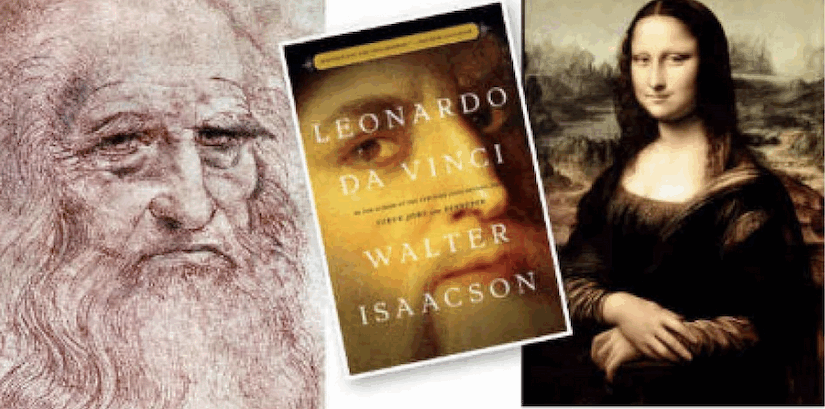
About the Book
Reading this with NS & DO, a subset of the 26 minute book group. As I begin, I find myself a little hesitant about a biography written about someone 400+ years ago, where there is presumably a scarcity of 1st hand accounts. But certainly his very detailed notebooks will help…
Later: And the notes do, indeed, help, although the undated nature of the notes, and the fact that they have been remixed over the ensuing centuries makes them less effective as a chronological record. Still, I’m learning a lot about Leonardo, his approach to life and innovation, and his accomplishments.
The Book
INTRODUCTION – I Can Also Paint
The introduction offers a general description of Leonardo as a man who blended art and science and who, in fact, probably did not distinguish. It suggests that we have much to learn from Leonardo in that “Leonardo’s genius was a human one, wrought by his own will and ambition,” in contrast to those who seem to have prodigious cognitive powers. Certainly, he left profuse documentation of his curiosity and his reliance on observation and analysis of the natural world to fuel his creativity and inventiveness. Leonardo: “He who can go to the fountain does not go to the water jar.“
The rest of the introduction discusses sources — three early accounts — and offers some suppositions about Leonardo’s personality.
C1 – Childhood
- Born in 1452. Leonardo was illegitimate, but while that blocked him from some things (belonging to the notary guild like his father, Piero, grandfather and so on), it was not a huge social disadvantage. Isaacson makes the case that it was an advantage in that it allowed him to avoid Latin school’s scholastic approach to knowledge and training to become a notary.
- Leonardo was acknowledged by his father and received a public baptism; he and his mother were supported by his father (though he married her off to someone else and she had more children). His father had no other children until Leonardo was 25.
- By five Leonardo was primarily living in the Da Vinci family house, primarily with his grandfather Antonio and his uncle, Francesco, who was only 15 years older than Leonardo.
- This was a good time to be an artist and innovator: In 1452 Florence was beginning a 40 year period without war, and the rising middle class of merchants and bankers were increasingly prosperous and seeking ways to show that through patronage of art and public events. There was also an influx of scholars and others fleeing the fall of Constantinople.
C2 – Apprentice
- At 12, Leonardo’s grandfather and step mother died, and so his father brought him to Florence. There Piero arranged for Leonardo to get a rudimentary education at abacus school (which would have taught him analogical reasoning), and subsequently would help him get an apprenticeship with the artist Verrocchio, one of his father’s clients, as well as assisting him in getting his first commissions.
- Predilections. By this time, according to early accounts, Leonardo was avidly drawing and sculpting.
- Florence was a hotbed of creativity, with large numbers of artists finding employment in producing objects for the burgeoning middle class to display their status: clothing, sculpture, painting, buildings, and more emphemeral materials for sponsored entertainments and spectacles.
- Brunelleschi and Alberti preceded Leonardo. The advanced ideas and understanding of perspective, and had paved the way for large scale architecture and art that made use of engineering and scientific principles and devices. Brunelleschi died before Leonardo was born, but his famous cathedral dome lived on. Likewise Alberti modeled the melding of art, architecture, writing and engineering, as well as providing a model of someone with a distinctive and public style.
- Verrocchio. At 14 Leonardo began his apprenticeship with Verrocchio:
Verrocchio conducted a rigorous teaching program that involved studying surface anatomy, mechanics, drawing techniques, and the effects of light and shade on material such as draperies.
[…]
An inventory of his [Verrocchio’s] shop showed that it had a dining table, beds, a globe, and a variety of books in Ital-ian, including translated classical poetry by Petrarch and Ovid as well as humorous short stories by the fourteenth-century popular Florentine writer Franco Sacchetti. The topics of discussion in his shop included math, anatomy, dissection, antiquities, music, and philoso-phy. “He applied himself to the sciences, and particularly geometry,” according to Vasari.– ibid., 33
- Verrocchio’s workshop seems like it was a great environment for Leonardo. In addition, Verrocchio focused on things that Leonardo was to pick up carry farther. This includes the depiction of movement in painting and sculpture, and the depiction of bodies with twists and turns and flows, often in three quarter view.
- In 1471 Verriucchio’s studio was given the commission of mounting a two-ton copper orb on Brunelleschi’s dome, and the creation of the orb, and the mechanisms for hoisting and mounting it fascinated Leonardo, who still referred to them in his notebooks decades later.
There were no welding torches at the time, so the triangular sheets of copper had to be soldered together using concave mirrors, about three feet wide, that would concentrate sunlight into a point of intense heat. An understanding of geometry was needed to calculate the precise angle of the rays and grind the curve of the mirrors accordingly. Leonardo became mesmerized—at times obsessed—by what he called “fire mirrors”; over the years he would make almost two hundred drawings in his notebooks that show how to make concave mirrors that will focus light rays from varying angles.
—ibid., 38
- Leonardo also showed a predilection for assembling physical models to guide his painting and other art. His first commission involved painting a fanciful creature on a shield, but rather than using his imagination, he created a model using parts from “real lizards, crickets, snakes, butterflies, grasshoppers, and bats.” Similarly, Leondardo would make models of figures, drapping them in cloths soaked with plaster, as models to draw from for studies of draperies.
- Chiascuro and sfumato. L developed his own technique for doing chiaroscuro by adding black pigments to a color, rather than making it more saturated. L also pioneered sfumato, the technique of blurring the edges or contours of an object, in the way that smoke vanishes into the air.
- Theatrical props and mechanisms. Isaacson argues that many of the inventions in Leonardo’s notebooks are intended as theatrical props – e.g., the helicopter deploying a “screw,” – rather than practical devices. This is an interesting instance where there is a public demand for objects that blend practical reality with fancy.
- Early paintings and stylistic characteristics. The rest of this chapter examines Leonardo’s early paintings (and collaborations) and look at characteristics of his style that emerged. These include great attention to landscapes (e.g., the morphology of bedrock) and flowing water, his love of spirals and curls (in hair, flowing water, etc.), and his use of his finger to blur painted lines and create sfumato. A good painting to look at closely is The Baptism of Christ, by Verrocchio (but in which Leonardo collaborated).
…reading break…
C3 – On His Own
- On his own at 25. Leonardo continued to live and work in Verrocchio’s workshop until he was about 25. This was unusually long….
- Gay. Leonardo was gay, and he was accused of sodomy at least twice, but witnesses did not come forward. Although a considered a grave sin, being gay was not unusual in Leonardo’s circle, and he did not appear conflicted about it. He had a series of (much) younger presumed lovers in his retinue for most of his life.
- Unfinished commissions. Leonardo took on commissions — often facilitated by his father — when he went out on his own, but was very bad about finishing them. These included the painting, “The Adoration of the Magi,” and that of “St Jerome.” Leonardo was focused on trying to create paintings that told psychological stories, with attitudes and emotions being conveyed by expressions, gestures and poses. Leonardo: “Movements of the soul are made known by movements of the body.“
- Perfectionism. Isaacson suggests that Leonardo was a perfectionist, and that he held onto (and delayed) paintings because not all the details were right. For example, the painting of St. Jerome had an anatomically correct neck muscle added a couple of decades after the original was (mostly) done.
C4 – Milan
- In 1482, at 20, Leonardo left Florence for Milan. Milan was a considerably larger city, and ruled over by Ludovicio Sforza, whose father had seized power, and was busy establishing his family’s legitimacy by commissioning art and entertainments.
- Delegation to Milan. Leonardo arrived as a member of a delegation sent by Lorenzo de Medici to the Duke of Milan. It is unclear to me how Leonardo got this position, as he had not been successful in getting patronage from the Medici’s. He came bearing a silver lute, which he apparently designed and crafted; there is an indication that he could play it [although perhaps the text referred to Sforza as playing it, it is unclear], though nothing has been said about his musical ability.
- Letter to Sforza – war machines. After his arrival in Milan he sent a letter to Sforza in which he claimed to be an unequalled designer of weapons and military equipment. This included siege engines, defensive mechanisms, bridges, a giant cross bow, an armored chariot, a steam canon, and other devices — many of which were elaborations and improvements of the designs of others. It is not clear, from the book, what the result of this letter was. The only thing L is known to deliver to Sforza was a survey of Milan’s defenses.
- The Wheellock. The only military invention of L’s that was realized was the wheel lock, a spring loaded wheel that struck sparks to ignite gunpowder. This was made and widely adopted, though in Germany rather than in Milan.
- Utopian City. At this time L also proposed a design for bi-level cities, a lower level for infrastructure, including sewage and water, and an upper level for living, walking, and beauty.
C5 – Leonardo’s Notebooks
- Leonardo began his practice of keeping regular notebooks with notes and sketches — called zibaldones at around 30. This was a popular practice in renaissance Italy.
- L’s notebooks, after his death, were often disassembled and re-assembled. This, combined with their lack of dates (and his habit of going back and adding to particular sketches and pages over the years), make chronology difficult to establish.
- Leonardo’s notebooks seem to evolve from a focus on practical solutions to broader notes that include trying to understand the ‘why’s’ of things.
C6 – Court Entertainer
- Leonardo went to Milan bearing a special lute that he had designed and crafted; he was also said to be a gifted musician who played and sang improvisations.
- L achieved success at Sforza’s court by designing plays and spectacles, with fantastic narratives and special effects created by special mechanisms he designed. Isaacson speculates that this type of work was important because, with the deadline imposed by the entertainment, L could not abandon or delay his work. Histories of the time record multiple works that L created and produced to great acclaim.
- L liked to create grotesques, exaggerated faces that showed extremes of emotion, often taken to a ludicrous end. Some of these were used by Tenniel, the original illustrator of Lewis Carroll’s Alice books (e.g., the dutchess).
- Fables, bestiaries, ‘prophesies.’ Leonardo produced short literary works as well, including fables, bestiaries, ‘prophesies,’ puns and things kind of like fantasy novellas.
…reading break…
C7 – Personal Life
C8 – Vitruvian Man
C9- The Horse Monument
C10 – Scientist
C11 – Birds and Flight
C12 – The Mechanical Arts
C13 – Math
C14 – Virgin of the Rocks
C15 – The Milan Portraits
C16 – The Science of Art
C17 – The Last Supper
C18 – Personal Turmoil
C19 – Florence Again
C20 – Saint Anne 315
C21 – Paintings Lost and Found
C22 – Cesare Borgia
C23 – CHAPTER 24 Hydraulic Engineer
C24 – CHAPTER 25 Michelangelo and the Lost Battles
C25 CHAPTER 26 Return to Milan
C26 – CHAPTER 27 Anatomy, Round Two
C27 – CHAPTER 28 The World and Its Waters
C28 – Rome
C29 – Pointing the Way
C30 – The Mona Lisa
C31 – France
C32 – Conclusio
CODA – Describe the tongue of the woodpecker
Views: 12