The City & the City, China Mieville

I read this for the Fall 2025 Science Fiction and Fantasy course I took at the U of MN.

I was not enthralled by this book. In fact, at about the halfway point, I misplaced it and did not finish it. I still haven’t found it, though no doubt it will turn up somewhere.

[Spoiler follows]

The City & the City is a competent murder mystery, but with the fantastical twist that the City is a place where an analog of the City in a parallel universe is partially visible and sometimes accessible. Inhabitants of the City have trained themselves to not see traces of the parallel city – if they give it too much attention something will happen — a mysterious force or set of police or something – will appear and remove everyone who was implicated or involved in noticing/acting in the parallel world. Yet, in spite of this, or perhaps because of it, there is an officially managed gateway between the two versions of the City, though much bureaucracy is involved in moving from one side to another.

The murder which drives the plot — well, at least the plot for the half of the book I’ve read — appears to have been committed in the parallel city, and then the body deposited in the other city. This brings police from both ‘sides’ together to investigate what happened. That had just begun to happen when I lost the book…

While it’s an interesting set up, and while the writing is well done, I found (as is often the case) that I don’t really care for the protagonists. There’s one chief detective (or maybe he’s an inspector) and he’s gotten a younger colleague involved to assist him — but he seems to have no life other than work, and no real friends. The most emotional life he shows has to do with his colleague, but even there it is pretty sparse (though perhaps something richer will develop as the book proceeds).

While I finish the book when I find it again? I’m not sure… I don’t find that I care very much or feel very curious.

# # #

Views: 11
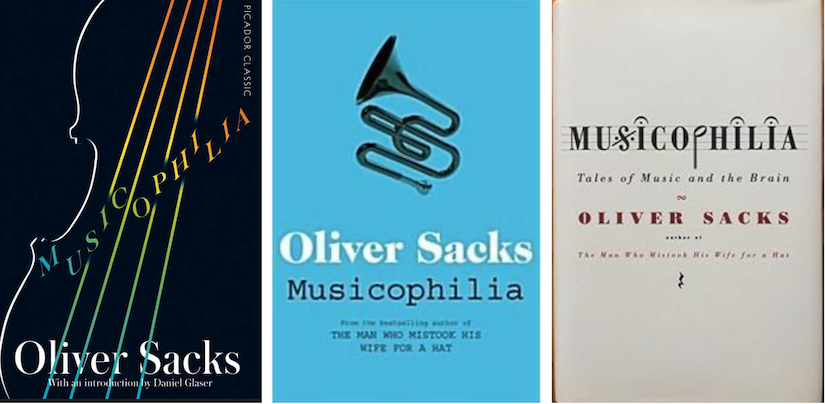
Musicophilia, Oliver Sacks

EP#24: Musicophilia: Tales of Music and the Brain, Oliver Sacks, 2007

November 2025 – February 2026

This is the 24th entry in the Essays Project. We continue on our quest to read the complete Sacks oeuvre. 

Afterwards: There were essays in this that I enjoyed, but overall the book seemed lacking to me. That’s especially true of the first half. I can’t really put my finger on what is missing, although perhaps it had to do with Sack often reporting on the what other neurologists had learned of other patients with cases similar to those of Sack’s patients…

Preface

It is a bit of a mystery why humans appreciate music. Darwin remarked on this in The Descent of Man, as have subsequent neurologists and psychologists such as Pinker. Pinker and others argue that our musical powers are a consequence of recruiting neurological systems developed for other purposes and that music has, in the words of William James, entered our mind by “the back stairs.

Yet music is found in all cultures and, with a very few exceptions, all humans can perceive tones, timbre, pitch, intervals, melodies, harmony, and rhythm. Music, as well, seems to have a deep conection and resonance with emotions.

Our auditory systems, our nervous systems, are indeed exquisitely tuned for music. How much this is due to the intrinsic characteristics of music itself-its complex sonic patterns woven in time, its logic, its momentum, its unbreakable sequences, its insistent rhythms and repetitions, the mysterious way in which it embodies emotion and “will”-and how much to special resonances, synchronizations, oscillations, mutual excitations, or feedbacks in the immensely complex, multilevel neural circuitry that underlies musical perception and replay, we do not yet know. 

ibid. xii

To me, it seems evident that music is a means by which humans bond with one another, and strengthen connections within a community. I think back to Putnam’s observation that the best predictor of the economic success of towns in Italy was whether they had a chorale society, music being a way, as he saw it, to create social capital. It seems odd to me that Sacks (and others he cites) do not appear to pick up on this.

Continue reading Musicophilia, Oliver Sacks

Views: 30