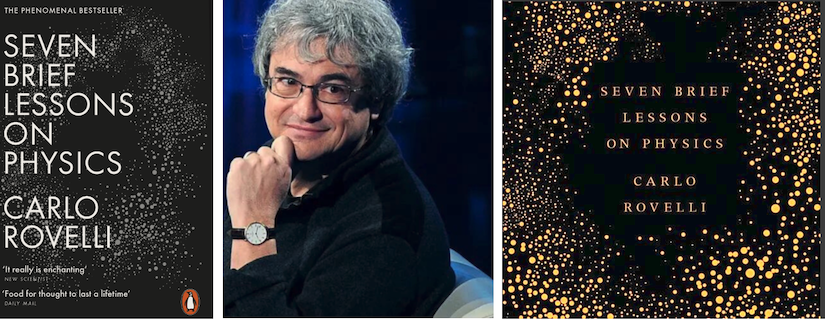
I’m not sure how I came across this book or even why it attracted me. I think that — wherever I encountered it — there must have been a description that mentioned simple but lyrical expositions of key ideas in Physics.
So, far, after having read the first two chapters, I’m liking it very much.
…And now, having completed it, I enjoyed it very much. While a few concepts, particular the issue of time, remain cloudy, over all I understand a lot more about the ‘shape’ of modern physics, and the current frontiers and challenges being addressed. I highly recommend the book.
Nice Phrases
Rossi writes beautifully. A few of my favorite bits are below (and more in the chapter-by-chapter notes). I particularly appreciate the metaphor of a befogged landscape for capturing the state of our collective knowledge. And I liked that he put questions in the readers’ mouths, and then moved to answers. And also the way, below, that he used the imagined perplexity of a student to call out the differing perspectives different theories offer on the nature of reality. All of these are worth trying to imitate.
- Ever since we discovered that the earth’s round and turns like a mad spinning top we have understood that reality is not as it appears to us.
- Two theories, profligate in their gifts…
- Here, in the vanguard, beyond the borders of knowledge, science becomes even more beautiful – incandescent in the forge of nascent ideas, of intuitions, of attempts. Of roads taken and then abandoned, of enthusiasms. In the effort to imagine what has/ not yet been imagined. … Twenty years ago the fog was dense. Today paths f have appeared.
- The question is legitimate; the answer to it is subtle.
- A university student attending lectures on general relativity in the morning and others on quantum mechanics in the afternoon might be forgiven for concluding that his professors are fools, or have neglected to communicate with each other for at least a century. In the morning the world is curved space where everything is continuous; in the afternoon it is a flat space where quanta of energy leap.
- Within the immense ocean of galaxies and stars we are in a remote corner; amidst the infinite arabesques of forms which constitute reality we are merely a flourish among innumerably many such flourishes.
- The separation is a subtle one: the antelope hunted at dawn is not far removed from the antelope deity in that night’s storytelling. / The border is porous. Myths nourish science, and science nourishes myth. But the value of knowledge remains. If we find the antelope we can eat.
The Book
FIRST LESSON: The Most Beautiful of Theories
- Einstein: His 3 papers in 1905: One showed that atoms really exist. The second laid the foundations for quantum mechanics. The third was special relativity.
- But he was disturbed that Special Relativity did not align with what was known about gravity. He worked on the problem for 10 years, and produced General Relativity, which is what his lesson is on.
- “Undistracted by schooling, one studies best during vacations.”
- One thing that this lesson does is he sometimes steps back and talks about his own experience — in this case, he writes about when he first started to understand General Relativity and how it made him feel.
Every so often I would raise my eyes from the book and look at the glittering sea: it seemed to me that I was actually seeing the curvature of space and time imagined by Einstein. As if by magic: as if a friend was whispering into my ear an extraordinary hidden truth, suddenly raising the veil of reality to disclose a simpler, deeper order. Ever since we discovered that the Earth is round and turns like a mad spinning-top we have understood that reality is not as it appears to us: every time we glimpse a new aspect of it, it is a deeply emotional experience. Another veil has fallen.
But amongst the numerous leaps forward in our understanding that have succeeded each other over the course of history, Einstein’s is perhaps un-equalled. Why?
—ibid. 4
- Newton imagined gravity as a force that acted between two objects separated by distance in “space.” But he did not say what “space” was. After Newton, Faraday and Maxwell had cone up with the concept of the electromagnetic field, which fills space. Based on this, Einstein thought about gravity as a field… his insight was the gravity is space — or more precisely, the curvature of space:
It’s a moment of enlightenment. A momentous simplification of the world: space is no longer something distinct from matter, it is one of the ‘material’ components of the world. An entity that undulates, flexes, curves, twists. We are not contained within an invisible rigid infrastructure: we are immersed in a gigantic flexible snail-shell. The sun bends space around itself and the Earth does not turn around it because of a mysterious force but because it is racing directly in a space which inclines, like a marble that rolls in a funnel. There are no mysterious forces generated at the centre of the funnel; it is the curved nature of the walls which causes the marble to roll. Planets circle around the sun, and things fall, because space curves.
—ibid. 6
- Einstein embodied this insight using Riemian geometry as the basis for an equation:
Rab – 1/2 RGab = Tab- The theory has astonishing predictive power:
- Describes how space bends around a star, and that even light stops moving in a straight line
- Describes how time passes at different speeds at different points in space
- Describes how, when a star burns out, it collapses and forms a black hole
- Describes how the universe — that curved material entity that is space itself — exands and contracts, and predicts the expansion of space
- Describes how (gravitational( waves move through space.
SECOND LESSON: Quanta
- 1900: Max Planc assumes that the energy of an electric field is distributed as “packets,” so as to make a calculation possible.
- 1905: Einstein proposes that this is not just a trick for calculation, but that energy (light) really exists as quanta, localized at points in space, which move without dividing, and which can only be absorbed and radiated as complete units. We now call quanta of light “photons.”
- In the 1920’s and 30’s Niels Bohr and others at his lab in Copenhagen took this farther. Bohr understood that the energy of electrons in atoms could only take on certain values and discontinuously jumped between energy levels (quantum leaps), emitting or absorbing a photon during these jumps. In 1925 Bohr and his colleagues released equations that entirely replaced Newtonian mechanics. The entire periodic table can be generated as a set of solutions to the main equation of quantum mechanics.
- Werner Heisenberg was the first (?) to produce these equations (all of them?). He imagined that electrons do not always exist — they only exist when they are observed, or more generally, interact with something else.
- Einstein was never convinced of the objective reality of quantum mechanics — for the rest of his life he and Bohr debated QM…
- QM does describes only how one physical system interacts with another; it does not describe what happens to the system. Yet, QM is exceedingly useful in physics, materials science, biology, and so forth.
THIRD LESSON: The Architecture of the Cosmos 21
This chapter goes through our changing conceptions of the universe:
- (Flat) earth below, sky above.,
- Earth is an object surrounded by sky (Anaximander, circa 600 BC)
- Earth is a sphere surrounded by sky (Paramenides or Pythagoras, circa 500 BC), and so is the space around it and the objects therein (Aristotle, circa 300 BC)
- The sun is in the center of the solar system; the earth is one of many planets that orbits abound it (Copernicus, circa 154x CE)
- Solar system is part of a galaxy
- Our galaxy is one of billions (circa 1930)
- Universe originated from big bang…
FOURTH LESSON: Particles
- Protons and neutrons are made of quarks bound together by gluons.
- Light and matter as we know it consists of quarks, gluons, electrons and photons.
- There are other particles in addition, though not more than 10. These include neutrinos and the Higgs boson.
- These ‘particles’ are quanta of various fields; they disappear and reappear, and exist only as interactions, rather than continuously.
Even if we observe a small empty region of space, in which there are no atoms, we still detect a minute swarming of these particles. There is no such thing as a real void, one that is completely empty. … the fields that form the world are subject to minute fluctuations, and it is possible to imagine its basic particles having brief and ephemeral existences, continually created and destroyed by these movements. This is the world described by quantum mechanics and particle theory.
—ibid., 30-31
- This — the particles and their interactions — is called “the standard model,” and in many ways it seems arbitrary and kludged together. Its equations lead to absurd results unless their parameters are made infinitely large — this is referred to as “renormalization.”
- In addition, there appears to be “dark matter,” something that exerts gravitational pull on stars and galaxies, but cannot be seen. It cannot be something described by the standard model.
- Other theories have been invented, SU5 (string theory) and more recently supersymmetry, but attempts at confirmation of their empirical predictions have failed.
FIFTH LESSON: Grains of Space
- The two principal theories of the twentieth century – general relativity and quantum mechanics – are profligate in their gifts, and have created the foundations of our science and technology.
- But they contradict one another. In general relativity space is curved and continuous; in quantum mechanics it is flat and continuity is an illusion, with particles existing only when they interact, and not in between.
- Many past theories have emerged out of combining and reconciling seemingly disparate theories: Newtonian gravity from Galilean parabolas and Keplerian ellipses; Maxwell’s equations from electricity and magnetism; Einstein’s relativity by reconciling an apparent contradiction between mechanics and electromagnetism.
- Quantum Gravity, or Loop Quantum Gravity, is an attempt to reconcile quantum mechanics and general relativity. It posits that space itself is quantized, made of tiny — a billion billion times smaller than an atom — grains of space conceptualized as interconnected loops.
- Loop Quantum Gravity has two consequences: Space is produced by the linking of the loops; and time does not exist — that is, time does not appear in the variables that described quantum loops and their behavior. There is no longer space that contains the world, nor is there time within which events happen.
- One approach to trying to verify Loop Quantum Gravity has to do with observing the results of Black Hole collapse. The final stage of the life of a star where it has collapsed into a black hole and beyond to a point where its mass is balanced by the quantum fluctuations of space-time is called a Planck star, a state in which a start the size of our sun would be no larger than an atom. This state, a Planck star, is unstable, and it should begin to expand again in an explosion. To an observer sitting on a planck star, the explosion should be very fast; to an observer elsewhere it would be very slow. Experimental verification of LQG involves looking for radiation produced by the explosion of early black holes.
Here, in the vanguard, beyond the borders of knowledge, science becomes even more beautiful – incandescent in the forge of nascentideas, of intuitions, of attempts. Of roads taken and then abandoned, of enthusiasms. In the effort to imagine what has/ not yet been imagined. … Twenty years ago the fog was dense. Today paths f have appeared
—ibid., p 39
SIXTH LESSON: Probability, Time and the Heat of Black Holes
- Maxwell and Boltzmann: the heat of a substance has to do with the motion (vibration) of its atoms and molecules.
- A fundamental aspect of heat is that it moves from hotter substances to colder substances, and never the reverse. That is, phenomena involving heat indicate the direction of time; phenomena that do not, such as the motion of planets, are said to be reversible: their motions could equally occur in reverse without any violation of physical law. But heat related phenomena have time as an inherent component.
- Why does heat move from hot substances to cold ones? Blotzmann’s insight was that it is simply due to probability. The likelihood of a fast moving atom or molecule bumping into a slower moving one and transferring some of its energy is greater than the reverse. (This would seem to assume that when a collision occurs, the same proportion of a atom or molecules vibration is transferred)
- Rossi argues that probability is, in a way, a function of our ignorance. That we talk about probability because we, as sentient beings, cannot interact with all the variables that determine the behavior of something. I understand the point, but unsure if it has implications for my understanding of probability.
- The concept of time is problematic. Consider “here” and “now.” Both are dependent on the circumstances of their utterance. However, whereas we would not think of saying that things that are not here do not exist, we are quite comfortable saying that things that are not “now” do not exist — they are past or future. I think the implication is that past, present and future, at least if we want to be consistent, should be regarded as all as a single entity.
- Towards the end of this chapter I find my understanding grows increasingly fuzzy,.
IN CLOSING: Ourselves
I thought the final chapter was poetic, but it seemed more to assert a particular perspective than to make an argument establishing its validity.
# # #
Views: 10