February 2026
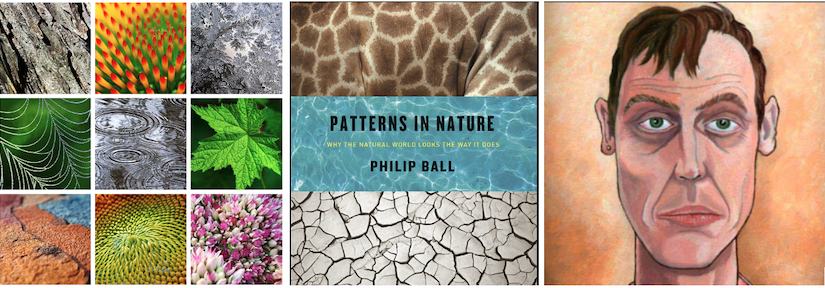
Patterns in Nature: Why the Natural World Looks the Way It Does, Philip Ball, 2016
About the Book
My pick for the first round of reading for the club for 2026. I’m obsessed with patterns, and this book has 250 beautiful photos. Whether it will go deep enough to teach me some new things is another question, but even if not it should be a pleasant read.
The Book
Introduction
- In 1917 D’Arcy Wentworth Thompson published On Growth and Form. One of his aims was to counter the tendency to ascribe all patterns to evolution, to assert that they were all products of adaptation and natural selection. Instead, he argues, that often patterns simply arise from physical forces.
- Patterns are often (always?) produced via growth.
… it does make many patterns variations on a theme, and reflects the fact that they often arise from broadly similar processes-ones in which some driving force, be it gravity or heat or evolution, prevents the system from ever settling into a steady, unchanging state; in which various influences interact with each other, sometimes reinforcing and sometimes competing; in which patterns and forms might switch abruptly to a new shape and appearance when the driving force exceeds some threshold value; in which small events can have big consequences and what goes on here can influence what transpires at a distant point there; and in which accidents may get frozen into place and determine what unfolds thereafter.
—ibid.,
Symmetry
- Symmetry operations: Reflection; Rotation; Translation.
- Patterns arise through (limited) symmetry breaking. Something that is perfectly symmetric, i.e. the same under all symmetry operation, has no pattern; pattern arise from reducing symmetry. “The more symmetry that gets broken, the more subtle and elaborate the patterns.”
Fractals
- A complex pattern may be described simply if one focuses on the process that generates it.
- Fractal networks, having fractional dimensions, are good at spanning an integral dimensional space without filling it up.
- Fractal forms may be produced by growth and accumulation, or by erosion and removal.
- Growth instabilities — self amplifying projections as in snowflake formation.
- In the absence of fractal structures filled spaces in which redistribution must occur must generate their own structures (e.g., convection cells or ‘pedestrian columns.’)
- The self-similarity across scales means that a complex structure can be produced by a simple algorithm.
- The branching vein networks of leaves, unlike branches or roots, can intersect and join up, forming loops that provide alternative pathways if parts of the leaf are damaged. P 70.
Spirals
- Archimedean vs. logarithmic
- Logarithmic: increase circumference as it grows; one side grows faster (to create curve).
- Vortices due to friction in moving fluid
- Flow vortices vs self-organizing density waves
Flow and Chaos
- Laminar flow
- Shear flow
- Kármán vortex streets
- • • Flocking
Waves and Dunes
Bubbles and Foam
Arrays and Tiling
Cracks
Spots and Stripes
Views: 4