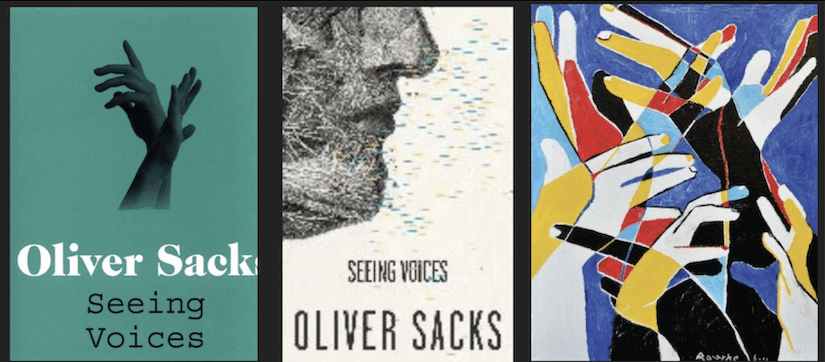
*Seeing Voices: A Journey into the World of the Deaf, 1989.
August/September 2025
This is, I believe, volume 21 in the Essay’s Project; we are in the process of reading all of Oliver Sacks works. We’ve read much of his work in haphazard order, but after finishing his Letters, we decided to read those books we haven’t read in the order of publication. So far that has been Migraine, A Leg to Stand On, [skipping Awakenings which we’d already read], The Man who Mistook his Wife for a Hat, and now Seeing Voices.
About the book, briefly
This describes Sacks jouney towards understanding Deafness, something he had been hitherto ignorant of. This book — really three separate essays — was written about three years into his inquiry, so, as Sacks notes, he is not writing from a position of expertise. Nevertheless, the book gives a very interesting history of how the Deaf were treated and how their circumstances evolved from being treated as mentally deficient people to non-disabled people who, though they could not hear, used Sign to express themselves, reason, and to develop a unique culture. There is also an account of ASL as a language, and its impact on cognition in those who learn it. It’s a good book, although I think there are probably now better books if what you are interested in is understanding how ASL works.
Preface
Sacks writes that he knew nothing of the Deaf before 1986. It appears that the particular incident that started him on his journey was a request to review the book When the Mind Hears, by Harlan Lane. The request, from Bob Silvers at the New York Review of Books, was accompanied by a note: “You have never really thought about languge; this book will force you to.” Sacks writes (in the first section of the book) that he opened the book with “indifference which soon turned to incredulity.” Over time the review expanded to an essay (the first in this volume) when it appeared in the New York Review of Books in March of 1986. He writes that then Stan Horowitz of the University of California Press immediately responded to the essay and encourage him to turn it into a book. How things unfolded from there is not clear, though he visited Gallaudet later that year. It is clear that, over the three years he worked on the book, he was in dialog with leading researchers, including Ursula Bellugi, Bob Johnson of Gallaudet, and Jerome Brunner.
Besides providing information about the evolution of the book and the origins of its three parts, the main point the Preface makes is that he came to realize that Sign functions as a real language, and, as such, has implications for how the minds of the deaf — particularly the prelinguistic deaf — function, give the intimate relation between language and thought.
A final bit in the Preface is the comment that the title, Seeing Voices, suggested by Sacks’ neice, comes from A Midsummer Night’s Dream, where Bottom, the malapropistic actor playing Pyrasamus addresses Thisbe: “I see a voice.“
A Deaf World
This section is essentially a history of deafness as seen from medical and public perspectives, though it is entwined with bits about how Sacks carried out his investigation of deafness, and explanations of his view of deafness (which has subsequently changed in some respects.
- Sacks was strongly influenced by an autobiography given to him by Auden in 1960. At the time he only skimmed it; he returned to it in and was hugely influenced by it.
- Sacks mentions learning from Lucy K, a colleague who he hadn’t realized was deaf because she was so adept at lip-reading (which he notes involves reading the entire face, gestures, and even bodily postures).
- Sacks distinguishes between the pre-lingually deaf, and the post-lingually deaf. The latter lost their hearing after they had been exposed to oral language, and as a conseqence have a vastly easier time learning to speak and lip-read. Without an initial exposure to oral language — they have no auditory inages, memories or associations. As a consequence the prelingually-deaf are terribly handicapped, unless they have access to a deaf community that uses Sign.
History
- pre-1755: Mental Defectives In brief, prior to 1755, deaf people were seen as mental defectives. This is because growing up without the constant exposure to language appears to inhibit the ability to think propositionally. Entwined with this is that there was no cultures or communities for the deaf — had there been, as was subsequently the case, the development of one form or another of Sign would have made a huge difference.
- In this period philosophers were very interested in the development of mental facilities. The discovery and study of the Wild Boy of Aveyron, and other studies of ‘savages’ and ‘primitives’ were attempts to understand what really constituted the nature of man. The Wild Boy seems to have served as a refutation of Rosseau’s belief in the corrupting influence of civilization, and in the idea that there was a universal primitive language…
- 1750: The Abbé de l’Epée and the first Golden Age.
Around 1750 the Abbé de l’Epée, concerned for the souls of the deaf, made contact with a deaf community in Paris that had its own indigenous sign language. He took this seriously, learned their language, and then, by associating signs with words and pictures, taught them to read. In 1755 he opened a school for the deaf, published a book in 1776, and by his death in 1789, 34 years later, had trained a multitude of teachers and opened 21 schools throughout France and Europe. His schools survived the French Revolution and by 1791 had become the National Institution for Deaf-Mutes headed by Abbé Sicard.- The Abbés de l’Epée and Sicard also gave public lectures and demonstrations that were very popular. Sacks depicts this as a sort of golden age of education of the deaf and public acceptance, and the emergence of the deaf into positions of responsibility and eminence.
- de l’Epée’s heroic efforts and achievements were somewhat undercut by his unfounded belief that Sign was not a full language, and needed to be supplemented by a system of sign and language that he had devised. Possibly because of his influential beliefs, Sign was not recognized as a true language for nearly two centuries.
- This development led to the first books by deaf people, in particular one by Pierre Desloges, called Observations, published in 1779. Many of these early works are collected in a book edited by Harlan Lane and Franklin Phillip called The Deaf Experience.
- 1819: Expanison to America and Evolution of ASL.
In 1819 Laurent Clerc (from Paris) and Thomas Gallaudet (of America) set up the American Asylum for the Deaf in Hartford. Other schools soon abounded, and French Sign soon combined with other forms of indigenous American Sign, notably including Sign from Martha’s Vinyard, where hereditary deafness had lead to a situation where Sign had been used as a lingua franca for a couple of generations.
One has, indeed, the strong sense of pollination, of people coming to and fro, bringing regional languages, with all their idiosyncracies and strengths, to Hartford, and bringing back an increasingly polished and generalized language.
ibid. p. 21
- 1870: The Turn Towards Intolerance. In the 1870’s there was a general turn towards Victorian oppressiveness, and intolerance of minorities and minority usages of every kind — linguistic, ethnic, religous. With respect to deafness, there were a number of exponents of oralness, meaning that the ability of the deaf to speak was viewed as of primary importance. The most famous and vociferous of these was Alexander Graham Bell. In 1880, the use of Sign in schools for the Deaf was officially proscribed.
After this history, which ends with the dark ages that began in 1870, Sacks returns to Martha’s Vineyard, and gives an account of an elderly woman (hearing) who was one of the last generations to sign. He describes her, at one point falling into a reverie, with her hands in constant motion.
But her daughter, also a signer, told me she was not knitting but thinking to herself, thinking in Sign. And even in sleep, I was further informed, the old lady might sketch fragmentary signs on the counterpane she was dreaming in Sign. Such phenomena cannot be accounted as merely social. It is evident that if a person has learned Sign as a primary language, his brain/mind will retain this, and use it, for the rest of that person’s life, even though hearing and speech be freely available and unimpaired: Sign, I was now convinced, was a fundamental language of the brain.
Thus we are set up for the next section.
Thinking in Sign
This section is my favorite. The first and last are very good at providing the historical perspective. But, ultimately, I’m interested in the neurological and cognitive aspects of deafness.
The key claim of this chapter is that it appears that learning language is necessary to thinking in the way that most humans do — that is, thinking in terms of past and future, reasoning about causality, and employing other abstractions. And — building on this — that the pre-lingually Deaf can think in this way, but only if they have the opportunity to learn ASL or some other form of Sign. Thus, historically, the efforts to suppress the use of Sign in educational settings (something that, starting in 1880 spanned nearly a century) did great damage to those born deaf.
Notes
- The chapter begins with various accounts of bv deaf people who grew up without language. Various accounts portray the pre lingually deaf raised without any language as being able to only think in the present, largely in terms of perceptual categories and immediate needs. The concepts of past and future, and even the concept of asking and answering questions, seem beyond the scope of people those without language.
- I was a bit skeptical of these accounts, until Sacks then summarized accounts written by pre-lingually deaf authors who acquired language later in their lives. Their own accounts of their cognitive abilities before and after acquiring language are consistent with the previous accounts,
- There was a long period where Sign was thought to be a pidgin rather than a real language; it was only in 1960 that xxx Stokoe, a professor at Gallaudet who became interested in sign, published a work that argued that sign was a true language in that it had a grammatical structure, albeit one very different than the extended linear grammars of oral languages.
- Glimpses of what it means to think in sign are provided — for example, a parent describes her daughter’s construction of meaning in terms of her building spatial structures where every element has a place. Unfortunately, few examples are given of what it actually means to “think in sign.”
- Here, at least, is an example of the ways a sign — in this case for “Look at” — may be modified to convey meanings like ‘stare,’ ‘watch,’ ‘look at each other,’ etc.
Thus there are numerous forms of LOOK-AT (“look-at-me,” “look-at-her,” “look-at-each-of-them,” etc.), all of which are formed in distinctive ways: for example, the sign LOOK-AT is made with one hand moving away from the signer; but when inflected to mean “look at each other” is made with both hands moving towards each other simultaneously.
A remarkable number of inflections are available to denote durational aspects (fig. 1); thus LOOK-AT (a) may be inflected to mean “stare” (b), “look at incessantly” (c), “gaze” (d), “watch” (e), look for a long time” (f), or “look again and again” (g) — and many other permutations, including combinations of the above. Then there are large numbers of derivational forms, the sign LOOK being varied in specific ways to mean “reminisce,” “sightsee,” Took forward to,” “prophesy,” “predict,” “anticipate,” “look around aimlessly,””browse,” etc.–ibid., p. 67
- Research on the neurophysiological correlates of Sign show that the left hemisphere is essential for ‘speaking’ Sign. Fluent signing can be disrupted by left hemisphere lesions (but ability to gesture is unimpaired), and signers perform better on ‘reading’ sign when it is presented to the right visual field (and thus the left hemisphere).
- A particularly fascinating finding was that a Deaf subject who had experienced a stroke and had lost the ability to see (or even imagine) her visual field, still used the entire field of space in front of her when signing. See figure on page 77,
- There are various experiments showing that deaf signers perform better at various visual/spatial tasks (e.g., face recognition and various spatio-visual tasks. This does not strike me as surprising.
- There is a lot of anecdotal evidence that deaf children exposed to Sign learn it very quickly, and that deaf children, with no exposure but to one another, spontaneously develop Sign-like methods of communication. There is also a claim that Signers of a language like ASL, can become fluent in entirely unrelated foreign Sign languages in a matter of weeks. I wonder about this, but on the small number of people who are very talented at spoken languages can ‘pick up’ a new one in, reportedly, a matter of weeks.
- It is interesting that children appear to be inclined to pick up language spontaneously, regardless of whether it is oral or visual. I’m mystified by the ability to ‘read’ sign, but it is the case that both oral languages and Sign are generated by essentially creating gestures and shapes — it is just that with oral languages the generation is hidden with the larynx, throat and mouth and made audible by blowing air through them. One wonders what signers would sound like if they signed in a wind tunnel!
The Revolution of the Deaf
An day-by-day account of the week of protests at Gallaudet University that led to the selection of King Jordan, a Deaf president (although he was not pre lingually deaf, which some objected to. Sacks traveled to Gallaudet for this, and engaged an interpreter. A reasonable first-person account of the protest, but not a lot of interest beyond that.
Well, there is a bit more on the recent historical events effect the deaf:
- 1960: Stokoe publishes Sign Language Structure. Initially ignored or criticized (including by the Deaf), it came to have a huge impact and led to the acceptance (and more research) on ASL as a real language.
- 1965: Stokoe publishes his Dictionary; it includes an appendix by Carl Croneberg on the linguistic and social community of the deaf — the first description of Deaf culture.
- 1967. Founding of the National Theatre of the Deaf — although the initial productions used signed English, and only later shifted to AS in 1973.
- 1970. Ed Klima and Ursula Bellugi begin their studies of Sign.
- 1972: Fant publishes Ameslan: An Introduction to American Sign. This was a primer inspired by Stokoe’s work, and played a big role in the reintroduction of Sign into Deaf schools.
- 1973. First play performed in ASL by NTofD
- 1988: Revolution at Gallaudet
Views: 71