December 2025
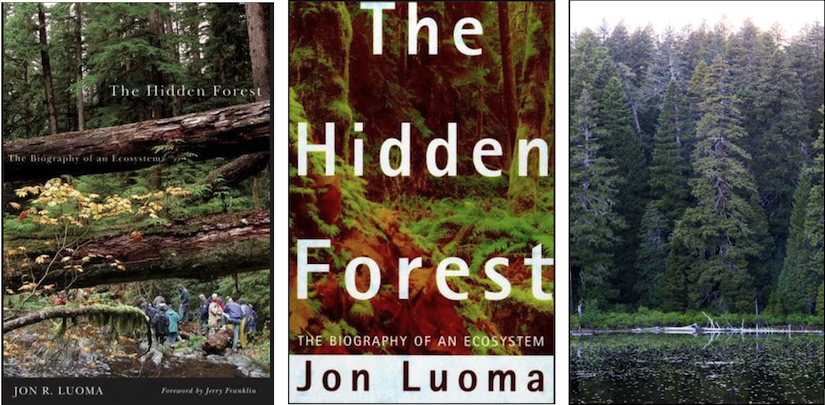
The Hidden Forest: The Biography of an Ecosystem, John R. Luoma. 1999/2006
About the Book
I’m reading this with RB. Originally published in 1999, it proved unexpectedly popular and was re-published in 2006 by Oregon State University Press. I had mis-remember this book as being about a periodic study, over the course of a year, of about 20 square meters of forest. Instead, this is an account of several decades of study of the H. J. Andrews experimental forest — a Douglas Fir ecosystem in the Pacific Northwest set aside for scientific investigation. The book appears (I’m writing this after reading four chapters) to combine forest ecology science with an account of how scientific thinking about forests (and their management) have changed over the last 5+ decades. It is very well-written.
The Book
Chapter 1 <chapters have no titles>
- An experiential introduction to the Andrews Experimental Forest.
- In the forests of the Pacific Northwest, every genus of conifer is the largest of its kind on the planet: the Sitka spruce, the western red cedar, the western hemock, the sugar pine, the noble fir, and the Douglas fir. It is believed that this immensity is an adaptation to the climate – 90% of the region’s abundant rain falls in the winter, and the immense boles of the trees enable them to store water in quantity.
- These forests hold more biomass per acre than tropical rain forests: 500 tons/acre
- Most studies of forests are (a) very short term and (b) cover a very small error. The Andrews Experimental Forest is a notable exception, covering 16,000 acres, and permitting studies that will last many decades.
Chapter 2 – ((some history))
- The aim of this experimental forest is to understand how an entire ecosystem works.
- Carolus Linneaus, the inventor of the taxonomic naming system, also wrote a book called The Oeconomy of Nature (1749), which was, essentially, the first book on ecology. He introduced concepts such as the ecological niche, the food chain, and the idea of succession.
- In 1789, Gilbert White, an amateur naturalist, published a book describing a four decade long study of a ecosystem: The Natural History of Selborne. White’s book introduced the idea that waste (e.g., cow droppings) could become food for other organisms (e.g., insects and worms), which in turn became food for yet other organisms (e.g., fish).
- A century later Henry David Thoreau documented the succession of forest trees in New England presented at a lecture in 1860).
- In 1866 Ernest Haeckle coined the word Okologie as the name for a science that would study the complex interconnections of things noted by Darwin in Origin (1858)
- In 1895 Eugenius Warming, a Dutch biologist, began to lay out, in detail, how organisms functioned as parts of biological communities. He introduced the notion of comensalism, in which species are so composed as to minimally compete with one another for resources
- In 1894 Henry Cowles Chandler, on a train trip, happened to view a surprising succession of ecosystems in the dunes of Northern Indiana. Investigating, he realized that what he was seeing was an example of how ecosystems adapted to environmental change.
Cowles concluded that the marram grass colonizing a bare dune| could survive high wind and searing wind, even burial by sand and direct sunlight. But once it was firmly established, the marram not only stabilized the landform-the dune—it provided for other life-forms a bit of shelter and cooling shade, and as it lived, then died, its decay made just a trace of nutrient-rich soil. In time, less hardy plants eventually could prosper. Eventually those plants would crowd out the marram, building more soil, more shade, making way for a new guild of species, and on and on until the ecosystem reached a “chi-max” stage, a mature, dense forest that would operate-or so Cowles supposed—in a steady, stable state. In time, the progressive shade and shelter of plants and the steady decay of accumulating life would change the very character of the soil, and then of the ecosystem itself.
—ibid., 29
- In the 1970’s, Fred Swanson, initially trained as a geologist, became interested in the landforms in the pacific northwest, and morphed into a geomorphologist. He found that the landscape was basically participating in a very slow landslide, and that trees, roots and all, moved millimeters to feet every year.
Chapter 3 – ((the paradigm shift in forestry))
- The idea of forests as managed tree plantations, designed to maximize productivity revenue. Some of the problems resulting from the implementation of this paradigm, and the harmful believes (e.g., old growth forests are decadent; downed trees and logs should be removed).
- Transition to recognizing the value of diversity — of structure, species, niches, etc. — in forests.
- In 1969 Jerry Franklin succeeded in getting an NSF grant to support multidisciplinary study of forests. I believe that this is when the Andrews Experimental Forest was set aside, but I’m not sure.
Chapter 4–((discoveries in the high canopy))
- Description of using a crane to study the canopy of the forest. Claim that the canopy of an old growth forest is its own ecosystem — similar in kind to that of a coral reef, in that its functioning is driven by air and light.
- Lobaria Oregana, a lichen that grows in the canopy, and only in trees over a hundred years old, is responsible for fixing Nitrogen at the rate of 22 pounds/acre, making it one of the dominant N2 fixers of the forest.
- A different researcher discover a fungus (Rhabdocline parkeria) that lives inside Douglas fir needles — it is an endophytic symbiont that synthesizes alkaloids for defense against pests in exchange for sugar and other nutrients. This makes sense because fungi adapt and evolve far more quickly than trees.
- Another researcher discovered that large trees can develop above ground roots to take advantage of the detritis and soil that accumulates in the upper canopy over the centuries.
Chapter 5—((decay of litter, branches, et al))
The forest clonks and bangs and sings with the hissing and the booming and the knocking and the thwacking of bits of litter, from pieces of limb or lichen, moss or needle, of seed cone or sloughing bark. For hour by hour, day by day, the standing forest ecosystem fairly rains down bits of its own life, and death, to the forest floor.
—ibid., p 68
- Over a year, five tons of litter will fall onto a single acre of the floor of an old growth forest. In addition, rain, snow and fog-drip dissolve nutrients that live as ‘lawns’ on Lobaria lichen in the canopy, and carry nutrients down to the forest floor. This links the ecosystem of the canopy to that of the forest floor.
- Although rich in carbon, a log has only the fraction of the nutrients required by a tree: those are found in leaves, buds, and the thin layer of inner bark containing the phloem and the xylem.
- An early survey of the Andrews forest found 219 tons/acre of downed wood, and another 49 tons in the form of standing snags.
- Description of the structure of leaves, and the process of photosynthesis. Photosynthesis is described at the atomic level, with electrons being knocked out of orbits in a cascade, culminating in the electrolysis of water into oxygen and hydrogen, the latter of which is enzymatically (in a process called “the dark phase”) joined with carbon dioxide to make sugars. Over the course of a season, a tree will produce about 2 tons of sugar.
- A tree trunk consists of: bark, inner bark (the tissue-thin cambium that produces wood), the sapwood (that transports water and nutrients [N, P, K, Ca, S, Mg, & Fe (and trace amounts of I, Mn, Cl, & Co)), and the heart wood (that provides structural support). The water is transported upward because it is in a continuous column, and due to hydrogen bonds has a significant tensile strength approach that of metal wires).
- A tree that falls in a forest will open a large ‘gash’ — in part because it will pull down other trees as well – within which saplings, forbes and other organisms may grow. Likewise, snags offer habitat for a large variety of organisms.
- It may take a large log 2 centuries to completely decay. During the process, the log will come to contain more biomass than the living tree. 20% of its weight may be biomass, in contrast to 5% of the weight of a living tree.
- Log decay:
- Decomposers start fermentation
- Ambrosia beetles, attracted by the scent of alcohol, create tunnels under the bark
- As they burrow, the Ambrosia beetles transport fungi on their backs
- The fungi grow in the gallaries of tunnels, providing food for the beetles and their larva
- At the same time female bark beetles will burrow into the bark
- After the inner bark is consumed, new organisms appear. The Ponderous borer will bore into the heart wood, laying its own eggs. Carpenter ants will do the same.
- Predators and parasites will follow the borers — for example, a small wasp that feeds on borer larva
- After about ten years the Pacific dampwood termite will invade the log, and begin digesting the the cellulose; the microbes in their gut also fix nitrogen…
I asked AI to clean up and expand the above list:
Early Decomposers (Year 0-1)

Bacteria and yeasts - Begin fermentation of simple sugars and starches in the sapwood, producing ethanol and carbon dioxide as byproducts; lower pH through production of organic acids, creating anoxic conditions that inhibit some competing microorganisms

Early-Middle Stage (Years 1-3)
2. Ambrosia beetles - Attracted by ethanol and volatile organic compounds from fermentation; bore through bark into sapwood creating extensive gallery systems; physically fragment wood and increase surface area for decomposition

Ambrosia beetle-associated fungi (Raffaelea, yeasts) - Transported in beetle mycangia; colonize gallery walls, breaking down cellulose and hemicellulose; provide nutrition for beetle larvae; further acidify wood environment
Bark beetles (females) - Burrow into inner bark (phloem/cambium); vector ophiostomatoid fungi into sapwood; create entry points for other organisms; deplete inner bark nutrients

Middle Stage (Years 3-10)
5. Wood-boring beetles (Ponderous borers, cerambycid beetles) - Attack after bark nutrients depleted; bore into heartwood creating larger tunnels; fragment wood structure; larvae develop over 2-3 years

Carpenter ants - Excavate galleries in softened wood (don't consume wood but remove it); prefer wood with 20-40% moisture content; create extensive cavity systems that increase wood exposure to air and moisture

Predatory and parasitoid wasps - Follow wood borers; parasitize beetle and borer larvae; their activity creates additional openings in wood structure

White-rot fungi (basidiomycetes) - Begin colonizing wood through beetle galleries and cracks; produce lignin-degrading enzymes; break down complex lignin compounds into simpler molecules; increase nitrogen availability. [[TE: For lignin breakdown to occur the basidiomycetes require molecular O2]]

Late-Middle Stage (Years 10-20)
9. Pacific dampwood termites (Zootermopsis) - Colonize wood with elevated moisture content (>20-30%); digest cellulose with help of gut protozoa and bacteria; their gut microbiome includes nitrogen-fixing bacteria that convert atmospheric nitrogen into ammonia; create fine galleries throughout remaining wood

Nitrogen-fixing bacteria (Rhizobiales, others) - Populations increase as wood C:N ratio decreases; fix atmospheric nitrogen, enriching wood and surrounding soil with bioavailable nitrogen; support fungal decomposition

Late Stage (Years 20-50+) - fungi & bacteria => soil invertbrates
11. Soft-rot fungi (ascomycetes) - Dominate in wet, well-decayed wood; attack cellulose in cell walls; work under high moisture, low oxygen conditions where white-rot fungi less active

Brown-rot fungi (basidiomycetes) - Break down cellulose and hemicellulose while leaving lignin relatively intact; create simpler organic compounds; and create cubical cracking pattern in wood; make remaining lignin accessible to other decomposers

Diverse bacterial communities (Acidobacteria, Burkholderia, Actinobacteria) - Populations increase dramatically as fungi create simpler organic compounds; metabolize fungal exudates, wood sugars, organic acids; continue nitrogen transformations; prepare substrate for soil incorporation

Soil invertebrates (mites, springtails, millipedes, salamanders) - Colonize highly decayed, moist wood; physically fragment remaining wood; mix decomposed material with mineral soil; transport fungi and bacteria; accelerate final stages of incorporation into forest floor
- Benefits of logs:
- Decomposing logs act as sponges, retaining enormous amounts of water, even after fires.
- Nurse logs (especially western red cedars and Sitka spruce) enable saplings to grow on them (which would otherwise have difficulty taking root on the mossed-over forest floor).
- Downed logs slow erosion, and the soil built up on their uphill side provides habitat for insects and small mammals
- Rotting logs provide habitat for salamanders, voles, chipmunks
- Logs in rivers slow streams, reduce erosion, aid sedimentation, and provide fish and wildlife habitat
- Functions of snags:
Chapter 6—((bugs and living soil))
- In terms of number of species, arthropods [== “jointed feet”] vastly outnumber non-microbial species: 41,000 vertebrates; 500,000 plants; 30 million insects. The combined weight of insects on earth may exceed that of all humans by a factor of 12.
- Diversity and evolution: The diversity of arthropods is in large part due to the combination of their short lifespans with high mobility due to flight.
- The diversity of arthropods in the forest floor of Andrews appears to rival the diversity found in tropical forests. They are referred to as a “precision barometer,” a rather odd metaphor, but I take the meaning.
- The community of arthropods in the forest floor is a very accurate mirror of the ecosystem above.
- Soil, rather than being primarily an assemblage of inorganic material, is mainly made of biogenic substances… countless microbes and the bodies and feces of invertebrates.
On one such slide, Moldenke showed me the image of what was clearly a needle from a Douglas fir—or so it seemed. … But a closer look showed that it was not intact at all. It was a collection of unconnected fragments, thousands of infinitesimal bits arranged in almost precisely the pattern of the needle. Without moving the needle at all, countless tiny arthropods had swallowed parts of it. In fact, every bit of the needle had been chewed up and swallowed. Bacteria living in the insects’ digestive systems had worked furiously for a few hours on the outside of the bit of food, extracting nutrients both for themselves and for the arthropod. And then the remaining cell tissue-constituting most of what had been chewed off in the first place-was repackaged into a tiny pellet of ground-up plant matter, and then excreted almost precisely in place. The needle had been, in short, thoroughly reprocessed through the first stages of decay. And it still looked much like a needle, or at least a needle rendered by a pointalist.
—ibid., p 100
- There is a lot of detail on how arthropods (and their microbes) rapidly transform detritus into soil. (Note that many arthropods – mites, springtails, microspiders, et al. — are extremely small sub-millimeter scale).
- Most of the nutrients used by the forest are very near the surface in the biogenic portion of the soil. Roots go deep primarily for water and to provide support.
Moldenke: “If you went to Andrews Forest and brought me back a handful of dirt, I could tell you what time of year you dug the sample up—all critters have life cycles-the altitude it was taken, the slope face-whether north or south. I could tell you the vegetative cover—whether it was Oregon grape or wood sorrel or something like that. I could tell you the successional stage of the forest—whether it is early, middle, or late— whether it was old growth or not. In some areas, I could tell you what kind of tree was nearby and how far away,” he says. … “And it’s easy! Anybody could do it with a little bit of training.”
—ibid., p 106
Chapter 7—((roots and fungi))
- A. B. Hatch discovered the relationship between fungi and tree roots and coined the term micorrhizae. He discovered that saplings associated with fungus grow faster than those with no such associations.
- Fungal hyphae interpenetrate tree roots, growing between individual cells and sometimes even growing into cells. The hyphae get sugar and some vitamins from the tree roots and in response grow into mats that cover hundreds of square feet that bring water to the tree; fungal hyphae are also capable of taking in certain nutrients (like phosphorous, which is not water soluble). Dendrologists now believe that hyphae connect trees to a thousand times more soil area than the roots themselves. These fungal mats also seem to act as reservoirs for nutrients that would otherwise get washed away.
- Some organisms, such as voles, shrews, and pika, feed on fungal fruiting bodies (e.g. digging for truffles), and spread the spores in their feces.
- Tree roots grow — at a micro-scale — with extreme rapidity. They extend root hairs which, in the absence of water melt away (well, melt means eaten by microbes and small arthropods).
- A single rye plant has approximately 600 thousand miles of root hairs, and has an estimated 14 billion individual hairs.
- In some cases there appears to be a one to one relationship between a root and a leaf — that former provides water to the leaf, and the later sugar and nutrients to the roo.
- Scientists now believe that about 40% of the photosynthate made by the leaves of a tree go to support its micorrhizal fungi and the ecosystem that exists just beyond the roots.
- Soil Structure. The structure of soil — particular the diversity of pores or spaces in it — seems to be correlated with its health/fertility. This structure is a consequence of fungal hyphae exuding polysaccharides that ‘glue’ grains of soils into clumps.
- Some trees that grow in intense shade — maples, hemlocks — appear to be able to obtain nutrients from the very overstory trees that are making the shade; they do this thru hyphal bridges.
… discussion break—next two chapters for March 9th …
Chapter 8—((disturbances))
- The original conception of ecosystems did not get everything right.
(1) One mistaken idea was that ecosystems evolve until they reach a permanent, self-sustaining stable climax community
(2) Ecologists also did not pay attention to the role of disturbances in ecosystems — to the fact that they may rely on disturbance. “…the weaving and wedging of evolution…” Without fire some forests cannot reproduce; without drought, some wetlands can not thrive or even survive. - Jack Pine forests. Jack pines thrive on poor soil and harsh climates; in the absence of these they will be out-competed by other trees. Jack pines build up thick mats of highly flammable needles, and, in the area of Michigan being discussed, burn every few decades. The burns are needed for their cones to open, so that they can reproduce; the burns are also essential for maintaining the landscape needed by the Kirkland Warblers.
- Jack Pine forests provide habitat for the Kirtlands Warbler. This bird nests on the ground under the low hanging branches of Jack Pine (and only Jack Pine). It also relies on insects that associate with Jack Pine for nutrition, and also requires forests with open areas where blueberries and other easily picked edibles are available.
- Foresters are exploring ways of creating forest-landscapes that will support the Kirlands Warbler. So far these are not as effective as the regular cycle of burns, but they succeed to a degree.
- The exemplifies a more general approach sometimes referred to as “new forestry,” that tries to preserve properties of the natural ecosystem (e.g., snags, downed logs etc).
- Douglas Firs are not the climax ecosystem — without disturbances like wind, they would eventually be replaced by Western Hemlock.
- Om 1977 the Franklin teams writes a paper that will eventually cause major changs in how people think about forests: The Ecological Characteristics of Old Growth Douglas Fir Forests.
- In 1988 Chris Maser and Jim Trappe published a small booklet: The Seen and Unseen World of the Fallen Tree.
- Mt St Helens story. After the eruption the Franklin team started studying recovery of the ecosystem. To their surprise, only a few weeks post-eruption, there was life amid the ash: gophers, deer mice, fungi, plants (like blackberry) re-sprouting from rhizomes; there were also amphibians and aquatic invertebrates that had survived in the mud beneath streams and lakes. And of course many kinds of seeds which, as the ash eroded, were able to sprout. The Franklin team referred to this as the biological legacy, and went on to propose that preserving this legacy was one of the keys to the new forestry.
Chapter 9—((The New Forestry))
- 1967: E. O. Wilson and Robert Macarthur: The Theory of Island Biogeography. This is a classic book that was the beginning of Conservation Biology, and argued that the issues involving species extinction were more complex than simply habitat loss.
- Issues that are related to species extinction include inbreeding; population biology (with a small overall population, natural population fluctuations may hit zero, in which case the cycle stops); edge vulnerability.
- Endangered Species act was passed in 1973, but it took time for species to be studied to determine whether they could be listed as threatened or endangered.
- The Spotted Owl story.
- Job loss in Pacific Northwest lumber industry was due primarily to automation, not the Endangered Species Act. From 1979 to 1987 about 15% of the industries jobs were lost to automation. And even with job loss related to that — e.g., due to the preservation of old growth forest for the spotted owl — was only moved ahead in time: there was not much old growth left, and the mills and personnel that serviced that aspect of the industry were doomed.
- New Forestry: Recovery biological legacies. Emphasis on preserving larger areas, and creating corridors between preserved areas for species migration and re-colonization.
… reading break—likely will discuss 3/16…
C10—((Flows in forests ))
- The 1996 flood in the PNW. More sediment entered streams during the flood than in the preceding three decades.
- A river flows downstream not in two dimensions but in three — over time it changes the land around it. Floods alter the contours of fluvial landscapes and also reshape the ecological communities that inhabit them.
- There is a remarkably consistent correlation between the width of a river channel and the wavelength of its meanders: 1::10-14.
- There are dramatic differences between recently logged forests and unlogged ones: Within 5 years flows of a recently logged area increase 50%; and they remain 20-40% higher for as much as 25 years. Even logging as little as 5% of a forest can increase peak flow rates by 10% to 55%.
- Fungal mats occupy large areas of the forest floor (up to a quarter of the area) and constitute lots of biomass (as much as 50%) One previously unsuspected function is that fungi can extract nutrients directly from humic molecules left over after bacteria break down sugar, starches and lignin.
- Some mycorrhizal species can break down rocks and extract their minerals — what are they, and what kind of rocks do they break down?
- Various pests and diseases (spruce budworm and other defoliators may not be so much a problem as a solution: they take out the weakest branches and trees, leaving the healthy.
- The idea that old growth forests consume less CO2 fails when one includes the the co2 released by wood debris, etc., in managed forests.
C11–((Into the Future))
- This chapter was of less interest to me. It advocated for more long term research, and for the value of simply describing what happens in ecosystems. And it gives examples of the value that such long term ecosystem scale research can provide.
- “Destruction is even more likely to occur at a ponderous pace in the secrecy of the invisible presence.” —John Magnuson
Views: 62