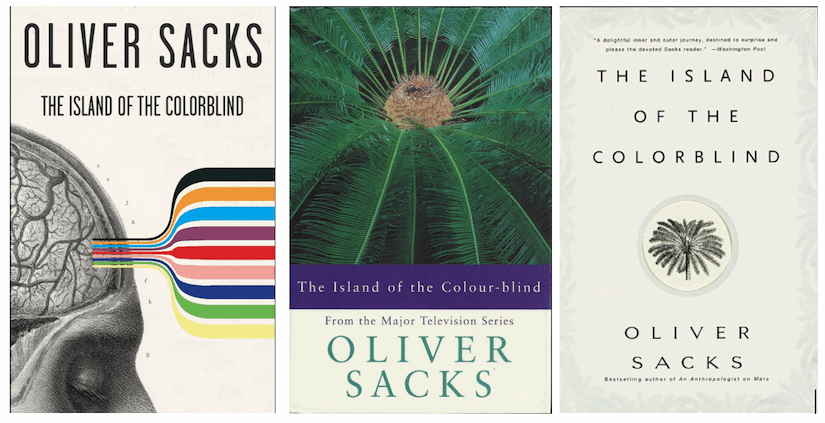
Island of the Colorblind, Oliver Sacks

October – November 2025

This is the 23rd entry in the Essays Project. We continue on our quest to read the complete Sacks oeuvre. Despite its title, this book is divided into two books: The Island of the Colorblind and Cycad Island.

Retrospective on the Book

This was not one of my favorite books, but it was not without interest. It gave interesting glimpses of life in the South Pacific, particularly the hints of how the US military dominates and suppresses freedom in this area of the world. Seems like a remnant of some of the worst of the colonial days. With respect to Sacks’ visits to various islands, the offer interesting accounts, though I have to say it seems to me that he learned little on his visits that he had not already learned from the informants who accompanied him or who he met there.

For me, the high point of the book was the last chapter about his visit to the island of Rota, a little-visited island near Guam. This visit, unlike the others, had no neurological goal: it was simply to see ferns, cycads and the other primitive plants that are dear to Sacks. I like this chapter because it provides some suggestive passages that offer insight on his love of ferns and the allies, which will come to the fore in his Oaxaca Journal. To wit:

The sense of deep time brings a deep peace with it, a detachment from the timescale, the urgencies, of daily life. Seeing these volcanic islands and coral atolls, and wandering, above all, through this cycad forest on Rota, has given me an intimate feeling of the antiquity of the earth, and the slow, continuous processes by which different forms of life evolve and come into being. Standing here in the jungle, I feel part of a larger, calmer identity; I feel a profound sense of being at home, a sort of companionship with the earth.

ibid., 198

Preface

Sacks wrote this book in one swoop, in July of 1995. Subsequently he added voluminous notes, which his editors paired back; this edition appears to have notes that the original one did not.

Sacks writes that his visits to the islands described herein were brief and unexpected, part of no agenda or research program. It does seem that he is pursuing his theme of how individuals (and, in this case, communities) adapt to rare neurological conditions: hereditary colorblindness in the first case, and a fatal neurodegenerative disorder in the second. It also sounds as if his other biological and botanical interests will play into the books.

Continue reading Island of the Colorblind, Oliver Sacks

Views: 15

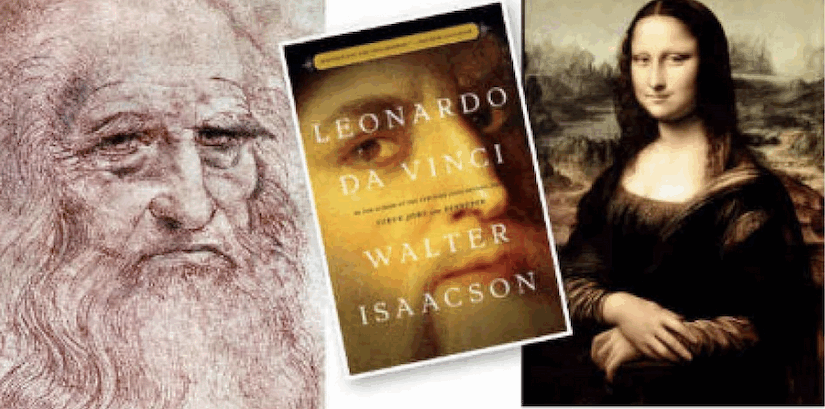
Leonardo Da Vinci, Walter Isaacson

October 2025

About the Book

Reading this with NS & DO, a subset of the 26 minute book group. As I begin, I find myself a little hesitant about a biography written about someone 400+ years ago, where there is presumably a scarcity of 1st hand accounts. But certainly his very detailed notebooks will help…

Later: And the notes do, indeed, help, although the undated nature of the notes, and the fact that they have been remixed over the ensuing centuries makes them less effective as a chronological record. Still, I’m learning a lot about Leonardo, his approach to life and innovation, and his accomplishments.


The Book

INTRODUCTION – I Can Also Paint

The introduction offers a general description of Leonardo as a man who blended art and science and who, in fact, probably did not distinguish. It suggests that we have much to learn from Leonardo in that “Leonardo’s genius was a human one, wrought by his own will and ambition,” in contrast to those who seem to have prodigious cognitive powers. Certainly, he left profuse documentation of his curiosity and his reliance on observation and analysis of the natural world to fuel his creativity and inventiveness. Leonardo: “He who can go to the fountain does not go to the water jar.

The rest of the introduction discusses sources — three early accounts — and offers some suppositions about Leonardo’s personality.

Continue reading Leonardo Da Vinci, Walter Isaacson

Views: 12

Gods of the Upper Air, Charles King

October 2025

About the Book

I’m reading this book chapter by chapter with CJS.The topic is the emergence of cultural anthropology via the work of Franz Boas and his students, who included Margaret Mead, Ruth Benedict, Ella Deloria, and Zora Nealel Hurdson. The work described here laid the foundation for the belief that all humans are fundamentally equal in their abilities, and that much of what had been thought to be innate was culturally constructed.

The Book

C1: Away

This chapter is really a preface. It begins with a vignette of Margaret Mead arriving in Samoa, but then segues to the general aim of the book.

A little over a century ago, any educated person knew that the world worked in certain obvious ways. Humans were individuals, but each was also representative of a specific type, itself the summation of a distinct set of racial, national, and sexual characteristics.

Each type was fated to be more or less intelligent, idle, rule-bound, or warlike. Politics properly belonged to men, while women, when they were admitted to public life, were thought to be most productive in charitable organizations, missionary work, and the instruction of children. Immigrants tended to dilute a country’s natural vigor and breed political extremism. Animals deserved kindness, and backward peoples, a few rungs above animals, were owed our help but not our respect. Criminals were born to a life beyond the law but might be reformed. Sapphists and sodomites chose their depravities but were probably irredeemable. It was an age of improvement: an era that had moved beyond justifying slavery, that had begun to shake off the strictures of class, and that might eventually do away with empires.

—ibid., p 4

The claim of the book is that the work of Boas and his students was critical to overturning these understandings. Boas and his students invented (and named) cultural anthropology and developed the theory of cultural relativity. Their work challenged heretofore accepted ideas that people fell into natural categories that differed in their abilities and predilections. It did this via a scientific examination of cultures…

Continue reading Gods of the Upper Air, Charles King

Views: 61

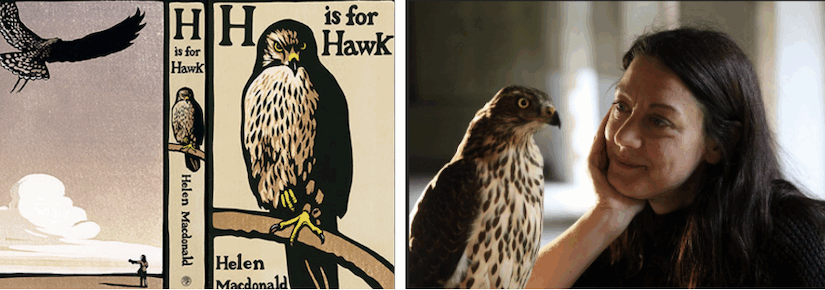
H is for Hawk, Helen Macdonald

October 2025

About the book

I read Macdonald’s Vesper Flights early this year when we were in Hawaii. Flights is a book of essays mostly about natural history and mostly about birds – though, true to the original meaning of essay, “about” covers a lot of ground. The writing was beautiful, and I not only read the book but studied it to improve my own writing. I’d expected much the same from Hawk. 

But Hawk is a very different book. To be sure, the writing is beautiful, and it will repay study, but it is a single-track narrative rather than a series of essays. Hawk traces out two central narratives: one is an account of her training a goshawk and her experiences training, living and hunting with it; intertwined with this narrative is an account of coming to terms with her father’s death, and the period of isolation, depression, and gradual recovery that ensured. Though as I write this, I note that the ‘coming-to-terms’ narrative is really itself a braid that includes childhood memories and an account of the life of T. H. White. Hawk was published in 2014 – I believe it to be her first book, possibly excepting poetry.

I am not going to provide a chapter by chapter account. Rather, my aim here, is just to record the phrases and passages that struck me. 

Continue reading H is for Hawk, Helen Macdonald

Views: 10