The City & the City, China Mieville

I read this for the Fall 2025 Science Fiction and Fantasy course I took at the U of MN.

I was not enthralled by this book. In fact, at about the halfway point, I misplaced it and did not finish it. I still haven’t found it, though no doubt it will turn up somewhere.

[Spoiler follows]

The City & the City is a competent murder mystery, but with the fantastical twist that the City is a place where an analog of the City in a parallel universe is partially visible and sometimes accessible. Inhabitants of the City have trained themselves to not see traces of the parallel city – if they give it too much attention something will happen — a mysterious force or set of police or something – will appear and remove everyone who was implicated or involved in noticing/acting in the parallel world. Yet, in spite of this, or perhaps because of it, there is an officially managed gateway between the two versions of the City, though much bureaucracy is involved in moving from one side to another.

The murder which drives the plot — well, at least the plot for the half of the book I’ve read — appears to have been committed in the parallel city, and then the body deposited in the other city. This brings police from both ‘sides’ together to investigate what happened. That had just begun to happen when I lost the book…

While it’s an interesting set up, and while the writing is well done, I found (as is often the case) that I don’t really care for the protagonists. There’s one chief detective (or maybe he’s an inspector) and he’s gotten a younger colleague involved to assist him — but he seems to have no life other than work, and no real friends. The most emotional life he shows has to do with his colleague, but even there it is pretty sparse (though perhaps something richer will develop as the book proceeds).

While I finish the book when I find it again? I’m not sure… I don’t find that I care very much or feel very curious.

# # #

Views: 11

The Saint of Bright Doors, Vajra Chandrasekara

The Saint of Bright Doors, Vajra Chandrasekara, 2023

This is an acclaimed science fiction book that has gathered both critical and popular praise. I read it a couple of years ago — I try to read the ‘best of the year’ books in SF – and it didn’t engage me, although I did manage to finish it. I am now reading it a second time, as part of a Science Fiction and Fantasy course I’m taking at the U, and am going to try harder to appreciate it; or at least to understand what others appreciate in it. And perhaps also reflect on aspects of it that prevent me from appreciating it.

At this point I’ve just started the re-read it. I am noticing some very nice turns of phrase. I also notice that the protagonist begins as, in a sense, an abused child who is being trained to do terrible things by a mother who sees him only as a tool. I’m not really noticing much in the way of love or affection or humor among any of the characters.

Continue reading The Saint of Bright Doors, Vajra Chandrasekara

Views: 7

Parable of the Sower, Octavia Butler

(with a a little bit on the sequel, Parable of the Talents)

May 2025

I read this book for the Elle Cordova SF book club; it is number 3 in the sequence. I was familiar with some of Butler’s earlier work, the Xenogenesis stories, which I liked, and at some point had read Parable of the Sower, which I did not care for.

To step back a moment: Octavia Butler is justly lauded for her impact on late 20th century and later science fiction. Though by no means the first black author to make a name in the genre (Samual Delany is, I think, the progenitor), she is among the first to really foreground themes related to black experience — characters experiencing racism, dominance/repression, resistance/survival, and (loss of) bodily autonomy. As I write this, I balk, because I am by no means a scholar of SF, and so I should preface the foregoing with “In my limited experience.”

In re-reading Sower, I found myself recapitulating my initial unfavorable reactions. The first being, ‘I don’t think this is really science fiction.’ [Clearly SF writers disagreed with me, as this novel was awarded a Nebula.] Still, it seems like a straight-forward post-apocalyptic novel — I was going to write, “in the vein of Cormac McCartney’s The Road — but on pausing to look it up, I find that this pre-dates Road by at least a decade. I didn’t care for The Road, either, so at least I am consistent here. In both cases, we don’t have much in the way of science happening, just an extrapolation of current trends that are leading / have lead to the breakdown to the climate, environment and society, and protagonists living off scavenged food amid a world filled with violent and destructive bands. Sower does give its protagonist, an odd disability/delusion called hyperempathy caused by a mother’s use of a drug during pregnancy, but, although complicating life for the protagonist, this problem does not seem to me to fundamentally shape the story.

My second unfavorable reaction has to do with the unrelentingly grim world of the book. The closest the book gets to hopefulness are a few periods of stability in the midst of a long, seemingly inevitable decline, which the protagonist tries, inadequately, to prepare for. Of course, this is perhaps a realistic portrayal of the challenges we face, but it does not make it a fun read (except, perhaps, in contrast to its sequel Parable of the Talents, which is grimmer.

It is true that the book suggests that kindness and inclusiveness is at least a middle-term effective strategy, and that people can overcome interpersonal obstacles to work together. It also posits an interesting belief system — essentially a new religion being constructed by the principal protagonist — that, it is argued, is more suited to the needs of the post-apocalyptic world,.

The belief system is called Earthseed, and its central tenant is that God is Change. It argues both the one can not resist change, but that one can, in small ways, shape the change. The evolution and spread of this religion is described in the second book, “Parable of the Talents.Talents is, as noted, even less of a pleasant read than Sower, but it does provide closure for Sower in the establishment of Earthseed as a widespread belief, though that occurs quite rapidly in the last few chapters.

The book is thoughtful and well-written, but I’m still not convinced that it should be called science fiction…

# # #

Views: 30

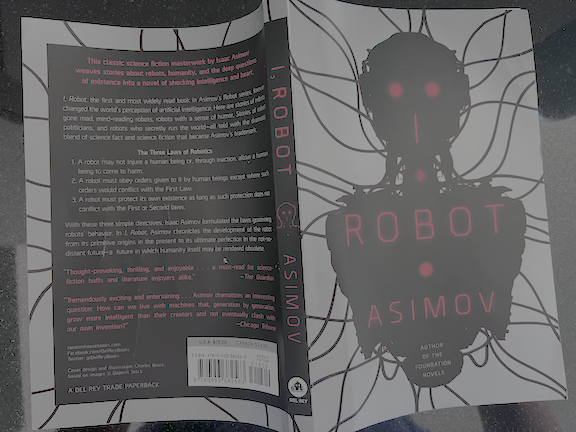
I Robot, Isaac Asimov

It is possible I read this over five decades ago, but if so, I don’t recall any of the stories. I know I read some ‘three laws’ stories, but that may have been in some other book/collection, possibly Caves of Steel. I read this because it was a pick for Elle Cordova’s SF Book Club, even though this one was picked and discussed before I joined. But, I was curious as to how I’d experience this very old story (circa 1950), and probably a little motivated by the ‘collect-the-whole-set’ phenomenon, as I picked up the book club on its second book.

Though I don’t remember any of these stories in particular, Asimov’s three-laws stories are sort of a one-trick pony: there is some kind of mystery or inexplicable event involving a robot, and the resolution turns on realizing that the three laws are not being interpreted or executed as intended, and thus the problem is that the robots are being too literal. Thus, in one story, a robot lies to various humans in the story because it is telepathic and knows what they want to hear, and so it can’t tell them the truth because that would ‘harm’ them. So, they are all essentially puzzle-stories.

Asimov’s characters are not terribly well developed. It feels as though he has carefully chosen a stereotype for each, and few physical or behavioral features of each character as a synecdote for their individuality. We’ve got the hot-headed, angry red-headed Irish engineer, and his cool and more reflective partner. And of course, Susan Calvin, the brilliant but plain woman who has repressed everything but her mind to make it in the world of science. But kudos to Asimov for creating a central female character in the 1950’s, and making her as well developed (which is to say, not very) as any of the male characters.

If these stories are from the golden age of science fiction, they are also from the golden age of smoking — it is astonishing, to 21’st century eyes, to see how many people smoke, even on space ships. It is also interesting — and characteristic of the time of writing — to find that unions have played a significant role in keeping robots off of earth and out of the workforce, as have religious movements.

I wondered reading these stories would whet my appetite for more of Asimov’s robot books, but the answer is no. Although, it could be interesting to read some of the other books where more modern writers — David Brin being one — filled in some of the gaps in Asimov’s world.

# # #

Views: 75

When the Moon Hits your Eye, John Scalzi

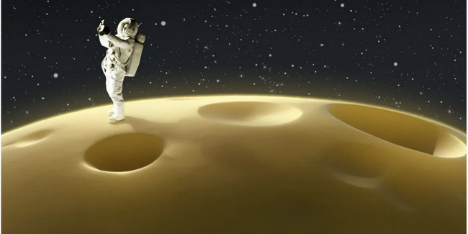
A new SF novel by John Scalzi. The premise is that all of a sudden, with no warning or explanation, the moon turns into cheese. This has various ramifications, and the novel — which hasn’t much of a plot — is how various people react to this event, and its consequences.

I did not care for it. In fact, it is by far my least favorite Scalzi. I will be surprised if many people do, though of course Red Shirts won a Hugo even though I didn’t like it.

# # #

Views: 5

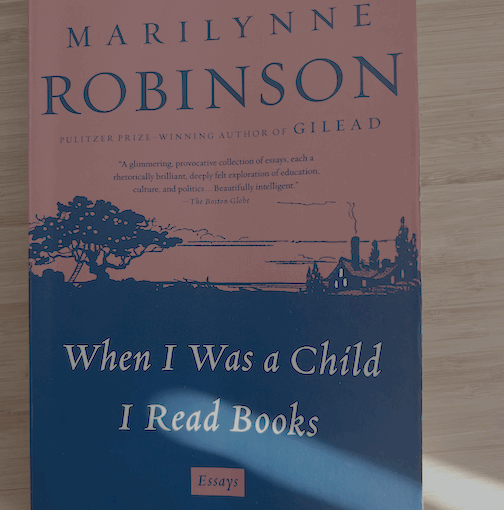
EP #17: When I was a Child…, Marilynne Robinson

When I was a Child I Read Books, Marilynne Robinson, 2012. This is book #17 in the Essay Project, a series of reading I am doing with CT. It marks a return to literary essays after an epistolary detour into the letters of Olive Sacks, and only a temporary return as we have plans to finish the rest of Sacks’ work…

My Thoughts on the Book

I must say, having just read the Preface and the first essay, I am beginning with a rather unfavorable impression. However, I will hope that her initial writing, which seems to me to quite polemical, will give way to more measured and approachable topics.

Later: After the discussing the first three essays, my reading partner and I decided that we would try to cherry-pick the essays, to see if we could find material we liked better. I proposed we read the title essay, and CT, after skimming the rest of the book, proposed we also read the final two. These are discussed below, but the bottom line is that while I can say that I enjoyed the title essay, the other two did not really grab me. I think, unless CT had a far different experience, we will stop after our next discussion, having read six of the ten essays.

Continue reading EP #17: When I was a Child…, Marilynne Robinson

Views: 35